The CD Is 40, The CD Is Dead

The Compact Disc is 40 years old, and for those of us who remember its introduction it still has that sparkle of a high-tech item even as it slides into oblivion at the hands of streaming music services.

There was a time when a rainbow motif was extremely futuristic. Bill Bertram (CC BY-SA 2.5)

If we could define a moment at which consumers moved from analogue technologies to digital ones, the announcement of the CD would be a good place to start. The public’s coolest tech to own in the 1970s was probably an analogue VCR or a CB radio, yet almost overnight they switched at the start of the ’80s to a CD player and a home computer. The CD player was the first place most consumers encountered a laser of their own, which gave it an impossibly futuristic slant, and the rainbow effect of the pits on a CD became a motif that wove its way into the design language of the era. Very few new technologies since have generated this level of excitement at their mere sight, instead today’s consumers accept new developments as merely incremental to the tech they already own while simultaneously not expecting them to have longevity.
Continue reading “The CD Is 40, The CD Is Dead”

An Airbag Charge To Launch A Projectile

It’s not particularly easy to buy small explosive charges. At least, it’s not in the UK, from where [Turbo Conquering Mega Eagle] hails. But it is surprisingly easy to get your hands on one because most people drive around with one right in front of them in the form of their car airbag. In a burst of either genius or madness, we can’t decide which, he decided to use an airbag charge to launch a projectile.

As you can see in the video below, he launches straight into dismantling the centre of a Renault steering wheel before seemingly abandoning caution and taking a grinder to the charge inside. It’s a fascinating deconstruction though, because it reveals not one but two differently sized charges separated by a space which appears to contain some kind of wadding.

His projectile is a piece of steel tube with a turned steel point, spigot launched over a tube placed in front of a breech in which he places the charge. The launch tube has a piece of metal welded within it, he tells us to render it legal by being unable to launch a projectile from within it. Upon firing at a scrap jerry can it has enough energy to easily pass through both its steel walls, so it’s quite a formidable weapon.

He assures the viewer that with the spigot-launched design he’s not breaking the law, but we’re not sure we’d like to have to explain that one to a British policeman. He does make the point though that while it’s an impressive spectacle it’s also quite a dangerous device, so maybe don’t do this at home.

If ripping airbags to pieces isn’t your thing, how about making one from scratch?

Continue reading “An Airbag Charge To Launch A Projectile”

Mid-Winter Hacker Camp In Civilised Surroundings

Imagine a weekend of opulence in which you meet your companion at the railway station and whisk away across the continent in a 190mph express train for a relaxing couple of days enjoying the ambience of a luxury resort hotel in the fresh surroundings of a woodland in midwinter. Break out the Martinis, it’s a scene of elegance and sophistication from a byegone era! This is the general idea of Hacker Hotel 2019, and I had a wonderful time!

On a recent February weekend I broke out the Club-Mate instead stea of a Martini. My companion for the Eurostar and Thalys trip was my local hackspace friend Matt “Gasman” Westcott with his keytar in a bulky suitcase for a chiptune gig, and we were heading for the Netherlands. It’s a pivot from the summer’s hacker camps as over 200 hackers fill a resort hotel for the weekend, scoring comfortable beds instead of dust or mud!

What follows is my experience from this weekend. Join me below and find out why you simply can’t miss the next one! Continue reading “Mid-Winter Hacker Camp In Civilised Surroundings”

It’s Raining Brand-new Commodore 64s

There’s never been a better time to build your own Commodore 64, apparently. Within a day of each other, we got tipped off on three (3!) separate C64 builds from two different hackers.

This has been made possible by a series of disparate projects that have individually recreated a piece of the full machine. Replacement motherboards exist, like the Ultimate 64 and the C64 Reloaded Mk2. New cases can be had courtesy of Pixelwizard. Even new keyboard bases can be had thanks to the Mechboard 64 project.

[Eric Hill] took all these parts and built his own C64 from scratch. And not content with one, he repeated the process and built another.

These two machines serve as demos for the two different motherboard options. Taken together, they serve to demonstrate how many of the vintage Commodore components have been remanufactured by the fan community: with the exception of the keycaps and possibly some of the silicon, all the parts in both machines are new.

Did we just say “keycaps?” This became the pet project of [Perifractic], who discovered that certain Lego Technic pieces had the same cross-shaped slot as the original Commodore 64 keys. After some experimentation, a full set of Lego keycaps was produced. (YouTube, embedded below.) Far from a thrown-together set of random pieces, the sets are available for order with printed tiles with recreation graphics. And this lets you build a C64 using precisely zero parts that came out of a Commodore factory. It’s a testament to the popularity of the world’s best selling computer that it is now once again possible to build one with brand new parts.

If you want to replicate this feat, [Perifractic]’s website is set up to make ordering everything you need easy. Things have certainly come a long way from the first reproduction cases launched on Kickstarter a few years ago.

[Thanks to Keith O for the tip!]

Continue reading “It’s Raining Brand-new Commodore 64s”

From A Dead Laptop To A Portable KVM And PiTop

An essential tool of many sysadmins is a portable terminal ready to plug into an ailing rack-mounted server to administer first aid. At their simplest, they are simply a monitor and keyboard on a trolley, but more often they will be a laptop pre-loaded with tools for the purpose. Sysadmins will hang on tenaciously to now-ancient laptops for this application because they possess a hardware serial port.

[Frank Adams] has taken a different route with his emergency server crash cart, because while he’s used an old laptop he hasn’t hung onto it for its original hardware. Instead, he’s used a Teensy and an LVDS driver board to replace the motherboards of two old Dell Latitude laptops, one of which is a simple KVM device and the other of which is a laptop in its own right featuring a Raspberry Pi 3. He’s produced a video as well, which we’ve placed below the break.

There was a time when laptop display panels were seen as unhackable, but the advent of cheap driver boards has meant that conversions such as this one have become a relatively well-worn path. The job he’s done here is a particularly well-executed one though, making good use of the generous amount of space to be found in an older business-class laptop. There isn’t a battery because this application doesn’t demand one, however, with the battery compartment intact it does not seem impossible that a suitable charger/monitor board could be included along with a boost converter to provide his 12V supply.

This isn’t the first Pi laptop in a re-used commercial machine’s case we’ve seen, there was also this Sony Vaio.

Continue reading “From A Dead Laptop To A Portable KVM And PiTop”

Come To The Hackaday Cambridge Mini Unconference!

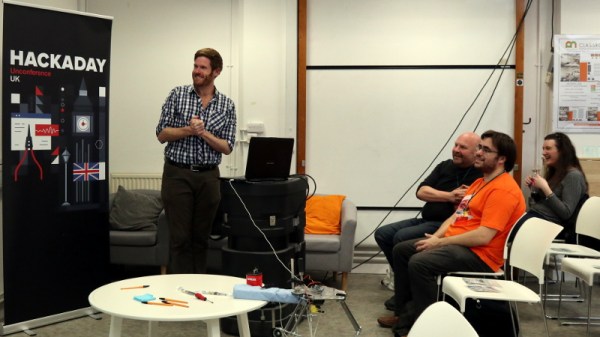
Hackaday would like to invite you to a Mini Unconference on Saturday 16th of March, hosted by our friends at Cambridge Makespace, UK.

One of our most successful engagements with our community over the years here at Hackaday has been the Unconference. A group of you our readers join us for a while and deliver a series of 8-minute lightning talks about what is on their mind. This could be a project, a trend, a technological discovery, or whatever, and they combine to form a fascinating cross-section of the state of our world at any given time. Delivering a talk isn’t essential so don’t worry if you’re shy, but we hope that many of you will have something to share.

This is a mini unconference since we have room for only about fifty or so people in a more intimate venue. Cambridge Makespace is a successful hackerspace in the British university city, and they have been so kind as to host the event for us in their classroom. We’ll convene after lunch and have two afternoon sessions with a break for coffee and snacks, and finish up by getting some pizzas in before heading out to enjoy what Cambridge has to offer. Places are limited, so if you know you are going to be able to make it to Cambridge, sign up without delay.

Look Ma, No Glue! Electrostatic Adhesion As If By Magic

One of the projects at the recent Hacker Hotel hacker camp in the Netherlands appeared to have achieved the impossible. A vertical PCB surface was holding pieces of paper as though they were pinned to it as on a notice board, yet there was no adhesive or fixings in sight. Was Harry Potter among the attendees, ready with a crafty bit of magic at a waggle of a wizard’s wand, or was a clever hack at work?

Of course, it was the latter, as [Jana Marie Hemsing], had created an electrostatic adhesion plate because she was curious about the phenomenon. A PCB with extra insulation has an array of conductors on one side that carry a very high voltage. High enough for electrostatic attraction to secure a piece of paper to the PCB.

The voltage is generated from an AC source by a Cockroft-Walton multiplier on the back of the PCB, and the front is coated with Plasti-Dip for insulation. It seems that soldermask is not a reliable insulator at such high voltages.

Using the board, [Jana] was able to attach a piece of paper to it with a shearing force of 5 mN at 3 kV applied voltage, which may not sound like much but appeared to be just enough to carefully pick the contraption up by the piece of paper. The boards are designed for tessellation, so larger arrays could easily be assembled.

We’ve never had a project quite like this one, but we have brought you an electrostatic ping-pong ball accelerator.