An ATtiny Metal Detector

A metal detector used to be an entirely analogue instrument, an oscillator whose frequency changed with the inductance of its sense coil when a piece of metal approached. [Łukasz Podkalicki] shows us a more sophisticated machine, but with judicious use of an ATtiny 13 it is not a complex one.

A pulsed induction metal detector induces a current spike in its search coil, and times the decay of the resulting oscillation. The coil is part of a resonant circuit with a capacitor, and any metal in its field will change its resonant frequency. In [Łukasz]’s design the ATtiny13 fires a pulse at his coil using a MOSFET, and the voltages at the coil are sensed by an analogue pin through an appropriate clamp circuit. His software does the timing, and sounds a buzzer upon metal detection. It’s a deliciously simple implementation, and while as he shows us in the video below the break its relatively small coil is more suited to detecting coins or wires behind the drywall than locating lost hoards, there is probably ample scope for further experimentation.

This isn’t the first project from [Łukasz] that has found its way into these pages, his history with the ATtiny13 goes back a few years.

Continue reading “An ATtiny Metal Detector”

Hands-on: Hacker Hotel 2019 Badge Packs ESP32, E-Ink, And A Shared Heritage

When you go to a hacker conference, you always hope there’s going to be a hardware badge. This is an interactive piece of custom electronics that gets you in the door while also delighting and entertaining during the con (and hopefully far beyond it).

Hot off the presses then is the Hacker Hotel badge, from the comfortable weekend hacker camp of that name in a Netherlands hotel. As we have already noted, this badge comes from the same team that created the SHA2017 hacker camp’s offering, and shares that badge’s display, ESP32 processor, battery, and firmware. The evolution of that firmware into the badge.team platform is an exciting development in its own right, but in the context of this badge it lends a very familiar feel to the interface for those attendees who were also at the 2017 event.

Continue reading “Hands-on: Hacker Hotel 2019 Badge Packs ESP32, E-Ink, And A Shared Heritage”

E-Ink Price Tags Fall Off Store Shelves Onto Your Workbench

There’s always a magic moment for our community in the lifecycle of any piece of technology: the point at which it first becomes available for pennies on the surplus market. Something which could previously be had only at a price is rendered down to mere pennies, and we are free to hack to our heart’s content.

Such a moment came for [Aaron Christophel] when he bought a quantity of used e-ink price tags (German, Google Translate link) that had formerly graced the shelves of a supermarket. A pile of readily hackable e-ink displays lay before him, so he set to work.

Cracking them open he found the display itself as well as a PCB with its own microcontroller, but he soon identified it as compatible with a WaveShare module for which he had data. Since its interface was thus identified as SPI he could desolder the unknown CPU and break out the pins for an Arduino or other board. The display itself turned out to be a custom model with a few quirks for price tags, it had a black border that could be enabled, and for some reason it appeared as a two-colour red-and-black model in which its black pixels responded as though they were the red channel. He has a quick overview video that we’ve placed below the break.

These displays have started appearing in our community, not least in electronic conference badges. This source of cheap components from the surplus market makes them ever more accessible, and we look forward to the projects that will come from them.

Continue reading “E-Ink Price Tags Fall Off Store Shelves Onto Your Workbench”

Teach Computing The Old-School Way With A Digi-Comp II

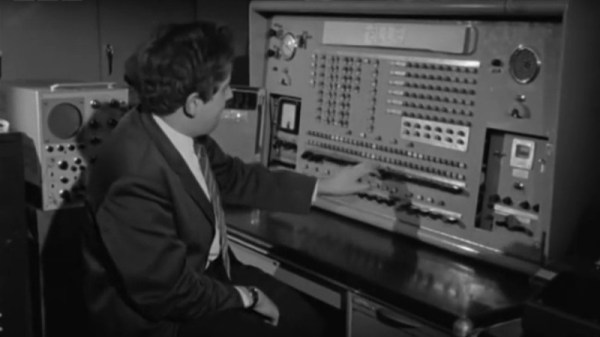
Ubiquitous computing has delivered a world in which there seem to be few devices left that no longer contain a microprocessor of some sort. Thus should a student wish to learn about the inner workings of a computer they can easily do so from a multitude of devices. For an earlier generation though this was not such a straightforward process, in the 1950s or 1960s you could not simply buy a microcomputer and set to work. Instead a range of ingenious teaching aids providing the essentials of computing without a computer were created, and those students saw their first computational logic through the medium of paper, ball bearings, or flashlight bulbs.

The DigiComp II was just such a device, performing logic tasks through ball bearings rolling down trackways. Genuine machines are now particularly rare, so [Mike Gardi] created a modern 3D printed replica that delivers all the fun without the cost. It’s a complicated build with a multitude of parts and wire linkages, and there is an element of fine tuning of its springs required to achieve reliable operation. You’ll neither run a Beowulf cluster of DigiComp IIs nor will you mine any Bitcoin with one, but it’s definitely one of the more unusual computing devices you could have in your collection.

Of course, should you need a truly authentic period computing device, there is always the slide rule.

Via Hacker News.

DAT, The HD Video Tape Format We Never Knew We Had

When we consume our music online via streaming services it is easy to forget the days of recordings being contained on physical media, and to overlook the plethora of competing formats that vied for space in our hi-fi systems to play them. [Andrew Rossignol] has an eye for dated recording media formats as a chiptune enthusiast though, because not only has he found a DAT machine from the 1990s, he’s hacked it to record HD video rather than hi-fi audio.

If you’ve not encountered DAT before, it’s best to consider the format as the equivalent of a CD player but on a tape cassette. It had its roots in the 1980s, and stored an uncompressed 16-bit CD-quality stereo audio data stream on the tape using a helical-scan mechanism similar to that found in a video cassette recorder. It was extremely expensive due to the complexity of the equipment, the music industry hated it because they thought it would be used to make pirate copies of CDs. But despite those hurdles it established a niche for itself among well-heeled musicians and audiophiles. If any Hackaday readers have encountered a DAT cassette it is most likely to have not contained audio at all but computer data, it was common in the 1990s for servers to use DAT tapes for backup purposes.

[Andrew]’s hack involves using the SPDIF digital interface on his Sony DAT player to carry compressed video data. SPDIF is a mature and well-understood standard that he calculated has a bandwidth of 187.5 kB/s, plenty to carry HD video using the H.265 compression scheme. The SPDIF data is brought into the computer via a USB sound card, and from there his software could either stream or retrieve the video. The stream is encoded into frames following the RFC1662 format to ensure synchronization, and he demonstrates it in the video below with a full explanation.

Continue reading “DAT, The HD Video Tape Format We Never Knew We Had”

Colour-Code Your Way To Timber Satisfaction

As Hackaday writers we see the insides of as many hackerspaces as we can, and some of us make it our business to be members of more than one within reach of our homes. Thus it was that a simple but extremely elegant hackerspace lifehack came our way, courtesy of our friends at Milton Keynes Makerspace.

MK Makerspace have found a home within another group, the local MK Men In Sheds is a charitable organisation providing workshop and social space for hackers of an older generation. Together the two combine to offer both a huge range of experience and a comprehensive array of tools and machinery.

Order imposed upon the chaos of the MK Men In Sheds woodstore.

Woodwork is a strong component in the life of any Shed, and at Milton Keynes the Shed has been particularly successful in attracting donations of surplus timber. The stock of freely available mixed pieces of wood has almost everything you could wish for when working on casual projects, but despite continual sorting efforts had become an unmanageable pile among which it was often difficult to find the piece required.

Step forward MK Men In Sheds member [Ricky] whose solution was nothing short of inspired in its combination of simplicity and effectiveness. A large rack has compartments, each one of which has a coloured label. Along the front of the rack is a simple ruler calibrated in coloured blocks, and it is the work of a moment to offer a new piece of timber up to the ruler and place it in the compartment with the appropriate colour. Now any member with a need for a piece of wood  can easily select an appropriate one, and return any usable offcut for easy selection by the next.

This may be a simple piece of work, but its value as a lifehack in a communal workshop is immense. It brings to mind a piece we published a couple of years ago, about how a vibrant hackerspace follows a good wood shop. Never a truer word was spoken for people of all ages.

Badge.Team: Badges Get A Platform

Electronic conference badges are now an accepted part of the lifeblood of our community, with even the simplest of events now sporting a fully functional computer as an eye-catching PCB on a lanyard. Event schedules and applications are shipped on them, and the more sophisticated ones have app libraries and support development communities of their own.

The trouble is that so often those badges fail to live up to their promise, and one reason behind that stems from the enormity of the task facing a badge team when it comes to firmware for a modern badge. There is some fascinating news from the Netherlands  that might reduce some of those firmware woes though, badge.team is a freshly-launched project that provides a ready-made badge firmware with the promise of both stability and long-term support. If you’re making a badge, or even a one-off device using the ESP32, this is a project worth checking out.

Continue reading “Badge.Team: Badges Get A Platform”