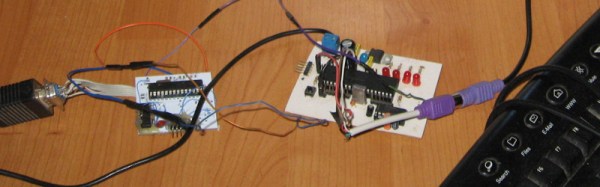
The Gray-1, A Computer Composed Entirely Of ROM And RAM

When we learn about the internals of a microprocessor, we are shown a diagram that resembles the 8-bit devices of the 1970s. There will be an ALU, a program counter, a set of registers, and address and data line decoders. Most of us never go significantly further into the nuances of more modern processors because there is no need. All a processor needs to be is a black box, unless it has particularly sparked your interest or you are working in bare-metal assembly language.

We imagine our simple microprocessor as built from logic gates, and indeed there have been many projects on these pages that create working processors from piles of 74 series chips. But just occasionally a project comes along that reminds us there is more than one way to build a computer, and our subject today is just such a moment. [Olivier Bailleux] has created his “Gray-1”, a processor whose only active components are memory chips, both ROM and RAM.

The clever part comes with the descriptions of how the ROMs are used to recreate the different functions of the processor, through careful programming. Some functions such as registers for example use loops, in which some of the address lines are driven from the data lines to maintain the ROM at a set location. The name of the computer comes from its program counter, which counts in Gray code.

The full processor implements a RISC architecture, and there is a simulator to allow code development without a physical unit. The write-up is both comprehensive and accessible, and makes a fascinating read.

It’s safe to say this is the only processor we’ve seen with this novel approach to architecture. Some more conventional previous features though have been an effort to create a processor entirely from NAND gates, and another made from 74 logic.

Fail Of The Week: GitLab Goes Down

Has work been a little stressful this week, are things getting you down? Spare a thought for an unnamed sysadmin at the GitHub-alike startup GitLab, who early yesterday performed a deletion task on a PostgreSQL database in response to some problems they were having in the wake of an attack by spammers. Unfortunately due to a command line error he ran the deletion on one of the databases behind the company’s main service, forcing it to be taken down. By the time the deletion was stopped, only 4.5 Gb of the 300 Gb trove of data remained.

Reading their log of the incident the scale of the disaster unfolds, and we can’t help wincing at the phrase “out of 5 backup/replication techniques deployed none are working reliably or set up in the first place“. In the end they were able to restore most of the data from a staging server, but at the cost of a lost six hours of issues and merge requests. Fortunately for them their git repositories were not affected.

For 707 GitLab users then there has been a small amount of lost data, the entire web service was down for a while, and the incident has gained them more publicity in a day than their marketing department could have achieved in a year. The post-mortem document makes for a fascinating read, and will probably leave more than one reader nervously thinking about the integrity of whichever services they are responsible for. We have to hand it to them for being so open about it all and for admitting a failure of their whole company for its backup failures rather than heaping blame on one employee. In many companies it would all have been swept under the carpet. We suspect that GitLab’s data will be shepherded with much more care henceforth.

We trust an increasing amount of our assets to online providers these days, and this tale highlights some of the hazards inherent in placing absolute trust in them. GitLab had moved from a cloud provider to their own data centre, though whether or not this incident would have been any less harmful wherever it was hosted is up for debate. Perhaps it’s a timely reminder to us all: keep your own backups, and most importantly: test them to ensure they work.

Thanks [Jack Laidlaw] for the tip.

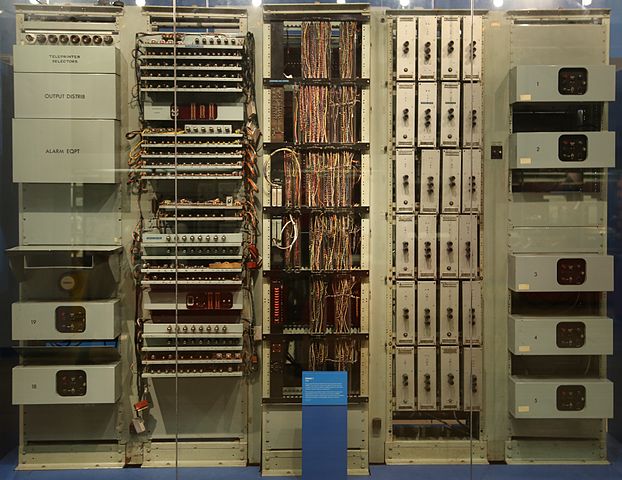
Rack server image: Trique303 [CC BY-SA 4.0], via Wikimedia Commons.

Everyone Should Build At Least One Regenerative Radio Receiver

When we build an electronic project in 2016, the chances are that the active components will be integrated circuits containing an extremely large amount of functionality in a small space. Where once we might have used an op-amp or two, a 555 timer, or a logic gate, it’s ever more common to use a microcontroller or even an IC that though it presents an analog face to the world does all its internal work in the digital domain.

Making A Transistor Radio, 2nd edition cover. Fair use, via Internet Archive.

There was a time when active components such as tubes or transistors were likely to be significantly expensive, and integrated circuits, if they even existed, were out of the reach of most constructors. In those days people still used electronics to do a lot of the same jobs we do today, but they relied on extremely clever circuitry rather than the brute force of a do-anything super-component. It was not uncommon to see circuits with only a few transistors or tubes that exploited all the capabilities of the devices to deliver something well beyond that which you might expect.

One of the first electronic projects I worked on was just such a circuit. It came courtesy of a children’s book, one of the Ladybird series that will be familiar to British people of a Certain Age: [George Dobbs, G3RJV]’s Making A Transistor Radio. This book built the reader up through a series of steps to a fully-functional 3-transistor Medium Wave (AM) radio with a small loudspeaker.

Two of the transistors formed the project’s audio amplifier, leaving the radio part to just one device. How on earth could a single transistor form the heart of a radio receiver with enough sensitivity and selectivity to be useful, you ask? The answer lies in an extremely clever circuit: the regenerative detector. A small amount of positive feedback is applied to an amplifier that has a tuned circuit in its path, and the effect is to both increase its gain and narrow its bandwidth. It’s still not the highest performance receiver in the world, but it’s astoundingly simple and in the early years of the 20th century it offered a huge improvement over the much simpler tuned radio frequency (TRF) receivers that were the order of the day.

Continue reading “Everyone Should Build At Least One Regenerative Radio Receiver”

Darth Vader, In A Nixie Tube

This may be a controversial statement, but Nixie tubes have become a little passé in our community. Along comes another clock project, and oh look! It’s got Nixie tubes instead of 7-segment displays or an LCD. There was a time when this rediscovered archaic component was cool, but face it folks, it’s been done to death. Or has it?

vadar-nixie-tube-unlitSo given a disaffection with the ubiquity of Nixies you might think that no Nixie project could rekindle that excitement. That might have been true, until the videos below the break came our way. [Tobias Bartusch] has made his own Nixie tube, and instead of numerals it contains a 3D model of [Darth Vader], complete with moving light saber. Suddenly the world of Nixies is interesting again.

The first video below the break shows us the tube in action. We see [Vader] from all angles, and his light saber. Below that is the second video which is a detailed story of the build. Be warned though, this is one that’s rather long.

The model is made by carefully shaping and spot welding Kanthal wire into the sculpture, a process during which (as [Tobias] says) you need to think like neon plasma. It is then encased in a cage-like structure which forms its other electrode. He takes us through the process of creating the glass envelope, in which the wire assembly is placed. The result is a slightly wireframe but very recognisable [Vader], and a unique tube.

Continue reading “Darth Vader, In A Nixie Tube”

An Awesome Interactive LED Table

If you want to create a large display with a matrix of LEDs, it’s a relatively straightforward process. Thanks to addressable LED tape and microcontrollers it becomes more of a software issue than one of hardware. [Vincent Deconinck] had some inexpensive WS2812 strips, so he sliced into an inexpensive IKEA coffee table  and mounted them in a grid beneath an acrylic sheet. Some work with Arduino Nanos and a Raspberry Pi later, and he had a very acceptable LED matrix table.

An attractive hack, you might say, and leave it at that. But he wasn’t satisfied enough to leave it there, and so to make something rather special he decided to add interactivity. With an infra-red emitter and receiver as part of each pixel, he was able to turn an LED table into an LED touchscreen, though to be slightly pedantic it’s not sensing touch as such.

The design of the IR sensors was not entirely straightforward though, because to ensure reliable detection and avoid illumination from the LED they had to be carefully mounted and enclosed in a tube. He also goes into some detail on the multiplexing circuitry he used to drive the whole array from more Arduinos and a GPIO expander.

The write-up for this project is a long one, but it’s well worth the read as the result is very impressive. There are several videos but we’ll show you the final one, the table playing touch screen Tetris.

Continue reading “An Awesome Interactive LED Table”

A Terahertz Modulator

We’re all used to the changes in the properties of radio frequency systems as the frequency increases and the wavelength becomes shorter. The difference between the way an FM radio and a WiFi adapter behave with respect to their environments, for instance. But these are relatively low frequencies in the scheme of electromagnetic radiation, as you will be aware with ever shorter wavelengths those properties change further until eventually we are not dealing with something we’d describe as radio, but infrared light.

Terahertz waves are the electromagnetic radiation that lies in that area between radio frequencies and infra-red light. You might expect that since science has delivered so many breakthroughs in both radio and IR, we’d have mastered them, but so far very few devices capable of working at these wavelengths have been developed.

A Nature paper from a group at Tufts University holds the promise of harnessing terahertz waves for applications such as data transfer, for they have developed the first terahertz modulator. It takes the form of a section of slot waveguide between two conductors on a substrate, interrupted by what they describe as a two-dimensional electron gas. This is a very thin layer of electron concentration in an InGaAs region of a semiconductor sandwich that can be created or dissipated by electrical stimulus. This creation and removal of the electron layer has the effect of interrupting the flow of terahertz waves in the waveguide, making a functional modulator.

Continue reading “A Terahertz Modulator”

Take A Look At The Hyperloop Competition Entries

If you are a follower of futuristic high-speed transport systems you’ll have had your fill of high-speed trains, you’ll mourn the passing of Concorde and be looking forward to future supersonic passenger aircraft. Unless you have a small fortune to pay for a spaceplane tourist flight at an unspecified time in the future, life is going to feel a little slow.

There is one spark of light in this relative gloom though, in the form of Elon Musk’s Hyperloop. A partially evacuated tube in which vehicles, or “pods” can accelerate to very high speeds. SpaceX may not be pursuing it themselves, but they’ve made it available for others and to promote it they are running a competition in which they have invited teams to submit pod designs. And as a significant number of teams have made it through the first round and are prepared to compete outside SpaceX’s headquarters, Business Insider have a look at all the teams and their prototype pods. Continue reading “Take A Look At The Hyperloop Competition Entries”