The Struggle Of Keeping A 1950s Candlepin Bowling System Working

When we hear the term ‘bowling’, most of us think of what is known as ten-pin bowling, yet this is only one of the many variations. Candlepin bowling — so called because of the distinctive pin shape — has been around since 1880, yet is mostly played within the US New England and Canadian Maritime provinces. Because of how relatively uncommon it is, candlepin bowling alleys such as the one that [Autumn Mowery]’s family runs is struggling to keep the system working, much of it due to a lack of spare parts.

On [Autumn]’s YouTube channel she goes through many of the behind the scene details at the Ellsworth, Maine-based bowling alley, the repairs and the scavenging of spare parts from the sacrificial bowling lanes that are used to keep the other lanes going for as long as possible. With the mechanics of the installed candlepin bowling system dating back to the 1940s and having been use constantly since the 1950s, it’s an every day struggle to keep the system from breaking down, with no spare parts available for sale.

Although the financially responsible approach might be to give up on the system and have a readily available tenpin bowling system installed instead, there’s a lot more to this form of bowling than the difference in pin shape. Differences include the much stricter rules, the use of a smaller ball without finger holes, lower chance of hitting a pin, and so on. This, along with the historical significance of the sport and this particular system would make it appear to be something that’s right up the (bowling) alley of our audience.

How’d you keep a 1950s-era bowling system up and running?

Thanks to [Tara Calishain] for the tip!

Comparing Cheap Capacitative Soil Moisture Sensors With Commercial Sensors

When your residence has soil moisture sensors embedded that were dictated by your friendly neighborhood HoA, you may start asking questions about the system used. That’s what [Modest Maker] did and the resulting findings along with an attempt to beat the commercial system with some cheap capacitive sensors, are coveredĀ  in a recent video that’s also embedded below. Part of the motivation here was that the commercial system in the community was not clearly installed properly.

To make a long story short, the commercial system by Hunter (Soil-Clik) appears to be a tensiometer-based system that uses the pressure produced by moisture intrusion into the measurement column. This translates to how easy it is for plant roots to extract water, depending on the soil type. [Modest Maker] had to first dodge the broken-by-design capacitive sensors that are available everywhere, but after that was able to cobble together a measurement system that he hopes will allow him to validate the commercial system’s installation.

Continue reading “Comparing Cheap Capacitative Soil Moisture Sensors With Commercial Sensors”

Detecting Machine-Generated Content: An Easier Task For Machine Or Human?

In today’s world we are surrounded by various sources of written information, information which we generally assume to have been written by other humans. Whether this is in the form of books, blogs, news articles, forum posts, feedback on a product page or the discussions on social media and in comment sections, the assumption is that the text we’re reading has been written by another person. However, over the years this assumption has become ever more likely to be false, most recently due to large language models (LLMs) such as GPT-2 and GPT-3 that can churn out plausible paragraphs on just about any topic when requested.

This raises the question of whether we are we about to reach a point where we can no longer be reasonably certain that an online comment, a news article, or even entire books and film scripts weren’t churned out by an algorithm, or perhaps even where an online chat with a new sizzling match turns out to be just you getting it on with an unfeeling collection of code that was trained and tweaked for maximum engagement with customers. (Editor’s note: no, we’re not playing that game here.)

As such machine-generated content and interactions begin to play an ever bigger role, it raises both the question of how you can detect such generated content, as well as whether it matters that the content was generated by an algorithm instead of by a human being.

Continue reading “Detecting Machine-Generated Content: An Easier Task For Machine Or Human?”

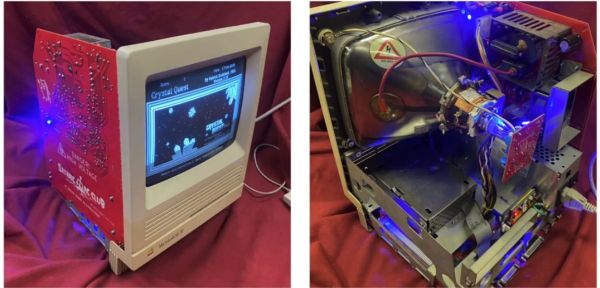
A New Analog And CRT Neck Board For The MacIntosh SE

Keeping a 35-year old system like the MacIntosh SE and its successor, the SE/30, up and running requires the occasional replacement parts. As an all-in-one system, the analog board that provides the power for not only the system but also the 9″ (23 cm) built-in CRT is a common failure location, whether it is due to damaged traces, broken parts or worse. For this purpose [Kay Koba] designed a replacement analog board, providing it with a BOM of replacement components. This also includes the neck board, which is the part that the CRT itself connects to.

As [Kay] notes in the project log, the design was inspired after building [Kai Robinson]’s Classic Reloaded logic board, which we covered previously. After a few revisions, [Kay] has now begun selling the PCBs for $42. The product page also links to BOMs for both the analog board and the neck board, with most of the parts simple through-hole parts. If the board’s fancy styling and LEDs compared to the original board isn’t your cup of tea, it does look like there exists interest in a more subdued version as well.

Opening A Safe With A Stepper Motor And DIY Auto-Dialer

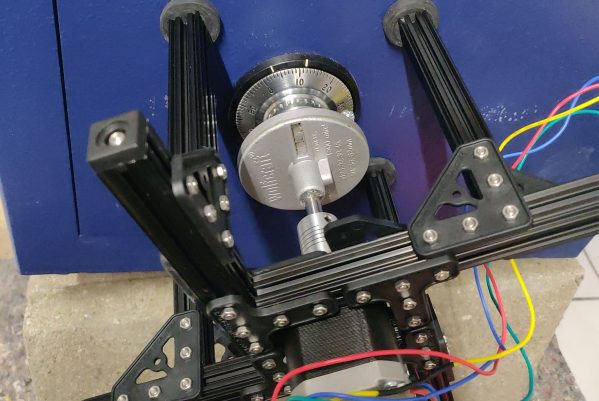
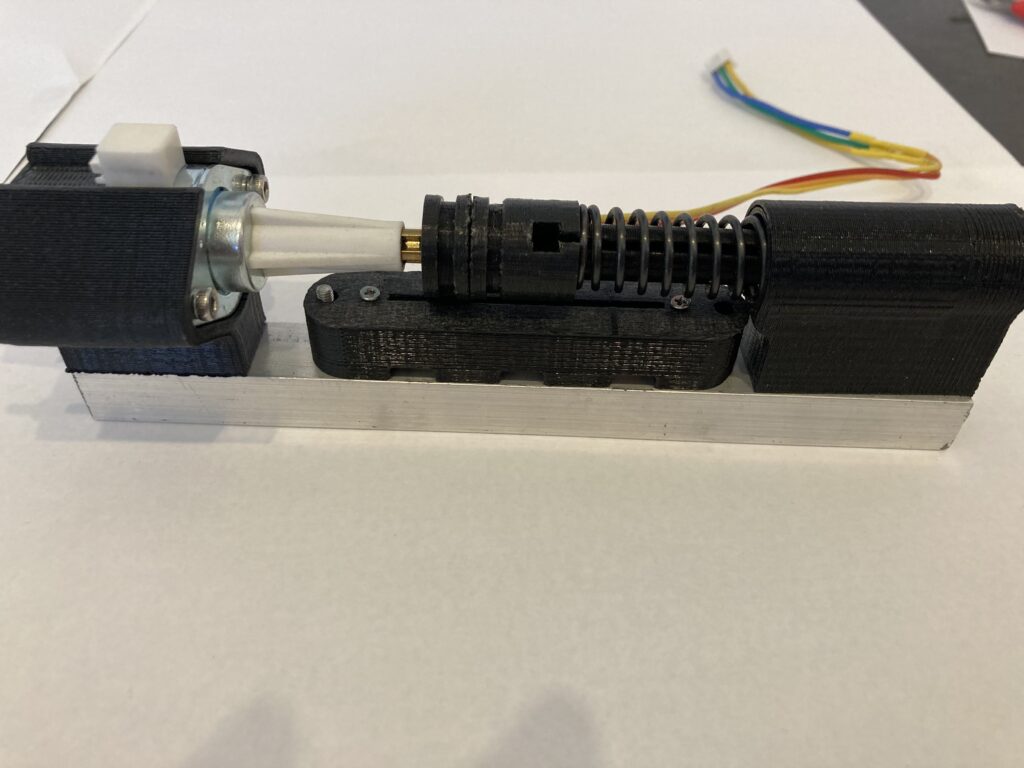
What do you do when you happen to come into possession of a safe of which the combination is lost to the sands of time? If you’re someone like [eNBeWe], you grab a stepper motor with driver module you had lying around gathering dust, an ESP8266 for the brains and a few other pieces to build your very own auto-dialer to crack that safe combination. The software has been made available on GitHub for those interested.

While other auto-dialers used with the fun hobby of safe cracking can generally find the combination in a matter of hours if not less, it took [eNBeWe]’s contraption two days to crack the combination. Much of this was due to the hacked together nature of the structure, with the glue joints among other weak points that’d probably not take too kindly to a lot of abuse. Since there was no particular rush to get into the safe, this worked out fine.

As an impromptu auto-dialer thrown together with parts that were lying around it seemed to perform just fine for the task, and we presume that this is the beginning of a beautiful new lock- and safe-picking hobby.

Continue reading “Opening A Safe With A Stepper Motor And DIY Auto-Dialer”

Reverse-Engineering The Conditional Jump Circuitry In The 8086 Processor

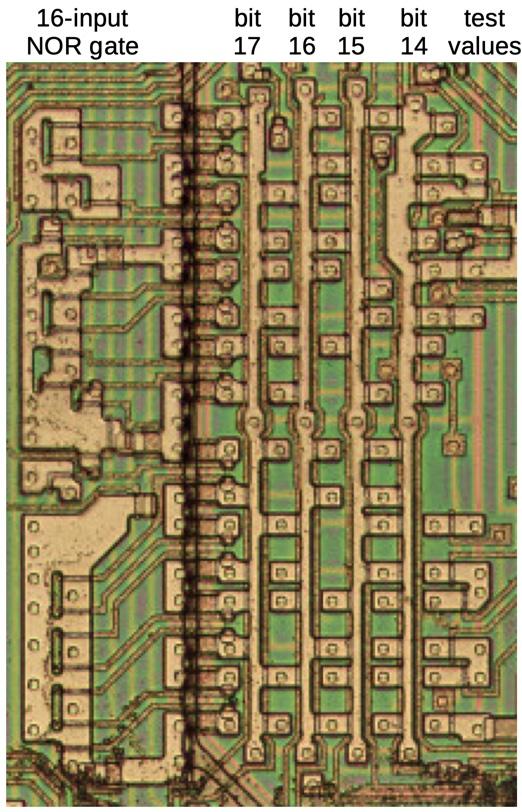
The condition PLA evaluates microcode conditionals.

As simple as a processor’s instruction set may seem, especially in a 1978-era one like the Intel 8086, there is quite a bit going on to go from something like a conditional jump instruction to a set of operations that the processor can perform. For the CISC 8086 CPU this is detailed in a recent article by [Ken Shirriff], which covers exactly how the instructions with their parameters are broken down into micro-instructions using microcode, which allows the appropriate registers and flags to be updated.

Where the 8086 is interesting compared to modern x86 CPUs is how the microcode is implemented, using gate logic to reduce the complexity of the microcode by for example generic parameter testing when processing a jump instruction. Considering the limitations of 1970s VLSI manufacturing, this was very much a necessary step, and an acceptable trade-off.

Each jump instruction is broken down into a number of micro-instructions that test a range of flags and updates (temporary) registers as well as the program counter as needed. All in all a fascinating look at the efforts put in by Intel engineers over forty years ago on what would become one of the cornerstones of modern day computing.

Adding Electronic Shifter Functionality To Bicycle Derailleur

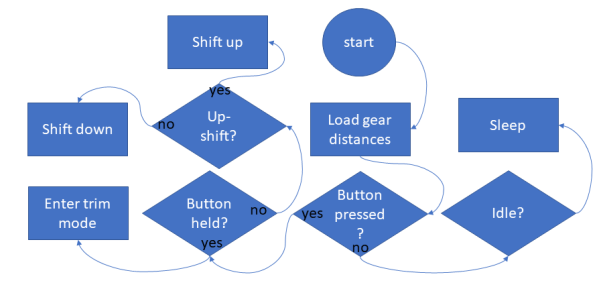
For the overwhelming majority of bicycles out there that feature multiple gears, switching between these is done purely mechanically, with a cable. Generally this uses a derailleur, which forms part of the gear switching and chain tensioning mechanism. As a mechanical system, it’s reliable when well maintained, but tuning it can be a real hassle. This is where an electronic shifter should be able to provide faster, more reliable and quieter shifting, and is also where [Jesse DeWald]’s electronic shifting project begins.

As [Jesse] points out in the introductory article on electronic shifting, it’s not a new concept, with everyone from Shimano (Di2) to Archer and others coming up with their own version. Some of these require replacing the existing derailleur, while others should allow for non-destructive modification. What [Jesse] did not find among this constellation of options was a version that’d work with existing derailleurs, did not require destructive modifications and have a long battery life.

[Jesse]’s design omits the servo present in Archer’s design, and uses the existing derailleur spring, with the reasoning explained in a nice spring physics refresher. Instead a stepper is used along with a matched balancer spring that in testing managed over 3 months of standby time with a 3,700 mAh Li-ion battery and thousands of shifts. At the core of the system is an Arduino Pro Mini board, the code for which is available along with the design plans.

The project is not done at this point, of course, with a whole range of improvements still to be added, including a case, so that the shifter can be used outside in the rain.