Add Some Animated Bling To Your GQ Duds

geeky-tie-uses-animated-leds

This tie turned VU meter has us asking: Will anyone be able to look you in the eye during a conversation? It uses an integrated microphone and microcontroller to make a single-column display made of RGB LEDs move to ambient sound.

It shouldn’t be hard to guess that this project is another build from [Becky Stern]. She’s been on fire lately, offering up glowing football helmets and a turn-signal backpack. This uses the same family of components as the latter. A Flora board brings an Arduino to the party. It drives sixteen RGB LED pixels which are addressed using a 1-wire protocol. Sound is measured through a microphone and amplifier breakout board.

Since the hardware gets in the way of a full-windsor, the tie used for the project is a breakaway version which uses velcro. But because you need the needle and (conductive) thread to sew on the components it wouldn’t be hard to alter any tie to perform like this.

Don’t miss the high-quality video tutorial which we’ve embedded after the break.
Continue reading “Add Some Animated Bling To Your GQ Duds”

Acrylic Enclosures Use Integrated Clips To Do Away With Fasteners

acrylic-clip-lock-enclosures

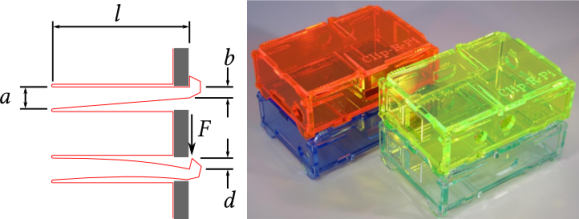
Here’s a design that lets you make acrylic enclosures without using fasteners. The red outline in the diagram above is a bit hard to make out. But look closely and you’ll realize that there is very little material which has been removed to form the clip. This uses the rigidity/flexibility of the material to form a spring that will hold a couple of pieces tightly together.

In a links post last year we looked at [Patrick Fenner’s] fantastic analysis of the strength of using kerf-bending to form several sides of a case out of one piece of material. He’s used that same analytic expertise to take a look into this design. He even suggests that making the cut on the hook-side a bit deeper will help improve the resilience of the part. If you have a laser cutter on hand and want to give this a try he’s posted the plans on Thingiverse.

NSL Takes Their Propeller Driven Car To The Drive Through

nsl-propeller-driven-land-vehicle

So what’s the first thing you do after completing your propeller driven land tricycle build? Head on over to the Starbucks drive through and see what kind of response you get from the workers. That’s exactly what the guys from North Street Labs did. You can see the response in the clip after the jump.

Having three wheels and being moved by an electric motor with a propeller led to the name TriFly. The build is their entry in The Deconstruction, a build contest which includes other entries like the Beer pouring machine we featured on Monday. Aside from the fun with the final project, NSL’s well-produced video includes a quick trip through the fabrication process. They did a great job making the machine about 40% street legal and it’s obvious they had a blast while doing so.

Continue reading “NSL Takes Their Propeller Driven Car To The Drive Through”

Mac EFI PIN Lock Brute Force Attack (unsuccessful)

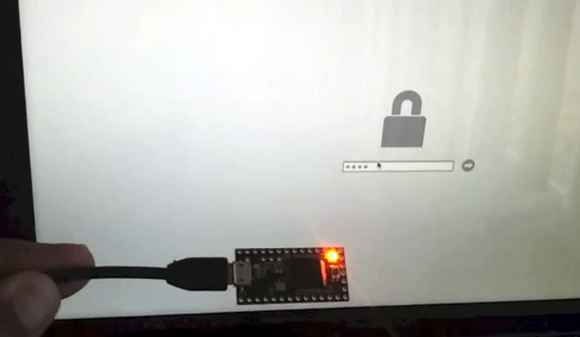
[Oliver] wiped the hard drive from a Macbook Pro using the ‘dd’ command on another machine. This does a great job of getting everything off the drive, but he was still faced with the EFI PIN lock protection when he tried to put it back into the Mac. You used to be able to clear the NVRAM to get around this issue, but that exploit has now been patched. So [Oliver] set out to use a microcontroller to brute-force the EFI PIN.

You can read his back story at the link above. He had the chance to enter a 4-digit pin before the format process. Now that he’s wiped the drive the code is at least 6 characters long, which is a lot more possibilities (at least it’s numeric characters only!). To automate the process he programmed this Teensy board to try every possible combination. It worked great on a text editor but sometimes the characters, or the enter command wouldn’t register. He guesses this was some type of protection against automated attackers. To get around the issue he added different delays between the key presses, and between entering each code. This fixed the issue, as you can see in the clip after the break. Unfortunately after two 48-hour runs that tried every code he still hasn’t gained access!

Continue reading “Mac EFI PIN Lock Brute Force Attack (unsuccessful)”

Simple To Build Programmable Foot Switches

programmable-footswitches

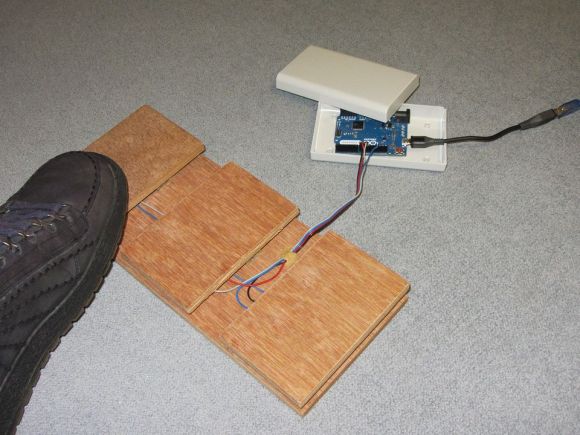
Your hands do a lot of work between the keyboard and the mouse, why the heck are you letting your feet be so lazy? [Dossier van D.] is putting an end to the podiatric sloth. He built this set of three foot pedals which have gone through two versions of functionality.

The buttons themselves are made from a base plate of plywood with a smaller piece on top for each ‘key’. The two parts are separated with some foam carpet pad, with a tactile push button in between to register a click. The only thing we’d change about this is adding a couple of wooden spacers next to the switch so that accidentally sanding on a button doesn’t break that electronic component.

Originally each button was soldered to a gaming controller. This worked just fine using button mapping, but recently [Dossier] made the switch to using an Arduino Leonardo. This is a perfect choice. Unlike input devices made with older Arduino versions the Leonardo board can natively register as a keyboard, making it a snap to programmatically map any key to the switches.

If you like this project you should check out [Dossier’s] foot mouse as well.

Smashed Tablet In NES Case Lives Out Its Days As An Emulator

smashed-tablet-nes-emulator

The creator of this project started off with a 7″ tablet he received from a coworker. The screen was horribly smashed from one corner spreading out through the entire surface. But the hardware inside still worked, including the HDMI out port. He ended up transplanting the tablet hardware for use as an emulator.

After a bit of sizing up it was determined that the tablet hardware would fit inside the case of a broken NES. The battery would have been a tough fit, but this thing is always going to need to be connected to a television so there’s no need to work without mains power. The back plate was cut down to size and used as a try for mounting the motherboard in the case. Before that step he wired up a USB hub and mounted it so that two ports could be accessed through the original controller port openings.

There’s no details on the software used, but the final image in the gallery shows a game of Starfox being played.

[Thanks Cody]

Python Frontend Is A GUI For Different Microcontrollers

python-frontend-gui-for-microcontrollers

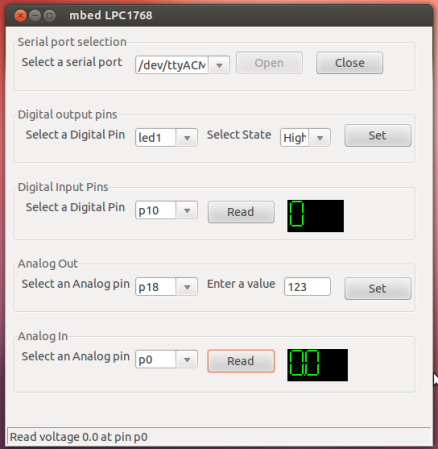
[Navin] has been hard at work producing a GUI which works with different micocontrollers. The idea is to make it even easier to develop projects by simplifying the feedback and control you can get from the prototyping hardware. The best part about it is that he designed the software to interface with any hardware which can be programmed in C++.

The screenshot above shows the program communicating with an mbed board which has an ARM microcontroller. But the Arduino board (which uses an ATmega chip) is supported as well. Support for additional architectures can be added by writing your own configuration file for the chip. The Python program then asks for the com port it should be using for this session.

The source package, including the code which runs on the microcontrollers, can be found at the project repository. The functions used in the sketches are quite simple and should be a snap to drop into your own code projects.