A Solar Powered Cattle Crossing Gate

solar-powered-cattle-crossing-gate

Anyone who’s traveled the grounds of a cattle ranch will tell you there’s a lot of stopping to open and close gates. But this project is aimed at letting you operate the gate from the comfort of your vehicle. It uses a spool of wire as the gate, lowering it for vehicle access with the use of a remote control.

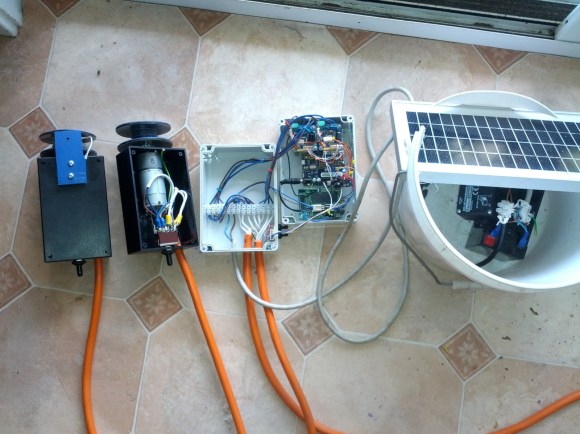
The base station uses a solar panel to keep the battery topped off. But if you’re not frequently using the system it shouldn’t take much electricity at all. An Arduino board listens for the signal from the remote control. It then unspools the wire until it lays flat across the ground and can be driven over. Once the car has passed another click of the remote raises the gate back into position. There’s even a version that uses two gates which make up a cattle corridor.

We were thinking that it would be easy enough for the cows to push right through this. But after seeing the clip after the break it’s obvious they like to follow the rules.
Continue reading “A Solar Powered Cattle Crossing Gate”

Hackaday Links: February 28th, 2013

Xbox 360 control for a toy heli

links-xbox-helicopter-remote

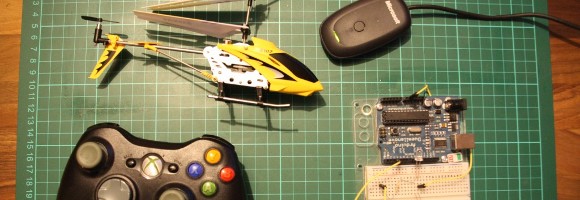
[Jason] leveraged the IR control libraries for Arduino to use an Xbox 360 controller to fly his Syma S107G helicopter.

Windows 7 running on Raspberry Pi

links-win7-rpi

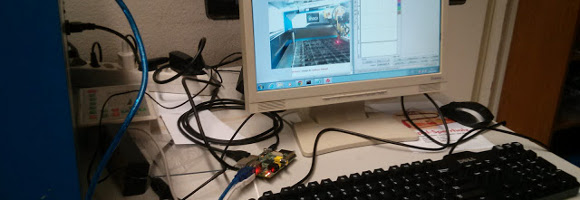
Why, oh god why? Well, the guys at Shackspace got their hands on a laser cutter that can only be driven with a Windows program. Their solution was to run Win7 on RPi as a virtual machine.

Twin-servos for your third hand

links-servo-third-hand

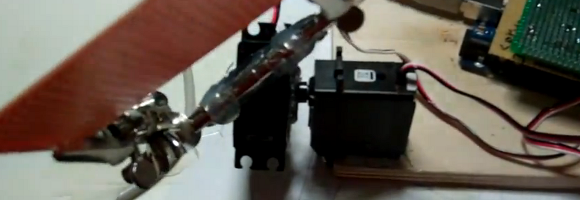
After growing tired of constantly flipping over the substrate being held with a third hand [Nidal] came up with a better way. He mounted his third hand on two servo motors so that it can be positioned with a joystick.

Depopulating SMD resistors

links-removing-smd-resistors

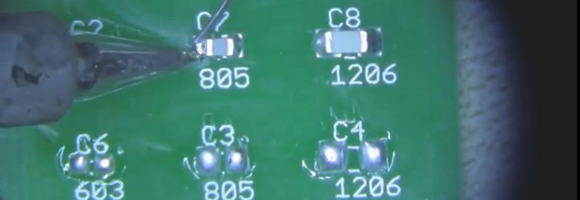
If you’ve ever tried to remove small surface mount resistors or capacitors with an iron you know it can be tricky. Take a look at the technique that [Scott] uses to remove the components.

Photographing the die of MSP430, Z80, PIC, and several other chips

links-decapping-chips

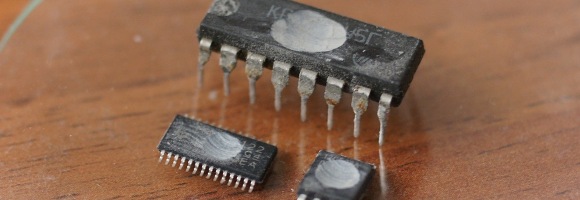
Here’s the latest work from [Michail] on photographing the die of various chips. You may remember reading his previous post on decapping chips with boiling sulfuric acid.

Optical Data Transfer Project At Local School’s Family Science Night

optical-data-at-family-science-night

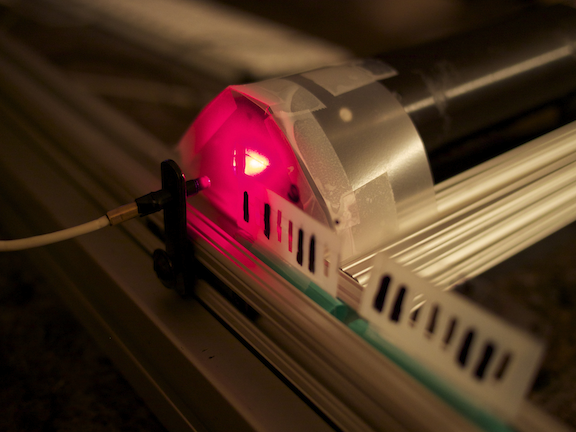
[Dave] wanted to show off a project at his 4th-grade son’s school during their family science night. We haven’t heard of an event like this before but it sounds like a fabulous idea! He had a new laser he wanted to include in the project, and noticed that his son was learning about how ASCII maps letters to binary number when the idea struck. He ended up building an optical data transfer system that demonstrates binary code.

This presents a fantastic learning opportunity as the project invited the school kids to select encoded strips like the ones seen above to form a secret message. The laser is pointed at a photosensor which is being read by a Raspberry Pi board. The Python code looks for a baseline and then records increases and decreases in intensity. Since the translucent tokens have either holes or black lines for 0 and 1 the baseline approach does away with the need to clock in the data. [Dave] reports that everyone who tried out the experiment was fully engaged at the prospect of pushing pieces of tape through the sensor and watching their secret message appear on a monitor.

He was motivated to write about this project after reading about data transfer using an LCD screen and photosensor.

Bending Materials With A Simple Hot Wire Forming Tool

bending-with-a-hot-wire-former

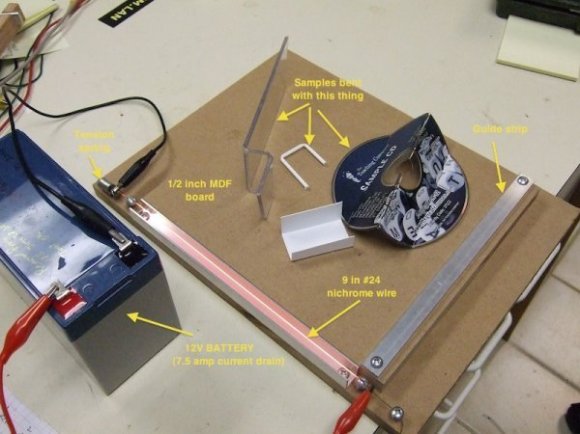
Regular reader [RoadWarrior222] has watched as we’ve featured several projects that show how to bend acrylic. But so far he hasn’t seen us cover his favorite technique developed by [Dale A. Heatherington] which uses a hot wire forming tool to make precise bends. The tool is simple to use plus it’s cheap and easy to build. It’s a great choice if you don’t have a heat gun, and it may be possible to make cleaner bends than other techniques.

The business end of the bending tool is the red-hot Nichrome wire running through the aluminum channel. That channel is used to protect the MDF and act as a spacer so that the wire doesn’t touch the acrylic. On the near side the wire is anchored with a screw, but on the far end it is kept taught by including a spring. The wire heats up as it is connected to a 12V battery, but since the heating is cause by the wire’s resistance it will only get red-hot in between the alligator clips providing power. To make sure your bends will be perpendicular to the edge of the acrylic there’s an aluminum guide strip on one side of the MDF platform.

You can salvage Nichrome wire from an old hair dryer. If you have any left over it’s great for other projects like building a CNC hot-wire cutter.

Adding A Home Theater Without Ruining A Victorian Home

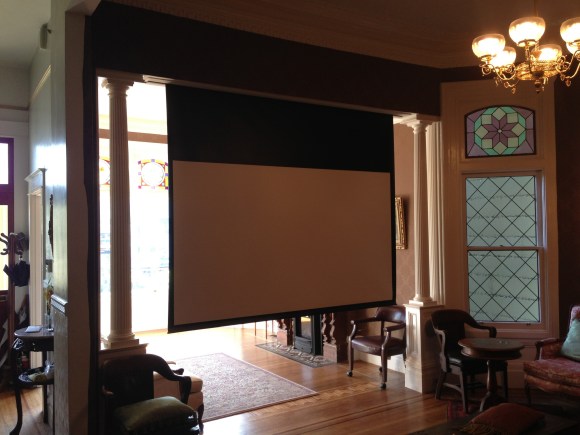
projector-screen-in-a-victorian-homeWe understand where [John Clarke Mills] is coming from when he says he wants a home theater but not at the expense of dedicating a room to it. His situation is a bit more sticky than most folks in that he has a beautifully kept Victorian era home. Recently he was removing a renovation from ages past that didn’t fit with the style and it gave him the opportunity to build in this hidden projector screen.
Years ago someone walled in this opening and added french doors. After opening up the wall [John] sized up the situation and decided he had just enough room to build a soffit which could hide a rolled up projection surface. He purchased a motorized screen (we’ve seen a few diy projection screens but can’t remember one that rolls up) and built a slot into the design just large enough for the screen to pass through. He’s testing it out in the clip after the break before doing the plaster work.

The columns on either side are his additions as well. The floor of the house is unlevel and one of those columns ended up a full inch longer than the other. We certainly can’t tell.

Continue reading “Adding A Home Theater Without Ruining A Victorian Home”

LCD-based QR Clock

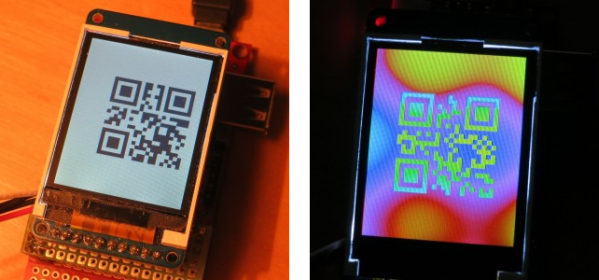
Here’s a new take on the QR clock concept that uses an LCD display. The concept comes from the work [ch00f] put into his two versions of a QR clock (both of which used LED arrays). The time of day is encoded using the Quick Response Code standard. This version generates a new code each second which encapsulates date, hour, minute, and second information. If you look at the image on the left you’ll notice the code is not centered. Take a look at the video after the break and you’ll see that’s because it’s bouncing around the LCD like a screensaver. Watch a little longer and you’ll see the psychedelic effects shown in the image on the right.

A PIC32 is driving the display. It’s connected to a DCF77 radio module which feeds the system atomic clock data. The color plasma effects are used to show when the device has locked onto the radio signal.

Continue reading “LCD-based QR Clock”

3D Printed HOG Drive

3d-printed-hog-drive

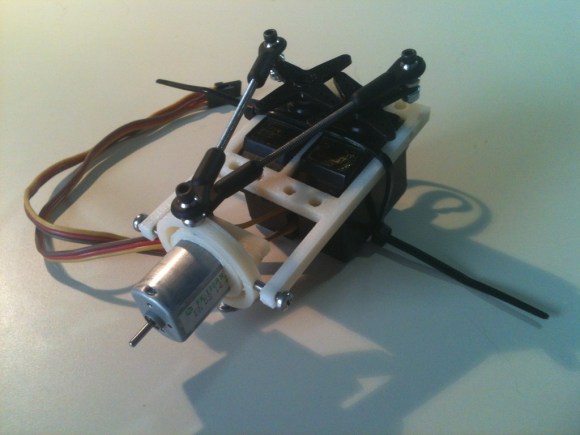
Here’s a 3D printed Hemispherical Omnidirectional Gimballed Drive system which you can make at home. That’s a mouthful which is why it is commonly referred to as a HOG drive. Never heard of one? Well you need to keep up with your Hackaday because about 20 months ago we featured this amazing robot project that uses one. The design is a tricycle orientation with the HOG drive as the only powered ‘wheel’. But it’s not really a wheel, it’s a half-sphere (a hemisphere which is not pictured above but attaches to the motor spindle) which can provide thrust in any direction depending on which way the motor is spinning a how the gimbal bracket is oriented.

Unfortunately [Dan] isn’t showing off a vehicle that is powered by the device just yet. But from what we’ve seen in the demo after the jump it is fully functional. His target project for the system is a line-following robot which we hope to post as a follow-up when he reaches that goal.

Continue reading “3D Printed HOG Drive”