Accelerometer May Help Make You A Sharpshooter

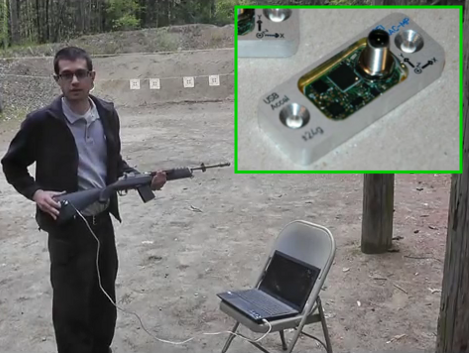
[Chris Suprock] is interested in using technology to improve your accuracy with a firearm. To that end, he’s using an Accelerometer mounted to a gun to gather feedback about each shot.

The hardware setup is pretty simple. We don’t have specific details, but it looks like he’s using a QFN accelerometer chip like you would find in a cellphone. The milled aluminum mounting bracket that holds the board has ‘USB’ printed on it, although the connector is something we don’t really recognize.

In the video after the break [Chris] demonstrates the feedback he can get when the device is mounted on the stock of a Ruger Mini-14. The graph of the data makes it obvious when the trigger was pulled. The most useful part may be the period leading up to that event, as it shows any unnecessary movement prior to the shot. If you’re into sport shooting, this may be one more tool that will help give you the edge on your competitors.

Continue reading “Accelerometer May Help Make You A Sharpshooter”
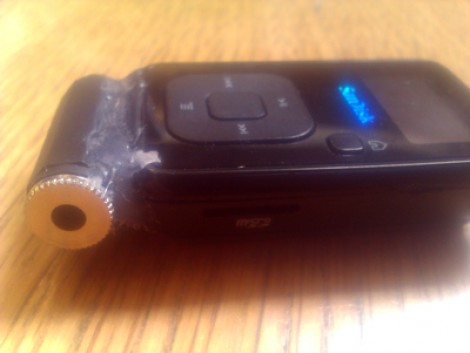
A New Method For Adding Audio Input To A Sansa Clip+

The Sansa Clip+ is a nice little MP3 player and recorder. But it doesn’t offer an input connector, instead relying on the built-in microphone. [Simon Frank] wanted to extend its functionality so he figured out how to add a standard audio jack for analog input.

This is not the first time this has been done, but [Simon] has found a different method of accomplishing the task at hand. The other external input hack we saw cannibalized the internal microphone, rerouting its connections as an external input. But the method seen here keeps that microphone intact. The device includes an FM radio chip which is attached to an ADC on one of the devices other integrated circuits. [Simon] just patched into those signals. Now all he has to do is set up the device to record from the radio and connect his source to the jack which he epoxied to the base of the enclosure.

SparkFun Gets A Subpoena For All Orders; Says Nah

It’s no secret that we’re fans of open source, and open hardware. And we have to applaud companies like SparkFun who also keep their customers in the loop about what’s going on with the business end of the company. For instance, they were recently contacted by a Sheriff’s office and asked for customer information and are sharing the story. One of their products had been used in a series of credit card skimmers and the officers wanted to get purchase information to track down the bad guys. SparkFun doesn’t just give out customer data and so was subsequently served with a subpoena.

The thing is, the document asks for all customer orders shipped to Georgia during a six month period. This seemed like it covered way too many orders, since the majority of them didn’t include the part in question. But the officials were willing to work with the company and narrowed the request to just the 20 or so orders that had the item in them.

It’s an interesting read, and we agree with SparkFun’s point about white hats and black hats. Often when posting about projects here we wonder about the potential to use the knowledge for no-good. But restricting the availability of knowledge (or hardware in this case) because of a few bad-actors is a concept we oppose. It’s like being a hacking super hero, with great skill comes great responsibility.

Hacking IPod Headphone Controller For Use With Android

[Buddhra] wanted to use a set of ear buds that also had a controller built into the wire. The headset he chose to go with is meant for use with iPod, but he figured it should be possible to make it work with Android too. He was right, and managed to alter the controller for Android use and still fit it into the original case.

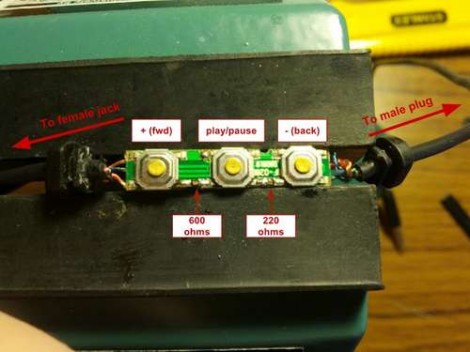
He had already made a custom control module that has fast forward and rewind features and play/pause events. The signals used for the controls are based on resistive dividers. The play/pause button on the iLuv headset already worked, so he cracked the controller open to see why the forward and back buttons didn’t work. It turns out all he needed to do was add the right resistors to those buttons. Here you can almost see the 0603 surface mount packages he used to add a 220 Ohm resistor to the back button, and a 600 Ohm resistor to the forward switch.

Building Sensors For The Scratch Programming Language

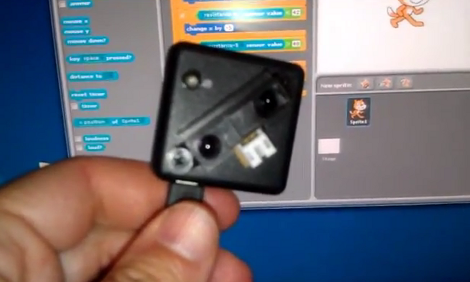
[Kevin Osborn] is making it a bit easier for young programmers to write programs that interact with the physical world. The device he’s holding in the picture is an Arduino based accelerometer and distance sensor meant for the Scratch language.

Scratch is a programming language developed at MIT. It has kids in mind, and focuses on graphical building blocks. This can make it quite a bit easier to introduce youngsters to programming concepts without the roadblocks and gotchas that come with learning syntax.

As you can see in the clip after the break, [Kevin’s] Arduino sketch includes hooks that automatically pull the accelerometer and distance data into the Scratch environment. We figure his example provides everything you need to get just about any type of sensor up and running, be it a magnetometer or LDR (both of which would make a nice burglar-alarm type project). Give it a try with your own hardware and see what you can accomplish.

Continue reading “Building Sensors For The Scratch Programming Language”

Retrotechtacular: Shakey Shows Off Robotics Innovation From 1972

In this installement of Retrotechtacular we’re taking a look at Shakey, a robot developed between 1966 and 1972 at the Stanford Reserach Lab. This was a glorious time when students had long hair but still wore long sleeves and ties to do their research.

The robot is actually communicating wirelessly with the PDP-10 computer which handles the processing. No computer monitor is used for interacting with the robot. Instead, a teletype machine lets you type out your commands on paper, and the response from the machine is printed back to you on the same sheet. There’s a camera which is used for image recognition, and sensors that give feedback when the body comes in contact with an obstacle.

We’d sure love to know what kind of budget this project had, but alas we couldn’t find any info about that. You can go and see Shakey in person if you want to. This info page mentions that the machine is on display at the Computer History Museum in Mountain View, California.

Continue reading “Retrotechtacular: Shakey Shows Off Robotics Innovation From 1972”

Snake-like Robot Can Roll Around In A Ring

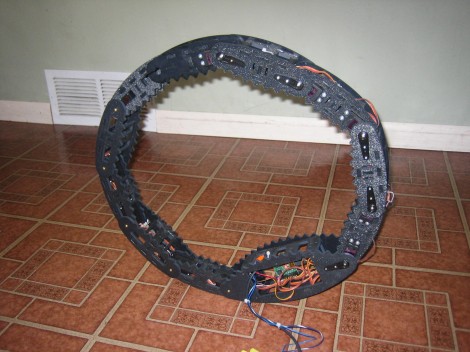
A lot of 3D printing and a many servo motors went into this snake-like robot, and it’s only about half of what [Toby Baumgartner] plans to accomplish. In this orientation the snake is rolled into a circle, and apparently some special movements in the segments allow it to roll around like this. He compares it to a tank tread without the tank attached to it. Notice that each link is rounded on the outside. When the snake opens itself up, the toothed inside of the links contacts the ground for added traction.

It looks like eventually the larger link at the bottom will be about three times as wide. This will make room for him to mount a second ring of links. The idea is that the larger link will act as the body and this can unfold itself into a quaruped. Motors that allow the segments to pivot side to side would make it something like a four-legged spider bot.