Burning Plasma Screen With Breathtaking Beauty

image

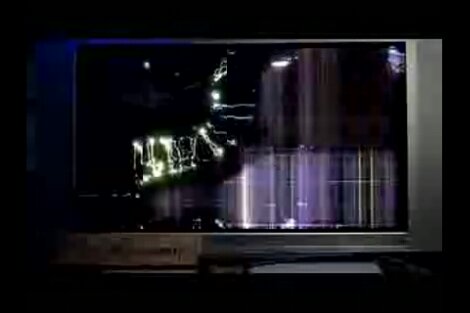
At some point you’ve got to resign yourself to the fact that the TV you’ve been trying to resurrect is just not salvageable. But if you’re knowlegable about working safely with high voltage, you might get quite a show out of it yet. Here [Aussie50] finds beauty in destruction when he fries a large plasma panel from a broken HDTV.

The flyback transformer from a microwave oven drives the display. The video after the break starts off kind of boring at first but before long it takes off. As portions of the display burn out the electric arcs jumping those gaps provide a thrilling view for the remainder of the 14 minutes.

Don’t want to commit to a video that long? Here’s a display that gives up the ghost after just four and a half minutes but we don’t think it’s quite as cool.

Continue reading “Burning Plasma Screen With Breathtaking Beauty”
SMDuino Helps Arduino Fit Into Tight Places

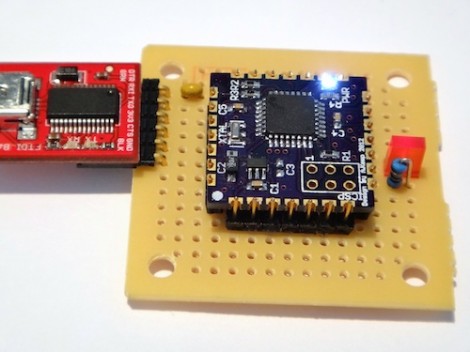
[Adam] was tired of plopping the same components over and over into his Arduino-based designs. He spent part of his weekend laying out a small board that would host everything he needed and could be built as a single component for all future projects. Above you can see the project he calls SMDuino, an Arduino clone that can be used as a surface mount part.

The contacts on four sides of the board break out the pins. They’ve been designed with 0.1″ pitch which means they will work with standard pin headers. But since they’re plated through from top to bottom they are easy to solder to surface mount pads as well. The project is open source, so you can order your own boards (he used DorkBot PDX) or email him if you want to get in on a pre-order. That is for unpopulated PCBs only. But there’s few components used here so it’s pretty inexpensive to throw together. You’ll need four caps, four resistors, a crystal, an LED, the ATmega*8 of your choice (an ATmega328 is used here), and a low dropout regulator. Of course it is possible to go without the crystal oscillator.

Does this remind anyone else of the Basic Stamp 2?

Adding Speech Control To An Old Robotic Arm

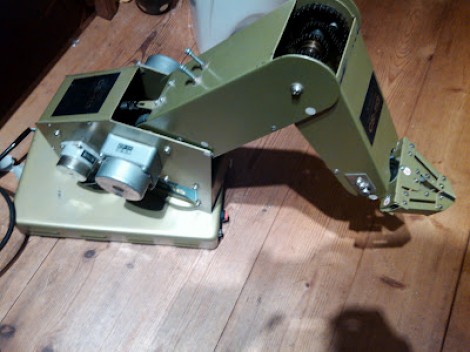
[Joris Laurenssen] has been hanging onto this robotic arm for about twenty years. His most recent project uses some familiar tools to add voice control for each of the arm’s joints.

The arm has its own controller which connects via a DB-25 port. [Joris’] first task was to figure out what type of commands are being sent through the connection. He did some testing to establish the levels of the signals, then hooked up his Arduino and had it read out the values coming through the standard parallel connection. This let him quickly establish the simple ASCII character syntax used to command movement from the device. There’s only eight command sets, and it didn’t take much work to whip up a sketch that can now drive the device.

The second portion of the project is to use voice commands to push these parallel signals to the arm. Instead of reinventing the wheel he decided to use the speech recognition feature of his Android phone. He used Scripting Layer for Android (SL4A) and a Python script to interpret commands, push them to his computer via Telnet, and finally drive the arm. We’ve embedded the video demo after the break. He gives the commands in Dutch but he overlaid comments in English so you can tell what’s going on.

Continue reading “Adding Speech Control To An Old Robotic Arm”

Cardboard Framed Tricopter

Talk about reducing the costs of a build, this tricopter uses cardboard as a frame and has one less motor than its quadcopter relatives. There are almost no details other than those shared in the video after the break so we’re just going to guess based on what we see (feel free to share your own insight in the comments).

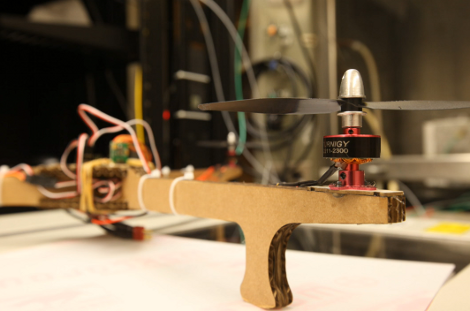
The smooth curves of this integrated landing pad makes us thing the frame was cut either with a CNC device or a utility-knife wielding ninja. Two of the three motor supports look just like what is shown above, but the third has a hinged mounting bracket attached to a servo motor. This way the propeller can be tilted around an axis running parallel to the support arm. We’d bet this feature is mainly for adjusting the yaw of the aircraft.

The video comments mention that this can hover when the throttle is at 45%, showing that there’s a lot lift available when needed. That is until you really weigh it down by adding plastic cages around the propellers. It’s kind of neat to see the thing ‘sticking’ to the ceiling at the end of that clip by driving the throttle wide open and using the cages as top-sided landing gear.

Continue reading “Cardboard Framed Tricopter”

Decoding, Then Cloning An IR Helicopter Toy’s Control Signals

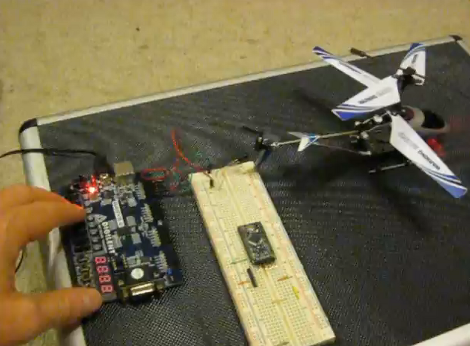
[Mike Field] got his hands on this Syma S107 helicopter with the intention of hacking it. After playing around with it for a while he set out to build his own infrared controller for the toy. It seems there is some protocol information about it published in various forum posts, but he decided it would be more fun to figure it out for himself.

He started off trying to capture the IR signals using Adafruit’s tutorial which has come in handy on a number of other projects. He could get his television remote to register, but not the toy’s controller. This didn’t stop fun, instead he tore open the controller and grabbed a logic sniffer to see what’s being pushed to the IR LEDs. The signals are a bit curious. It seems two different packets are sent with each command which [Mike] thinks is for use with two different models of the toy. In addition to that the frames are not synchronized. But a bit of 10 MHz sampling helped him to figure everything out, and he believes he’s got a more accurate version of the protocol than had previously been discovered. To prove it he developed an FPGA-based controller using VHDL which he shows off in the clip after the break.

Continue reading “Decoding, Then Cloning An IR Helicopter Toy’s Control Signals”

Ancient Laptop Given New Life As Mobile Prototyping Platform

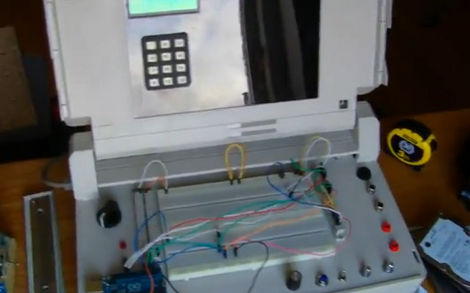
What can you do with a broken Compaq SLT 286? Its briefcase-like size and shape actually make for a pretty interesting portable electronic prototyping station. [Philip] gutted the components and started adding back the items he most commonly uses when developing a project.

He shares all of the details in the video after the break. At center stage is a double breadboard where the keyboard would normally be found. It’s hard to make out in the image above, but there is a set of terminal strips running vertically to either side of these breadboards. Each terminal is connected to a peripheral or power/ground bus. The black knob to the left lets him adjust the output of a variable voltage regulator. To the lower right there’s a rotary encoder, push button, toggle switch, and a couple of potentiometers. These, along with the keypad and character display (mounted where the screen used to be) and DB connectors (on the back of the case) have their pins mapped to the terminal block to the right. [Philip] has mounted an Arduino Uno over the area to the bottom left, but we’re sure that it’s pretty easy to swap out for just about any breakout board he needs.

To answer [Philip’s] running dialog from the video: no, it is not the worst demo ever. We think you did a great job demonstrating all the features. Loose connections are par for the course when it comes to prototypes.

Continue reading “Ancient Laptop Given New Life As Mobile Prototyping Platform”

Robot Jellyfish Fueled By Hydrogen From The Water Around It

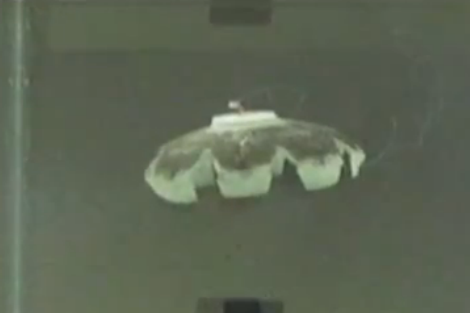
RoboJelly is certainly not what we’re used to seeing when it comes to robots. Instead of a cold metallic skeleton, this softie is modeled after jellyfish which have no bones. But that’s not the only thing that’s unusual about it. This robot also doesn’t carry its own power source. It gets the energy needed for locomotion from the water around it.

Artificial muscles are what give this the movement seen in the clip after the break. These muscles react to heat, and that heat is produced through a chemical reaction. The construction method starts with the muscle material, which is then covered in carbon nanotubes, and finally coated with black platinum dust. Sounds a bit like witchcraft, huh (Eye of newt, dragon heart string, etc.)? We certainly don’t have the chemistry background to understand how this all works. But we are impressed. So far it doesn’t have the ability to change direction, the flexing of all of the muscle material happens at the same time. But the next step in their research will be finding a way to route the “fuel” to give it some direction.

Edit – Looks like it is fueled externally. The actual study is here, but you need to log in to download it.

This brings another jellyfish-inspired robot to mind. Check out FESTO’s offering which flies through the air with the greatest of ease.

Continue reading “Robot Jellyfish Fueled By Hydrogen From The Water Around It”