Redbull Sends Marketing Doodad To Hackerspace Using An Open Source Product

Posts

Looks like Redbull is harnessing the power of open source hardware to market their product to hackers everywhere. We’d say that it worked because here we are, posting up some free advertising for them. It seems that a rep for the company dropped off a package at a hackerspace in LA called Null Space Labs. It came in what is obviously a laser cut wooden box, a material that tends to make hackers salivate. Inside they found the board you see above. It took a bit of time to look over the hardware was eventually identified as an Uzebox. Sure enough, then plugged in an original NES controller to the controller port on the back of the board and were playing a version of  Pac-man in no time.

Marketing and advertising have their place in our lives which can be annoying and intrusive at times. But we have no problem with it when done creatively and targeted to our interests. Good job Redbull, and might we add, that’s a heck of a routing path for your PCB outline!

Fusion Reactor Wins Science Fairs

[Will Jack] built a heavy water fusion reactor and then won district and regional science fair projects with it. Someone give this man a job!

We looked in on his fusion reactor about a year ago. At the time he had managed to build a magnetic containment field but didn’t have the voltages or the deuterium necessary to achieve fusion. We’ll that’s all changed. Using a boron-10 lined sensor tube he’s managed to detect the rise in neutron counts that would indicate fusion. Remarkable. He’s now working on a refined gas system that will allow him to increase the deuterium purity by cutting down on the leak rate. He mentions a few other hardware improvements such as a new containment unit and an ion source upgrade. Both of these concepts go beyond our knowledge so do make sure to put on your Nuclear Engineering hat while reading through his project update.

Learn The Geometry To Draw An Analog Clock On A Graphic LCD Screen

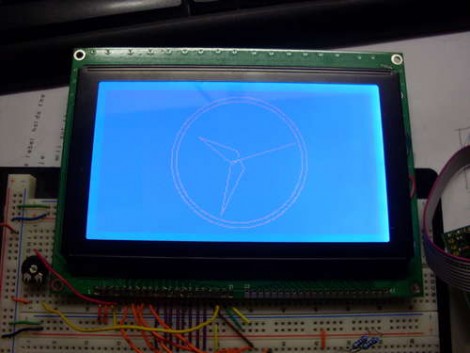
Does the image of the clock above make you shutter with fear because of the math you’d need to use to recreate your own version of the project? We certainly understand that High School geometry is becoming a very distant memory, but it’s really not as hard as you think. [Janw] built this analog clock using a graphic LCD and he’s done a great job of explaining the concepts behind it.

The hardware he’s using is pretty standard for an electronic hobby clock; an ATmega16, graphic LCD, DS1307 real-time clock, and supporting hardware like a potentiometer, resistors, and buttons. The code is written in Bascom, but like we said, [Janw] explains the concepts behind drawing the hands on the clock so you can recreate this with any microcontroller or software language you prefer. We  recommend grabbing a calculator and some blank paper. It took us a few tries to brush the cobwebs out and really grasp what he’s doing with each equation.

Photographing Stuff That’s Not There By Using Stencils

This image was not made in post production, but captured during a long camera exposure. The method uses stencils to add components to a picture. [Alex] built a jig for his camera from a cardboard box. This jig positions a large frame in front of the camera lens where a printed stencil can be inserted. He printed two identical sheets of paper with black covering the area all around the 8-bit joggers. When properly aligned and inserted in the jig, the black parts of the stencil will act to mask the areas where he wants to capture the natural surroundings of the image. Once the camera shutter is triggered, he uses a flash to illuminated the stencil, then removes the the paper image from the jig and ambient light from the dark surrounding is captured during the remainder of the 20-30 second exposure time. The real trick is getting the light levels between the flash and the ambient light to balance and produce a result like the one seen above.

Is anyone else hearing the Punch Out cut-scene music in their heads right about now?

High Voltage: How To Cook Your Goose In 62 Easy Steps

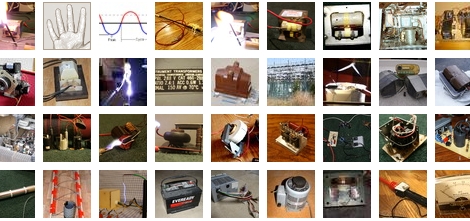
Prepare to learn. [Grenadier] has put together a collection of information about AC electricity that can safely be called a super-post. In 62 parts he covers a myriad of topics, some of them safe, many of them not so much. You may want to spend time reading through everything that he has to offer, but just in case you don’t, step one is a table of contents. In it you’ll find a listing of major points including transformers of every kind imaginable; from microwave ovens, neon signs, bug zappers, x-rays, and televisions. [Grenadier] covers the type of transformers that these items use, where to find them, and how to set up your own experiments. There’s plenty of pictures and several videos where the high-powered sparks fly. We feel like there’s enough here that we can be satisfied with vicarious AC interactions while safely in front of our monitor and far away from the heart-stopping action.

[Thanks Marcus]

Roll Away Clock Becomes A Programmable Rover

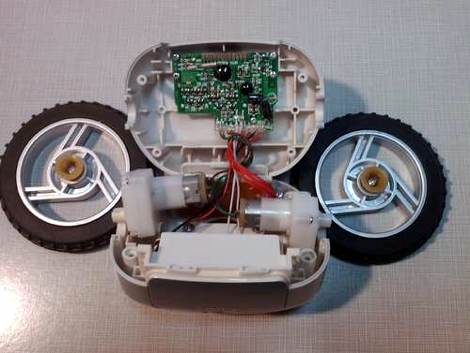
The parts laid bare in the picture above all make up a roll away alarm clock that flees when you don’t get out of bed. It’s an interesting idea, but considering most folks don’t sleep on hardwood floors we can understand why [TheRafMan] was able to pick this gem up for under $5. That’s quite a deal because there’s a very usable LCD module at the top. But for this hack, he focused on using the gearhead motors to make a programmable rover.

In order to make this programmable [TheRafMan] had to add a microcontroller. He chose an Arduino variant, called the Ardweeny. It’s a board that piggy-backs the ATmega328. But he didn’t use a stock Ardweeny; he’s altered it to play nicely with jumper wire. The uC is able to interface with the gearhead motors thanks to an L293D h-bridge motor driver chip. As you can see in the clip after the jump, the rover can now be driven around using a Wii Nunchuck or via a USB connection. If you’ve got a Bluetooth module lying around it wouldn’t be hard to make this a wireless solution that can be controlled with the accelerometers in a Wii remote.

Continue reading “Roll Away Clock Becomes A Programmable Rover”