Panoramic And Spheric Tripod Rig

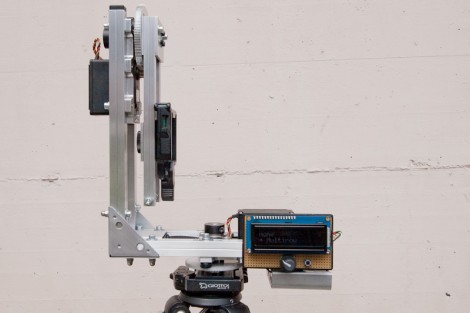
This simple yet precise build takes your camera for a spin in order to take spherical and multi-row panorama photographs. The rig mounts to a tripod, using two servo motors for motion, producing images that can be stitched together perfectly. An Arduino handles the hardware with an LCD interface for dialing in the settings.It’s not the cheapest way to get 360 degree shots but the example images are amazing.

[Thanks Juan]
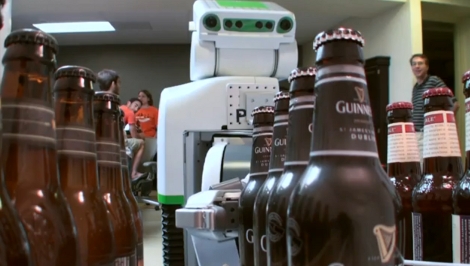
RBD (robotic Beer Delivery)

Those crazy programmers over at the Willow Garage are at it again. This time around they’ve created a robotic wench to deliver the beer. When thirst strikes you can fire up a web interface and drag a picture of your beer into a shopping basket. Once you submit your order the bot will raid the fridge and return with your frothy treat. It will even open the bottle for you but, as you can see after the break, this is where your beer becomes truly frothy.

So we’ve seen the PR2 playing pool, and now as a barmaid. Willow Garage just joined SparkFun on our list of places we wish we worked. Continue reading “RBD (robotic Beer Delivery)”

Homemade Induction Generator

[youtube=http://www.youtube.com/watch?v=RTTgLYzfQrE]

[Tyler LaVite] tipped us off about the generator he built. He combined a 5.5 horsepower Honda motor with a 10 horsepower electric bandsaw motor. To get an induction generator to produce alternating current you must feed electricity into the system to start the magnetic flux. [Tyler’s] solution was to include a bank of capacitors totaling 230mF which charge from the motor, then release back into the system. It’s not as green as the syngas generators we’ve seen since it still uses fossil fuel, but it reuses old parts sending less to the landfill.

A Pair Of Rube Goldberg Builds

[youtube=http://www.youtube.com/watch?v=KJfhgrNQnq4]

Here’s a couple of videos of Rube Goldberg machines that [Austin] built. The one above was completed in 2008 as a commercial contest entry for something-or-other. After the break you can see his build from 2007 which was just for fun. Both are quite nice additions to our collection of the complicated devices. We especially like the use of a sub-woofer to move a ping-pong ball and a vibrating cell phone for some wireless integration.

Continue reading “A Pair Of Rube Goldberg Builds”

Key Fob Programming

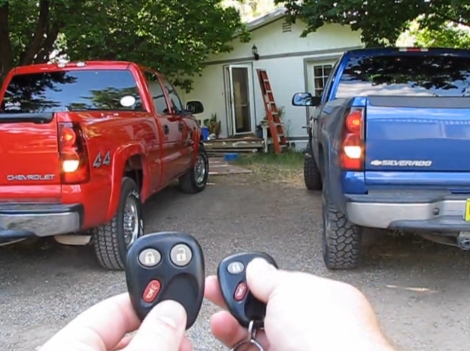
[Fileark] has instructions for reprogramming keyless entry devices for your car. His demonstration video, which you can see after the break, shows how to make one key fob work for two different vehicles. In this case he’s working on a couple of Chevrolet trucks but there are instructions for GM, Ford, Dodge, Toyota, and Nissan. If you need to reprogram one of these you may find this useful, but we’re wondering how it can be incorporated into a project. If you can sniff out the communications that are going on during the programming you should be able to build and pair your own devices with a vehicle. Wouldn’t it be nice to incorporate your keyless entry into your wristwatch?

Continue reading “Key Fob Programming”

Electronic Vuvuzela

[youtube=http://www.youtube.com/watch?v=AHsgRuAKJdQ]

Want to annoy fellow fans but  don’t have the lung power to do the job? [Hunter’s] electronic vuvuzela is just the thing you need. The plastic noisemakers were so prevalent at the world cup this year that some folks came up with audio filters to remove the sound. The electronic rendition is much smaller, using a 555 timer to mimic the instrument on a small speaker. [Hunter’s] build has buttons for five different notes which can be altered with some potentiometer. There’s no schematic but then again for something that’s annoying you don’t want to make it too easy to replicate.

Update: Hunter added the schematic to his site which spell doom for those who enjoy peace and quiet.

Programmable Drum Machine

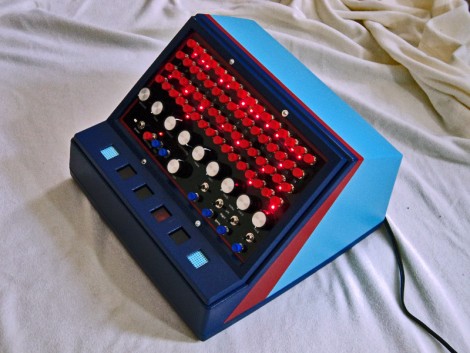
This sequencer, called Drumssette, uses audio tape to churn out some beats. [Mike Walters] built this around a Tascam four track cassette recorder. The tape inside has a different drum sound on each of the tracks, with a corresponding row of red buttons. Pushing a button adds the drum sound to the loop on that beat. He’s using a series of digital logic gates to patch through the sounds as well as clocking the device from one of the tape’s tracks. It’s pretty  neat  to see the focus selector used in the video after the break to sync up the beginning of the repeated drum patterns. This isn’t the first time we’ve seen [Mike’s] work. If you missed it last year take some time to review the Melloman.

Continue reading “Programmable Drum Machine”