DIY Resin Cast Project Box

resin_casting

[Rhys] wrote in to share a custom project box he built from scratch using polyester resin. He states that in New Zealand, he tends to have problems finding the perfect project box. They are typically too big or small to get the job done, so he figured he might as well just build his own to spec.

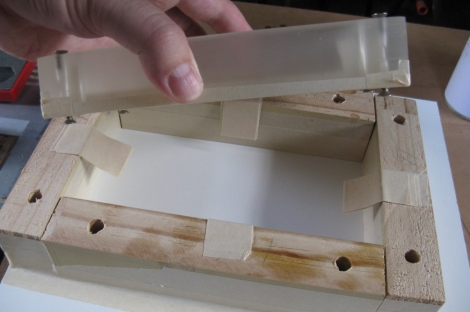
Using Google SketchUp, he designed his ideal project box, then got busy building wooden molds. He scored some free melamine scraps from a local company, which he used to build the base of his molding rig. Once the inner and outer molds were built, he secured them to his base and mixed up some polyester resin.

A few hours later, he pulled apart his molds and smoothed out his project box with some sandpaper. He drilled and tapped screw holes, then prepared to make a lid and base for the box.

He admits that the process is quite involved, but there is something to be said for building yourself an enclosure made specifically for the project it is going to house. If you are looking to do something similar be sure to check out his blog – he offers up some sound resin casting tips, as well as some pitfalls to avoid.

Location Tracking? ‘Droid Does

i_spy

Last week, the Internet was alight with stories of iPhone location tracking. While this wasn’t exactly breaking news in security circles, it was new information to many people out there. Lots of blogs were full of commentary on the situation, including ours, with many Android users chiming in saying, “Android doesn’t do that”.

Well, that’s not entirely true – the playing field is far more level than most people would like to admit.

Android does have the same tracking capability, as do Windows Mobile phones for that matter. Both companies also monitor the cell towers you have connected to, as well as which Wi-Fi hotspots you have passed by. All three companies anonymize the data, though they do assign a unique ID to your location details in order to tell you apart from other users.

Where things really differ is in regards to how much information is stored. Microsoft claims that they only store the most recent location entry, while Andriod systems store the 200 most recent Wi-Fi hotspot locations as well as the most recent 50 cell towers.

At the end of the day each vendor does allow you to opt out of the tracking services, and if you are seriously concerned about the data they are tracking, you can always periodically wipe the information from your handset, should you desire.

[Image via TheTelecomBlog]

Portal Turret Plushie Is Cute And Harmless

turret_plushie

As many of you are probably aware, Portal 2 was released last week, and gamers have been going crazy over it. Over the years, people have constructed replicas of their favorite in-game items and “characters”, including portal guns, companion cubes, and turrets.

After playing Portal 2 for a bit, [Jonathan] wanted a turret of his own quite badly. Rather than construct it from hard plastics and resins however, he decided he wanted to construct a cuddly turret that talked.

With the assistance of his friend [Leigh Nunan], he is now the proud owner of a plushie turret. It’s a bit smaller than you might expect, but it is packed full of turret personality. The plushie plays audio from the game, can sense motion near its face, detect if it has been tipped over, and also knows when it has been picked up. [Jonathan] added all of these features by stuffing an Arduino inside the turret, along with a wave shield for playing sounds. Proximity and motion sensing are provided via a trio of different sensors, enabling the turret to behave in the same way its in-game brethren do (minus the machine guns).

It really is a neat little toy, one we would no doubt be glad to have around. Keep reading to see a short video of his plushie turret in action.

Continue reading “Portal Turret Plushie Is Cute And Harmless”

Mini LED Message Board Built From Retro Displays

personal_electronic_retro_telegram

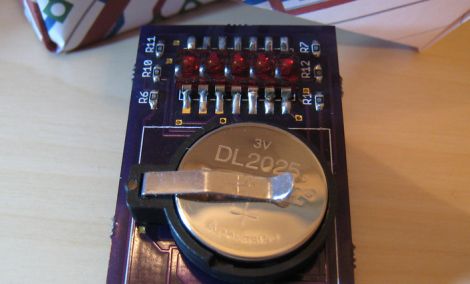
[Iain] is getting to the point in his life where he finds himself waxing nostalgic about various different technologies from his youth. One item he has always been fond of is first generation 7 segment consumer LED displays, like those found in old calculators.

He was excited to find one of these displays at the bottom of a box full of electronics odds and ends he received from a friend. After identifying the display and tracking down a data sheet online, he decided that he wanted to build some sort of little gadget out of it.

His first inclination was to build a tiny text scrolling gadget from the display, and thus his “Personal Electronic Retro Telegram” (P.E.R.T) was born. With Arduino in hand, he prototyped the circuit on a breadboard, then sent away to have some PCBs built. Once he received the boards, alll of his prototyping components were swapped out with SMD versions, including a TQFP ATMega168 chip in place of the full-sized Arduino board.

The final result is a nice melding old and new technology which he decided to give to his girlfriend as a gift. Continue reading to see a quick video of the P.E.R.T in action.

Continue reading “Mini LED Message Board Built From Retro Displays”

Hacking Cakes With LEDs

led_cake

A large part of science is making mistakes and learning from them in order to make each subsequent design that much better. When your experimentation involves hacking cakes, each failure is an exercise in deliciousness.

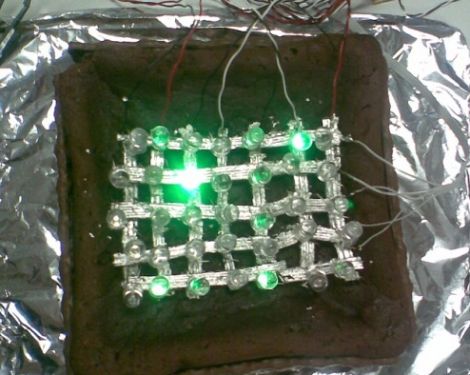
[Craig] and his group of research partners often bake electronics-related cakes whenever part of the team departs in search of other opportunities. Over the years, farewell parties have seen renditions of anything from multimeters to quantum computers. This time around, he wanted to make something that contained actual electronics parts, while still remaining edible.

He settled on making an LED matrix inside of a cake, using silver foil wrapped licorice for wires. In the end however, he found the silver foil to be incredibly difficult to work with, and the matrix ended up being little more than a few randomly blinking LEDs.

Even though things didn’t work out quite how he planned, he is not discouraged. The cake was still quite tasty, and through this process he has discovered edible silver paint, which will undoubtedly make it into the next farewell cake.

Hacking Analog Phones For VOIP

analog_phone

[Tyler] has been using Google Voice extensively for some time now, but he hasn’t quite found a microphone/speaker setup he is happy with. He tried a headset, but that just didn’t do it for him.

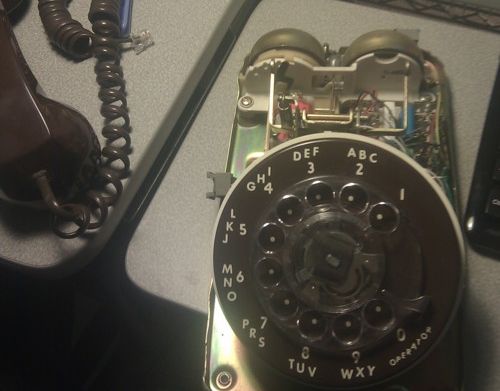
While browsing around at his local thrift store, he came across an old Model 500 rotary phone for just a few dollars and decided it just might do the trick. Once disassembled, he mapped out the circuitry and got busy wiring up the handset to a pair of 3.5 mm stereo plugs – one each for the earpiece and microphone.

Once everything was reassembled, he hooked it up to his computer and gave it a spin – success!

While he is happy with how the phone works at the moment, he already has plans for improving it. He is currently looking for a way to use the handset hook to disconnect calls as well as a way to implement the rotary dial for number entry. We think that hacking a Bluetooth headset would easily take care of the first part, as well as eliminate the need for any sort of wired interface to his PC. It would also make it dead simple to use with any other Bluetooth-enabled device such as a cell phone.

We’re pretty sure he is open to implementation suggestions, so let us know what you think.

DSLR Infrared Camera Conversion

ir_conversion

[Jerry] recently got a shiny new DSLR camera and was looking to do something with the old Pentax DSLR it replaced. Having performed a few point and shoot IR conversions in the past, he was pretty confident he could tackle this conversion without too much trouble.

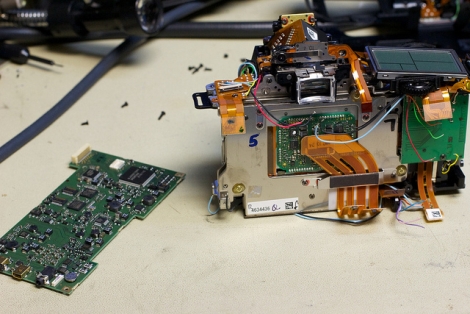
He located the service manual for the camera and got busy taking it apart. He had to desolder the main board to get to the CCD block, where the sensor, IR cut filter, and the shake reduction motors are all located. The IR cut filter was pried off without too much trouble as it is only secured with a clip and an adhesive foam gasket.

Once things were disassembled, the real work began. He had a little trouble cutting the IR filter he purchased, so it took a little bit of elbow grease to get things exactly the way he wanted. Once he got the filter in place, he carefully re-mounted the sensor block to ensure that it was set at the proper height.

Once things were fully reassembled, he tried taking a few test shots, but found that there were some focus issues due to the IR filter being thicker than the original IR cut filter. A few manual tweaks in the camera’s debug menu and he was in business.

Be sure to check out his photo stream to take a look at some of the pictures he snapped with his new IR camera.