Celebrating A Decade Of Bootleg Hackaday Merch

A listener of the podcast recently wrote in to tell us that, in the process of trying to purchase a legitimate Hackaday t-shirt, they discovered this 2012 Instructable from [yeltrow] that covers how you can cheaply crank out your own Wrencher shirts via screen printing.

Now historically, as long as you’re not trying to make a buck off of our name, we’ve never felt the need to stop folks from putting our logo on their projects. So we’re not too concerned that somebody was making Wrencher shirts, especially since they were almost certainly for their own personal use. Though the fact that [yeltrow] apparently described the project as a “Hackster-Style shirt” to try and avoid using our name ended up being a prophetic 4D chess meta-joke that you couldn’t make up if you tried. Continue reading “Celebrating A Decade Of Bootleg Hackaday Merch”

ImHex: An Open Hex Editor For The Modern Hacker

It’s little surprise that most hackers have a favorite text editor, since we tend to spend quite a bit of time staring at the thing. From writing code to reading config files, the hacker’s world is filled with seemingly infinite lines of ASCII. Comparatively, while a hex editor is a critical tool to have in your arsenal, many of us don’t use one often enough to have a clear favorite.

But we think that might change once you’ve taken ImHex for a spin. Developer [WerWolv] bills it specifically as the hex editor of choice for reverse engineering, it’s released under the GPL v2, and runs on Windows, Linux, and macOS. Oh, and did we mention it defaults to a slick dark theme designed to be easy on the eyes during those late night hacking sessions — just like your favorite website? Continue reading “ImHex: An Open Hex Editor For The Modern Hacker”

Low-Cost 433 MHz Door Sensors Get Open Firmware

It’s an unfortunate reality these days that if you see a cheap piece of consumer electronics, there’s a good chance its only cheap because it’s designed to lock you into some ecosystem where you’ll either end up paying a subscription, or worse, have your personal information sold behind your back. One of the best tools we have against these sort of anti-consumer practices is the development of open source firmware replacements that put control of the device into the hands of the community, rather than a corporation.

Now, thanks to the work of [Jonathan Armstrong] we have such a firmware for the 433 MHz magnetic door and window sensors that you can pick up on AliExpress for $4 USD a piece. The new firmware not only ensures you can use these sensors with a wide array of receivers, but adds a number of new features over their stock configuration. Continue reading “Low-Cost 433 MHz Door Sensors Get Open Firmware”

Hackaday Podcast 200: Happy New Year, The Ultimate Game Boy, And Python All The Things

This week, Editor-in-Chief Elliot Williams and Managing Editor Tom Nardi ring in the New Year with…well, pretty much the same stuff they do every other week. After taking some time to talk about the nuts and bolts of the podcast in honor of Episode 200, discussion moves on to favorite stories of the week including an impeccably cloned Dyson lamp, one hacker’s years-long quest to build the ultimate Game Boy, developing hardware in Python, building a breadboard computer with the 6502’s simplified sibling, and the latest developments surrounding the NABU set-top box turned retrocomputer. The episode wraps up with a review of some of the biggest themes we saw in 2022, and how they’re likely to shape the tech world in the coming years.

Check out the links below if you want to follow along, and as always, tell us what you think about this episode in the comments!

Download it in living MP3.

Continue reading “Hackaday Podcast 200: Happy New Year, The Ultimate Game Boy, And Python All The Things”

DIY GameTank Game Console Gets Upgraded Cartridge

Over the summer, you might recall seeing a homebrew 6502 game console called the GameTank grace these pages. The product of [Clyde Shaffer], the system was impressively complete, very well documented, and even had a budding library of games.

Recently, [Clyde] took to the r/electronics subreddit to show off the latest improvement to the GameTank: a revised removable cartridge. The biggest change this time around is the addition of 32 KB of battery-backed SRAM that gives games (or any other software that might be on the cartridge) some persistent storage to work with. Continue reading “DIY GameTank Game Console Gets Upgraded Cartridge”

New And Improved Arduboy Mini Smashes Funding Goal

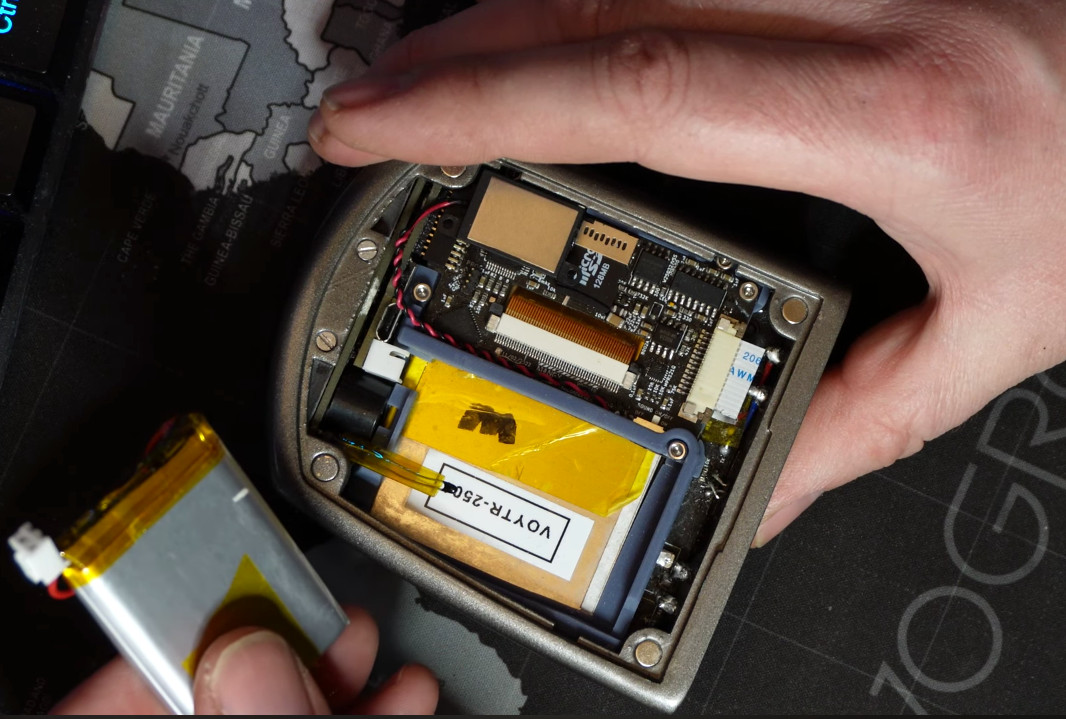
Just before the holidays, we brought you word of the Arduboy Mini — the latest in the line of open source 8-bit handheld gaming systems designed by [Kevin Bates]. He was good enough to send along a prototype version ahead of the system’s Kickstarter campaign, and we came away impressed with the possibilities it offered for customization.

Today, we’re pleased to tell you that not only did the Arduboy Mini Kickstarter cross the finish line with more than six times its original funding goal, but [Kevin] has made some pretty major changes to the design from the last time it graced these pages. The final Mini offers even more opportunities for modification and expansion, while still keeping the $29 USD price tag which made it so appealing in the first place. Continue reading “New And Improved Arduboy Mini Smashes Funding Goal”

N-O-D-E Unveils Slick Tech News Site

There’s probably some axiom in professional journalism that says you shouldn’t give out free advertisement to your competitors — but since none of us have any formal training in this kind of thing and are just making it up as we go along — we’re more than happy to plug the brand-new MOSFET.net.

We like the option to ignore Reality.

Created by the mysterious hacker [N-O-D-E], the site is exceptionally minimal, providing an experience not entirely unlike a feed reader. Each story has a main image, a few sentences that describe what it’s about, and the ever-important link to the original source. There’s even a color filter applied on the images so they aren’t jarring when compared to the site’s monochrome color scheme. (If that all sounds familiar, it’s because Hackaday came up with the idea 18 years ago. But it’s cool, we’re not salty or anything.)

In all seriousness, the site looks very well done and will no doubt be a great resource for the community. A particularly interesting feature is that entries expire automatically after 30 days. This speaks to the goal [N-O-D-E] has for MOSFET.net — it’s designed to show you relevant tech news, and literally nothing else. The focus and simplicity is beautiful.

Here’s wishing all the luck to [N-O-D-E] in this new venture. We know better than most that it can be a difficult and sometimes thankless job, but we wouldn’t still be doing it all these years if it wasn’t worth the effort. The tech world is always growing and there’s plenty of room for everyone. In fact, a recent peek at the analytics revealed that Hackaday got more views in 2022 than at any time in its history. As far as we’re concerned, the future looks bright for everyone.

Continue reading “N-O-D-E Unveils Slick Tech News Site”