The WindRunner unloading a blade, image Radia.

Giant Airplane Goes Long On Specialization

While not everyone agrees on the installation of wind turbines in their proverbial back yards, one thing not up for debate is that there is a drive to build them bigger, and bigger. Big turbines means big blades, and big blades need to be transported… somehow. If air freight is going to stay relevant to the industry, we’re gonna need a bigger airplane.

A startup called Radia has a plan for that plane, and it is a doosie. The “WindRunner” would clock in at a massive 108 meters (354 feet) long, but with a wingspan of just 80 m (262 ft). That’s very, very long, but it might not be the largest airplane, depending how you measure it. Comparing to the 88 m wingspan for the late, lamented An-225 Mriya, you can expect a lower payload capacity, but heavy payloads aren’t the point here. Wind turbine blades really aren’t that heavy. They’re big, or they can be — the WindRunner is designed to fit a single 105 m blade within its long fuselage, or a pair of 90 m blades.

Continue reading “Giant Airplane Goes Long On Specialization”

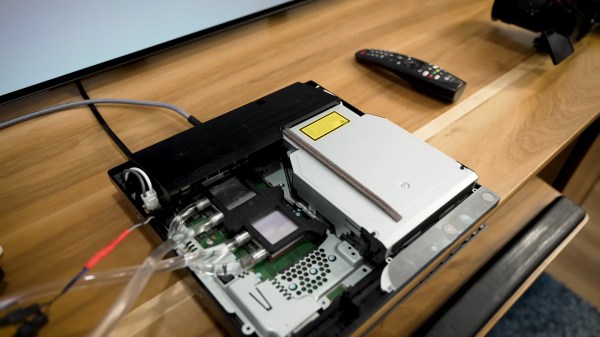
Yes, Gemini, A Wii Server Is Possible

When [Reit Tech] needed something to do with an old Nintendo Wii, he turned to Google. When the AI overview told him it could not be used as a server, he had his mission: prove that clanker wrong. It already runs Doom, so what else is there to do?

Of course should not that hard: Linux has been available on the Wii for years now. In fact there are several; he settles on “Arch, btw”, after trying Debian, Ubuntu, and even NetBSD. “Of course it runs NetBSD”– but NetBSD didn’t work with his USB network adapter, which is sadly as predictable as the hardware running NetBSD.

OK, it’s not vanilla Arch; it’s the Wii-Linux Continuation Project, based on ArchPOWER fork that compiles Arch for PPC. As the young YouTuber was surprised to discover, despite not being a PC or particularly powerful, the Wii has a PowerPC CPU. (He might be younger than the console, so we’ll give him a pass.) Wii-Linux couldn’t run the USB adapter either (appropriate apologies were offered to NetBSD), but it turns out the internal Ethernet adapter was available all along.

As a file server, python-based Copyparty worked flawlessly, but the rust-based Minecraft server he picked was not particularly usable. A little optimization would fix that, since you can serve Minecraft from an ESP32 and the Wii absolutely has more horsepower than that. Doubtless he could have loaded a web-server, and proved Google’s AI summary wrong, but the iPad-induced ADHD we all suffer from these days kicks in, so he settled for posting a screenshot of someone else’s blog, hosted on a Wii from NetBSD. So the LLM was wrong from the get-go, but the tour of “what home-brew loaded OSes still work in 2025” was certainly educational.

We could hunt that Wii-based blog down for you, but we’d be reluctant to link to it anyway: while the AI summary is wrong, and you can use the Wii as a server, that doesn’t mean it makes a good one. We’d don’t feel the need to inadvertently DDOS some poor unsuspecting shmuck’s Nintendo, so we’ll let you try and find it yourself.

Just be warned that all of this Wii hacking may not rest on the best of foundations. Continue reading “Yes, Gemini, A Wii Server Is Possible”

Blocky tread, yellow hub-- yep, it looks like LEGO

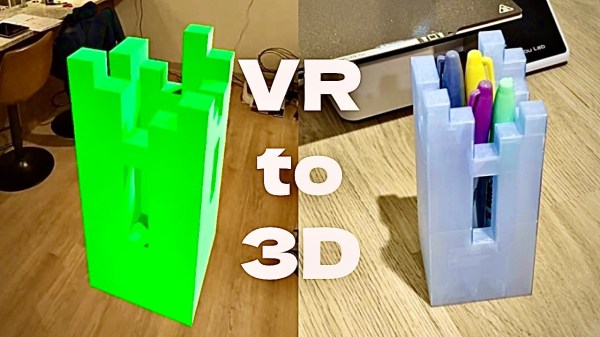
10″ LEGO Tyre Is Practical Nostalgia

If there’s one thing that has come to define the generations after the baby boom, it’s probably nostalgia. It’s heavily marketed and weaponized by the market: yearning for better, simpler times seems to be a core thread of the consumer economy these days. [Makerneer] combined his xilennial love of LEGO bricks with the flat tires on his log splitter to produce a 10″ TPU tyre will never go flat, and provide a dopamine release every time he sees it.

The tyre is a custom model to fit his particular rims, but he does provide STEP and F3D files if you’d like to try modifing it for your own purpose — they’re at Step 6 of the Instructable. Props to [Makerneer] for truly open-sourcing the design instead of just tossing STL files online. His build log also takes the time to point out the ways he had to modify the LEGO tyre profile to make it amenable to 3D printing: notably chamfering some of the tread pattern to eliminate bridging, which is a bit of a no-no with TPU.

As you can see in the (unfortunately vertical) demo video below, it’s a bit quite a bit squishier than a regular run-flat tyre, but that was part of [Makerneer]’s design goal. He didn’t like how rigid the non-pneumatic tyres he’d tried were, so endevoured to design something himself; the whole LEGO thing was just for fun. If you wanted to replicate this tyre with a bit less skoosh, you need only tune the infill on your print.

While only time will tell how long this LEGO-inspired add-on will continue adding whimsy to [Makerneer]’s log-splitting, we have tests to show it will outperform any other plastic he might have printed. This project is probably more practical than a 3D printed bicycle tyre, which doesn’t even have the side benefit of whimsy. Continue reading “10″ LEGO Tyre Is Practical Nostalgia”

How Many Phones Sport A 5 And 1/4 Diskette Drive? This One.

It all started with a sarcastic comment right here on Hackaday.com: ” How many phones do you know that sport a 5 and 1/4 inch diskette drive?” — and [Paul Sanja] took that personally, or at least thought “Challenge accepted” because he immediately hooked an old Commodore floppy drive to his somewhat-less-old smartphone. 

The argument started over UNIX file directories, in a post about Redox OS on smartphones— which was a [Paul Sajna] hack as well. [Paul] had everything he needed to pick up the gauntlet, and evidently did so promptly. The drive is a classic Commodore 1541, which means you’ll want to watch the demo video at 2x speed or better. (If you thought loading times felt slow in the old days, they’re positively glacial by modern standards.) The old floppy drive is plugged into a Google Pixel 3 running Postmarket OS. Sure, you could do this on Android, but a fully open Linux system is obviously the hacker’s choice. As a bonus, it makes the whole endeavor almost trivial.

Continue reading “How Many Phones Sport A 5 And 1/4 Diskette Drive? This One.”

Vertical Solar Panels Are Out Standing

If you’re mounting solar panels, everybody knows the drill, right? Point them south, angled according to latitude. It’s easy. In a video which demonstrates that [Everyday Dave] is truly out standing in his field, we hear a different story. [Dave] has a year’s worth of data in his Solar Panel Showdown that suggests there are good reasons to mount your panels vertically.

Specifically, [Dave] is using bifacial solar panels– panels that have cells on both sides. In his preferred orientation, one side faces South, while the other faces North. [Dave] is in the Northern Hemisphere, so those of you Down Under would have to do the opposite, pointing one face North and the other South.

Since [Dave] is far from the equator, the N/S vertical orientation beats the pants off of East-West facing panels, especially in winter. What’s interesting is how much better the bifacial panels do compared to the “standard” tilted orientation. While peak power in the summer is much better with the tilted bifacial panels (indeed, even the tilted single-sided panels), in winter the vertical N/S panels blow them out of the water. (Especially when snow gets involved. Vertical panels don’t need sweeping!)

Continue reading “Vertical Solar Panels Are Out Standing”

Diagram of an air-breathing satellite

It’s A Bird! It’s A Plane! It’s… An Air Breathing Satellite?!

The big problem with Low Earth Orbit is, oddly enough, air resistance. Sure, there’s not enough air to breathe in space, but there is enough to create drag when you’re whipping around the planet at 28,000 km/h (17,000 mph) or more. Over time, that adds up to a decaying orbit. [Eager Space] recently did a video summarizing a paradoxical solution: go even lower, and let the air work for you.

So called air-breathing satellites would hang out in very low earth orbit– still well above the Karman line, but below 300 km (186 miles)– where atmospheric drag is too dominant for the current “coast on momentum” satellite paradigm to work. There are advantages to going so low, chiefly for communications (less latency) and earth observation (higher resolutions). You just need to find a way to fight that drag and not crash within a couple of orbits.

It turns out this space isn’t totally empty (aside from the monoatomic oxygen) as missions have been at very low orbits using conventional, Xenon-fueled ion engines to counter drag. The xenon runs out pretty quick in this application, though, and those satellites all had fairly short lifetimes.

That’s where the air-breathing satellites come in. You don’t need a lot of thrust to stabilize against drag, after all, and the thin whisps of air at 200 km or 300 km above ground level should provide ample reaction mass for some kind of solar-electric ion engine. The devil is in the details, of course, and [Eager Space] spends 13 minutes discussing challenges (like corrosive monoatomic oxygen) and various proposals.

Whoever is developing these satellites, they could do worse than talk to [Jay Bowles], whose air-breathing ion thrusters have been featured here several times over the years.

Continue reading “It’s A Bird! It’s A Plane! It’s… An Air Breathing Satellite?!”

3D Printed “Book” Demonstrates Mechanical Actions

A book of mechanical actions is a wondrous thing — mechanically inclined children have lost collective decades pouring over them over the generations. What could possibly be better? Why, if the mechanisms in the book were present, and moved! That’s exactly what [AxelMadeIt] produced for a recent video.

Being just four pages, you might argue this is but a pamphlet. But since it takes up a couple inches of shelf space, it certainly looks like a book from the outside, which is exactly what [AxelMadeIt] was going for. To get a more book-like spine, his hinge design sacrificed opening flat, but since the pages are single-sided, that’s no great sacrifice.

At only 6 mm (1/4″) thick, finding printable mechanisms that could actually fit inside was quite a challenge. If he was machining everything out of brass, that would be room for oodles of layers. But [Axel] wanted to print the parts for this book, so the mechanisms need to be fairly thick. One page has a Roberts linkage and a vault-locking mechanism, another has planetary gears, with angled teeth to keep them from falling out. Finally, the first page has a geneva mechanism, and an escapement, both driven by a TPU belt drive.

All pages are driven from an electric motor that is buried in the last page of the “book”, along with its motor, battery, and a couple of micro-switches to turn it on when you open the book and off again when you reach the last page. Rather than a description of the mechanisms, like most books of mechanical actions, [Axel] used multi-material printing to put lovely poems on each page. A nice pro-tip is that “Futura”, a font made famous by flying to the moon, works very well when printed this way. If you just want to watch him flip through, jump to 8:00 in the video.

This reminds us of another project we once featured, which animated 2100 mechanical mechanisms. While this book can’t offer near that variety, it makes up for it in tactility.

Continue reading “3D Printed “Book” Demonstrates Mechanical Actions”