If you’re into automotive hacks and don’t watch [Robot Cantina], you are missing out. This hack has [Jimbo] taking a break from automotive hacking to butcher a poor, innocent Tecumseh lawnmower to run diesel fuel (or anything else) by converting the motor into a hot bulb engine. (Video embedded below.)
The secret is a long stack of anti-fouling adapters, which are essentially extension tubes that move the spark plug out of the combustion chamber to keep it from getting crudded up in an engine that’s burning too much oil. In this case, burning is what’s happening inside the anti-fouling adapters: by stacking seven of them, [Robot Cantina] is able to create a hot-bulb– volume that stays hot enough between strokes to induce spontaneous combustion of the fuel-air mix.
Hot-bulb engines were popular for certain tractors (the Lanz Bulldog being the most famous) and stationary engines from the late 19th century until Rudolf Diesel’s eponymous invention drove them out of their niche completely sometime after WWII.
One of the difficult things about raising chickens is that you aren’t the only thing that finds them tasty. Foxes, raccoons, hawks — if it can eat meat, it probably wants a bite of your flock. [donutsorelse] wanted to protect his flock and to be able to know when predators were about without staying up all night next to the hen-house. What to do but outsource the role of Chicken Guardian to a Raspberry pi?
Object detection is done using a YOLOv8 model trained on images of the various predators local to [donutorelse]. The model is running on a Raspberry Pi and getting images from a standard webcam. Since the webcam has no low-light capability, the system also has a motion-activated light that’s arguably goes a long way towards spooking predators away itself. To help with the spooking, a speaker module plays specific sound files for each detected predator — presumably different sounds might work better at scaring off different predators.
If that doesn’t work, the system phones home to activate a siren inside [donutorelse]’s house, using a Blues Wireless Notecarrier F as a cellular USB modem. The siren is just a dumb unit; activation is handled via a TP-Link smart plug that’s hooked into [donutorelse]’s custom smart home setup. Presumably the siren cues [donutorelse] to take action against the predator assault on the chickens.
Weirdly enough, this isn’t the first time we’ve seen an AI-enabled chicken coop, but it is the first one to make into our ongoing challenge, which incidentally wraps up today.
PLA is probably the most-printed filament on the market these days, and is there any wonder? It’s cheap, it’s easy, and it doesn’t poison you (as quickly as its competitors, anyway). What it doesn’t do very well is take the heat. Polymaker’s new HT-PLA formulation promises to solve that, and [My Tech Fun] put those claims to the test in a recent video.
Polymaker claims its HT-PLA is heat-stable up-to 150 C, but still prints as easily as standard PLA at up to 300 mm/s. By “heat stable” they mean able to maintain dimensions and form at that temperature when not under any load, save perhaps its own weight. If you need high-temp mechanical properties, they also offer a glass-fiber infused HT-PLA-GF that they claim is heat resistant up to 110 C (that is, able to withstand load at that temperature) which is hard to sneeze at, considering you you could print it on a stock Ender so long as you tossed a hardened nozzle on it.
Now it’s not a free lunch: to get the very best results, you do need to anneal the parts, which can introduce shrinkage and warping in HT-PLA, but that’s where HT-PLA-GF shines. If you want to see the results of the tests you can jump to 19:27 in the video, but the short version is that this is mechanically like PLA and can take the heat.
The verdict? If you like printing PLA and want to shove something in a hot car, you might want to try HT-PLA. Otherwise, it’s just like PLA. It prints like PLA, it looks like PLA, and when cold it behaves mechanically like PLA, which we suppose was rather what Polymaker was going for. There is no word yet on whether the additives that make it high-temp increase off-gassing or toxicity but since this stuff prints like PLA and can stand a little airflow, it should be easy to ventilate, which might make for fewer trade-offs when building an enclosure.
What do you think, will you be trying HT-PLA anytime soon? Let us know in the comments.
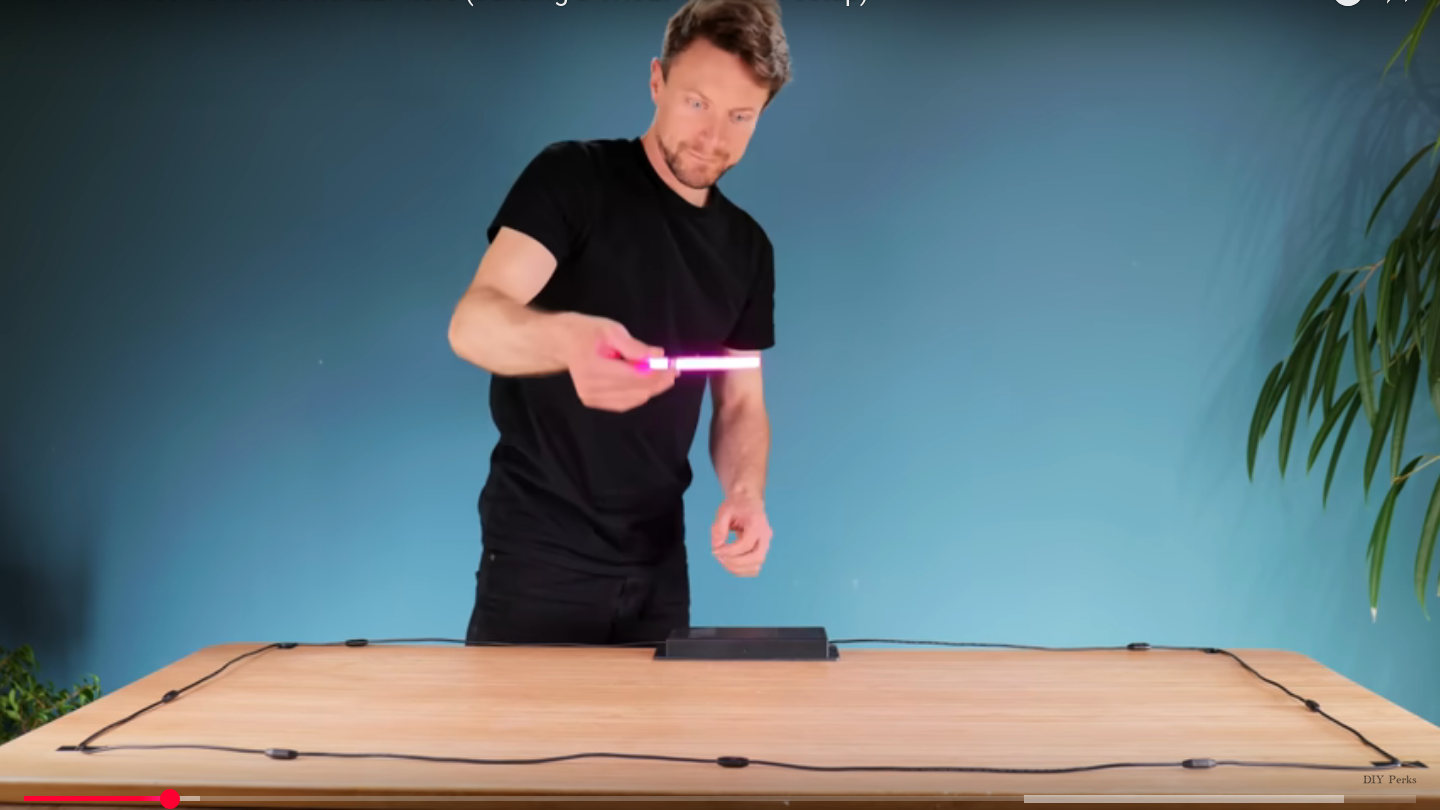
Some people hate cables with a passion; others are agnostic and prefer cabled peripherals to having to stop and charge their mouse. [Matt] from DIYPerks has the best of both worlds with this wireless-powered, no-cable desk setup.
The secret is embedded within the plywood desk: an evaluation kit from Etherdyne Technologies, Inc consisting of a 100 W RF power supply and its associated power antenna looping around the desktop edge. The mechanism is similar to the inductive charging often seen on phones nowadays, but at higher frequency and larger scale, enabling power to be transmitted several feet (at least a meter) above the desktop.
The range is impressive (this isn’t the maximum), but the efficiency is not advertised.
The kit from ETI contained several PCB-coil receivers, which [Matt] built into a number of devices, including a lamp, heated cup, microphone, speakers, his mouse, keyboard, and even a custom base to run his monitor, which really shows the power these things can pull.
The microphone is a non-Bluetooth RF unit lovingly modified to studio quality, at least as far as we can tell on laptop speakers through YouTube’s compression. The speakers use a pair of Bluetooth modules to negotiate stereo sound while staying in sync. And before you ask “what about signal for the monitor?”– we have to inform you that was taken care of too, via a wireless HDMI dongle. Check it out in the video below.
Of course the elephant in the room here is power usage — there’s a 10 W base draw, and probably a big hit to efficiency vs cabled-everything– but we figure he gets partway to a pass on that by using a Frameworks mainboard instead desktop hardware. Indeed, a full analysis might show that the transmission efficiency of this system is no worse than the power to charge/discharge inefficiencies in a more conventional battery powered wireless setup.
While no wires is pretty clean, we’re not sure this beats the totally-hidden-in-the-desk PC [Matt] built last year in terms of minimalist aesthetic. That Frameworks mainboard also likely lacks the power of his triple-screen luggable, but this was still an entertaining build.
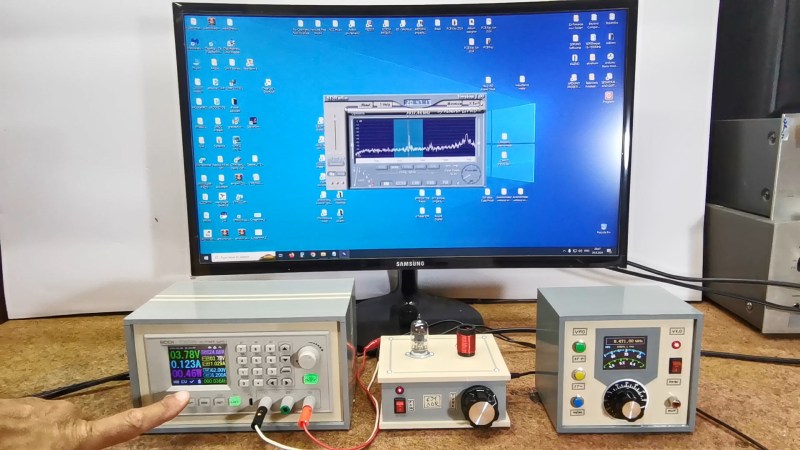
Software Defined Radio (SDR) is the big thing these days, and why not? A single computer can get rid of a room full of boat anchors, and give you better signal discrimination than all but the best kit. Any SDR project needs an RF receiver, and in this project [mircemk] used a single 6J1 vaccum tube to produce an SSB SDR that combines the best of old and new.
Single-tube radios are a classic hack, and where a lot of hams got started back in the day, but there is a reason more complicated circuits tend to be used. On the other hand, if you can throw a PC worth of signal processing at the output, it looks like you can get a very sensitive and selective single-sideband (SSB) receiver.
The 6J1 tube is convenient, since it can run on only 6 V (or down to 3.7 as [mircemk] demonstrates). Here it is used as a mixer, with the oscillator signal injected via the screen grid. Aside from that, the simple circuit consists of a receiving coil, a few resistors and a variable capacitor. How well does it work? Quite well, when paired with a PC; you can judge for yourself in the video embedded below.
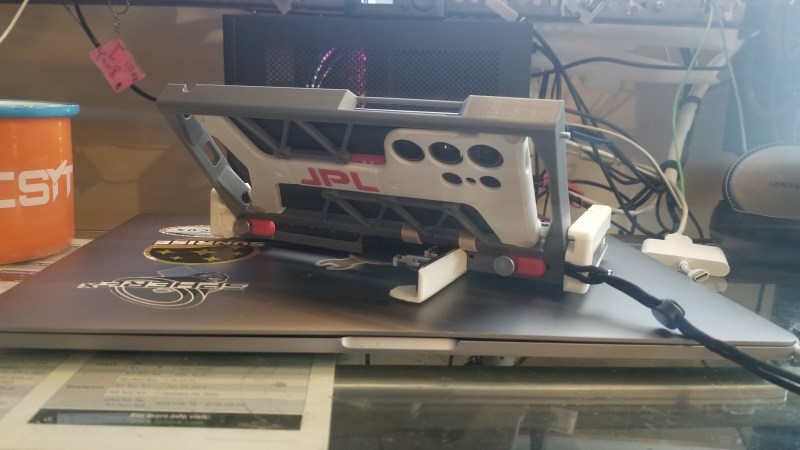
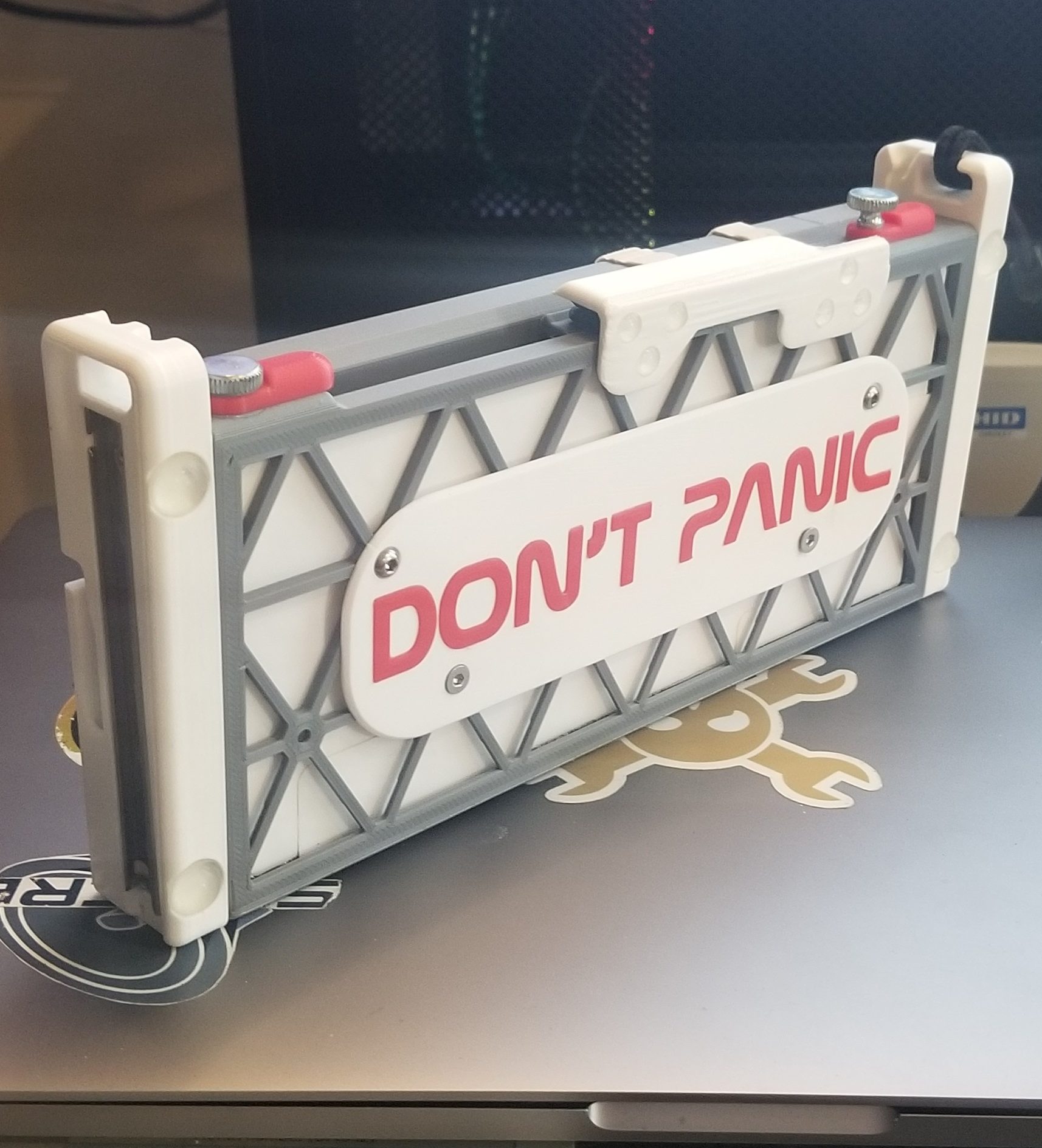
It’s been at least a few hours since Hackaday last featured a cyberdeck, so to avoid the specter of withdrawal, we present you with [Sp4m]’s SPACEdeck, a stylish phone-based cyberdeck!
The SPACEdeck takes a Samsung Galaxy S24 and puts it into a handsome clamshell case with a wireless keyboard, turning the phone into a tiny-screened laptop that urges you not to panic. Is The Hitchiker’s Guide to The Galaxy available on the Playstore? Well, the e-book of the novel surely is, and having access to Wikipedia comes close. The design is building off (or out from, as the case may be) a 3D-printed phone case for the S24 by Digital Proto.
Given that the Galaxy S24 has more horsepower than the ancient Macbook we’re writing this on, this setup is probably going to be more useful than you might think, especially when paired with Termux to give you the full power of Linux.
Like some modern laptops, the screen can rotate 180 degrees for when the keyboard isn’t needed. The case will also allow for Nintendo Switch2 joycon integration, but that’s a work in progress for now. The connection points will also be modular so other accessories can be used. All files will be released once [Sp4m] is happy with how the Joycons are holding on, hopefully with a license that will allow us to remix this for other phones.
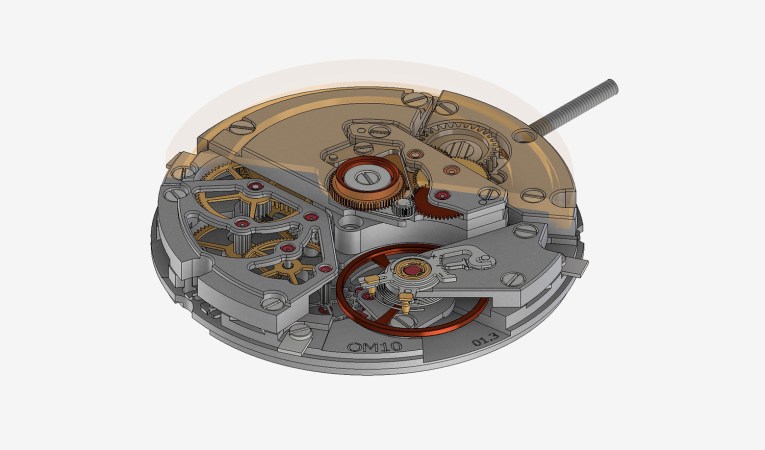
When you think of open-source hardware, you probably think of electronics and maker tools– RepRap, Arduino, Adafruit, et cetera. Yet open source is an ethos and license, and is in no way limited to electronics. The openmovement foundation is a case in point– a watch case, to be specific. The “movement” in Openmovement is a fully open-source and fully mechanical watch movement.
Openmovement has already released STEP files of OM10 the first movement developed by the group. (You do need to sign up to download, however.) They say the design is meant to be highly serviceable and modular, with a robust construction suited for schools and new watchmakers. The movement uses a “Swiss pallets escapement” that runs at 3.5 Hz / 25,200 vph. (We think that’s an odd translation of lever escapement, but if you’re a watchmaker let us know in the comments.) An OM20 is apparently in the works, as well, but it looks like only OM10 has been built from what we can see.
If you don’t have the equipment to finely machine brass from the STEP files, Openmovement is running a crowdfunding campaign to produce kits of the OM10, which you can still get in on until the seventh of June.