Dual Channel POV Display Also Has Nixie Tubes

What’s a tachyscope? According to [Daniel Ross], it is an animated display from an alternate timeline circa 1880. The real ones, of course, didn’t have LEDs and microcontrollers. The control unit looks like an old-timey radio, complete with Nixie tubes. The spinning part has blue and white LEDs, each accepting data from one of two serial ports. You can select to see data from one port, the other, or both. You can see the amazing contraption in the video below.

The LEDs are surface mounted and placed inside a glass test tube. Each display has its own processor. The project appears to have a PCB, but it is just a piece of fiberglass with a color print on top of it and holes drilled with a rotary tool. The board has no actual conductors — everything is point-to-point wiring. The base of the unit is old cookware. The slip ring is pretty interesting, too. It uses an old video tape head, D-cell batteries cut up, and contacts from a relay.

You might remember [Daniel] from his steampunk Victorian computer project, including a punk teletype and a magic eye tube. If you want some theory on these kinds of displays, we can help. If you just want a simple display, it doesn’t have to cost much.

Continue reading “Dual Channel POV Display Also Has Nixie Tubes”
Inside Digital Calipers

If you do any kind of machining, 3D printing, or PCB layout, you probably have at least considered buying a pair of calipers. Old-fashioned ones had a dial and were mechanical devices, but lately, digital ones have become quite affordable. We keep meaning to tear a set of ours apart to see what’s inside, but thanks to [learnelectronics], we don’t have to — the video below provides a fascinating look at what’s inside a cheap pair of Harbor Freight calipers.

Honestly, it doesn’t seem like it would be that hard to figure out how far down a bar you are. The trick is the caliper has to be super accurate. Oddly enough, the cheap calipers examined use capacitors as a sensing element.

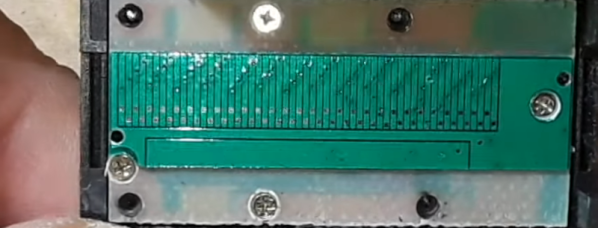
There is a long flexible PCB stuck to the sliding part with conductive pads. The display unit is also a printed circuit and manages the battery, the display, and the other half of the capacitive sensor. If you want a more detailed explanation of how the sensor actually works, check out capsense.com. If you note, the pattern on the sliding part has traces that look like a square wave, and half have a different phase than the other half. These are the sine plates and the cosine plates. A 100 kHz signal flows through the capacitor, and it is possible to read the direction of travel and the amount of travel easily.

The calipers are very accurate, but it’s possible to improve them. A more practical project is to make them communicate with the outside world.

Continue reading “Inside Digital Calipers”

In Praise Of RPN (with Python Or C)

HP calculators, slide rules, and Forth all have something in common: reverse polish notation or RPN. Admittedly, slide rules don’t really have RPN, but you work problems on them the same way you do with an RPN calculator. For whatever reason, RPN didn’t really succeed in the general marketplace, and you might wonder why it was ever a thing. The biggest reason is that RPN is very easy to implement compared to working through proper algebraic, or infix, notation. In addition, in the early years of computers and calculators, you didn’t have much to work with, and people were used to using slide rules, so having something that didn’t take a lot of code that matched how users worked anyway was a win-win.

What is RPN?

If you haven’t encountered RPN before, it is an easy way to express math without ambiguity. For example, what’s 5 + 3 * 6?  It’s 23 and not 48. By order of operations you know that you have to multiply before you add, even if you wrote down the multiplication second. You have to read through the whole equation before you can get started with math, and if you want to force the other result, you’ll need parentheses.

With RPN, there is no ambiguity depending on secret rules or parentheses, nor is there any reason to remember things unnecessarily. For instance, to calculate our example you have to read all the way through once to figure out that you have to multiply first, then you need to remember that is pending and add the 5. With RPN, you go left to right, and every time you see an operator, you act on it and move on. With RPN, you would write 3 6 * 5 +.

While HP calculators were the most common place to encounter RPN, it wasn’t the only place. Friden calculators had it, too. Some early computers and calculators supported it but didn’t name it. Some Soviet-era calculators used it, too, including the famous Elektronika B3-34, which was featured in a science fiction story in a Soviet magazine aimed at young people in 1985. The story set problems that had to be worked on the calculator.

Continue reading “In Praise Of RPN (with Python Or C)”

Fuel Cell Turns PET And Carbon Dioxide Into Useful Chemicals

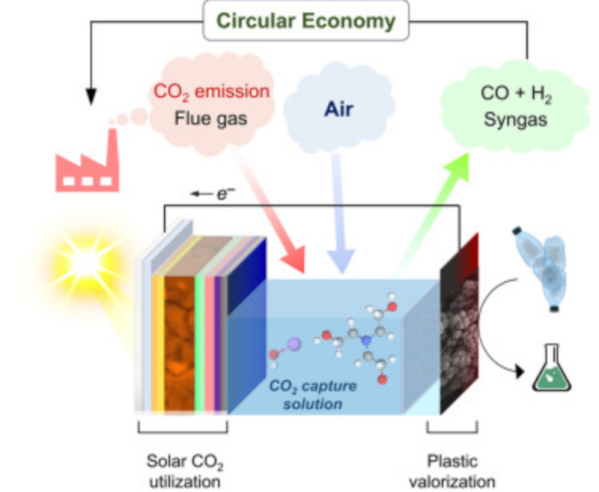
The University of Cambridge has a novel fuel cell design that can grab CO2 from the atmosphere or industrial processes and, combined with waste PET plastic, provides syngas and glycolic acid, a product used in some cosmetics. You can read about the device in a recent paper.

The strange juxtaposition of CO2 and PET is no accident. The processes work together with solar energy. There is no external voltage required, but the cell operates as a photocell to produce electricity from the solar energy. Removing both CO2 and waste plastic from the environment is a good thing.

Syngas is hydrogen and carbon monoxide and finds use in producing methanol and ammonia. It also will work as a fuel that can replace gasoline when gasoline isn’t available. It has a few other uses, like reducing iron ore to sponge iron and even converting methanol to gasoline.

The technology has a ways to go to operate at scale, and we doubt this will ever be a consumer item since you are unlikely to need syngas or glycolic acid in your home or vehicle. But it still is a promising technique to reduce both greenhouse gas and plastic waste in one swoop.

We’ve looked at other ways to grab carbon dioxide and make it useful. If you want to make your own syngas, there are other ways to do it.

Cosmic Ray Navigation

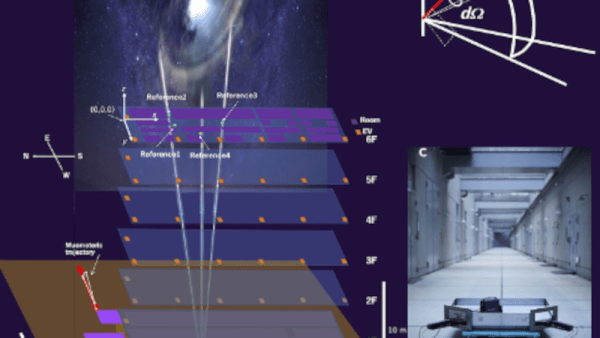
GPS is a handy modern gadget — until you go inside, underground, or underwater. Japanese researchers want to build a GPS-like system with a twist. It uses cosmic ray muons, which can easily penetrate buildings to create high-precision navigation systems. You can read about it in their recent paper. The technology goes by MUWNS or wireless muometric navigation system — quite a mouthful.

With GPS, satellites with well-known positions beam a signal that allows location determination. However, those signals are relatively weak radio waves. In this new technique, the reference points are also placed in well-understood positions, but instead of sending a signal, they detect cosmic rays and relay information about what it detects to receivers.

The receivers also pick up cosmic rays, and by determining the differences in detection, very precise navigation is possible. Like GPS, you need a well-synchronized clock and a way for the reference receivers to communicate with the receiver.

Muons penetrate deeper than other particles because of their greater mass. Cosmic rays form secondary muons in the atmosphere. About 10,000 muons reach every square meter of our planet at any minute. In reality, the cosmic ray impacts atoms in the atmosphere and creates pions which decay rapidly into muons. The muon lifetime is short, but time dilation means that a short life traveling at 99% of the speed of light seems much longer on Earth and this allows them to reach deep underground before they expire.

Detecting muons might not be as hard as you think. Even a Raspberry Pi can do it.

Behind The X86 Pipeline Curtain

We’ve often heard that modern x86 CPUs don’t really execute x86 instructions. Instead, they decode them into RISC instructions that are easier to schedule, pipeline, and execute. But we never really looked into that statement to see if it is true. [Fanael] did, though, and the results are very interesting.

The post starts with a very simple loop containing four instructions. In a typical RISC CPU — RISC-V — the same loop requires six instructions. However, a modern CPU is likely to do much more than just blindly convert one instruction set to another.

Continue reading “Behind The X86 Pipeline Curtain”

Better Antennas Via Annealing (Simulated)

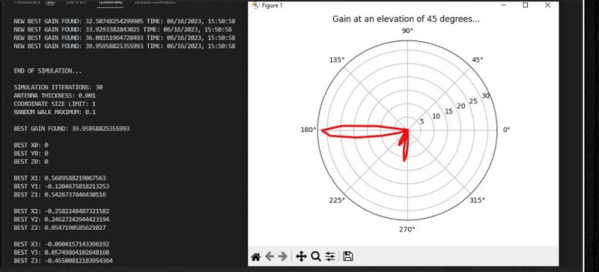
If you want to simulate a tic-tac-toe game, that’s easy. You can evaluate every possible move in a reasonable amount of time. Simulating antennas, however, is much harder. [Rosrislav] has been experimenting with using simulated annealing to iterate antenna designs, and he shares his progress in a recent blog post.

For many problems, it simply isn’t possible to try all possible inputs to determine what provides the “best” result. Instead of trying every single input or set of inputs, you can try random ones and discard all but the best guesses. Then you make small changes and try again. The only problem is that the algorithm may lock in on a “local maximum” — that is, a relatively high value that isn’t the highest because it forms a peak that isn’t the highest peak. Or, if you are looking for a minimum, you may lock on to a local minimum — same thing.

To combat that, simulated annealing works like annealing a metal. The simulation employs a temperature that cools over time. The higher the temperature, the more likely large changes to the input are to occur.

The Python program uses the PyNEC package to provide simulation. The program sets up random antenna lengths and finds the projected gain, attempting to optimize for maximum gain.

The post is long on code and short on details, so you will probably want to read the Python source to see exactly what it is doing. But it could probably serve as a template to do other simulated annealing simulations for other antennas or anything you had a simulation engine to evaluate.

Several techniques allow you to optimize things that are too hard to search exhaustively, and we’ve talked about simulated annealing and genetic algorithms before. However, lately, we’ve been more interested in annealing 3D prints.