Anodizing Titanium In Multiple Colors

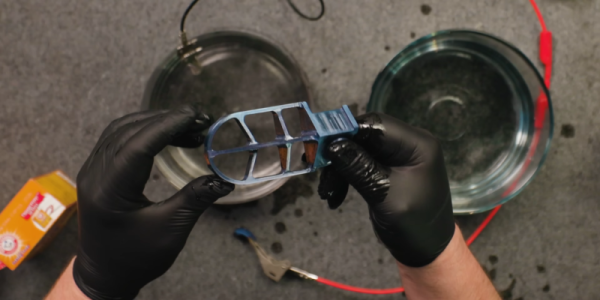
[Titans of CNC Machining] wanted to anodize some titanium parts. They weren’t looking for a way to make the part harder or less prone to corrosion. They just wanted some color. As you can see in the video below, the resulting setup is much simpler than you might think.

The first attempt, however, didn’t work out very well. The distilled water and baking soda was fine, as was the power supply made of many 9V batteries. But a copper wire contaminated the results. The lesson was that you need electrodes of the same material as your workpiece.

Continue reading “Anodizing Titanium In Multiple Colors”

Never Stare Down A Robot

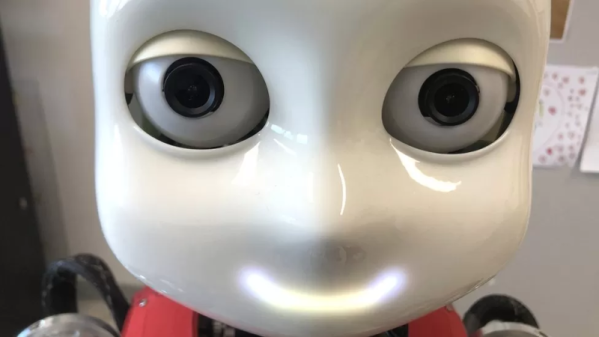
There are a few things historically difficult to make a robot do. Stairs, of course, are the obvious problem. But realistic blinking behavior is harder than you might think. At first, it might seem frivolous and simple to have a robot blink, but according to Italian scientists, it is both more important and more difficult than you probably think.

Blinking is a nonverbal cue when humans communicate. The post quotes a Finnish researcher:

While it is often assumed that blinking is just a reflexive physiological function associated with protective functions and ocular lubrication, it also serves an important role in reciprocal interaction.

Continue reading “Never Stare Down A Robot”

Your Childhood Inventions Brought To Life

If you are the kind of person who reads Hackaday, you probably spent time in school doodling little design day dreams. [Allen Pan] gets it, and he’s taken it upon himself to make some of those daydreams into reality. You can see how it worked out — or didn’t — in the video below.

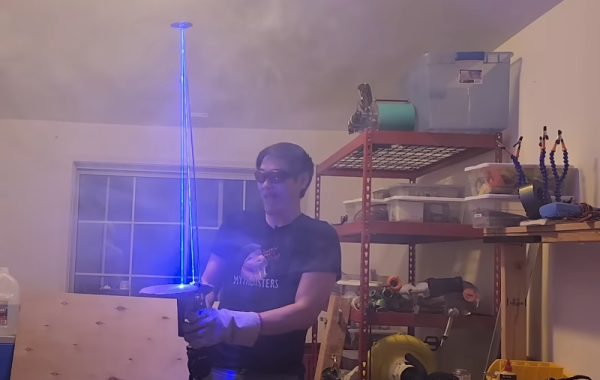
The video starts out with suction cup boots for walking on the ceiling, a laser sword made with a mirror, a plunger gun, and lawnmower boots. Some of these were more successful than others.

Continue reading “Your Childhood Inventions Brought To Life”

FNIRSI Vs Rigol: An Alternate View

We’ve heard of the FNIRSI 1014D scope, but we’ve had the impression that it might not be a great scope, although it is economical. [Learn Electronics Repair] had heard from another YouTuber that it was “a piece of junk.” However, he wanted to look at it compared to another inexpensive scope, the Rigol DS1052E. His results were different from what we usually hear. To be clear, he didn’t think it was a perfect scope, but he did find it very usable for his purpose.

The 46-minute-long video does more than just a casual look. He uses both scopes in some real-world measurements. If you are in the market for a scope in this price range, it is worth the time to watch.

Continue reading “FNIRSI Vs Rigol: An Alternate View”

Linux Fu: C On Jupyter

If you are a Pythonista or a data scientist, you’ve probably used Jupyter. If you haven’t, it is an interesting way to work with Python by placing it in a Markdown document in a web browser. Part spreadsheet, part web page, part Python program, you create notebooks that can contain data, programs, graphics, and widgets. You can run it locally and attach to it via a local port with a browser or, of course, run it in the cloud if you like. But you don’t have to use Python.

You can, however, use things with Jupyter other than Python with varying degrees of success. If you are brave enough, you can use C. And if you look at this list, you’ll see you can use things ranging from Javascript, APL, Fortran, Bash, Rust, Smalltalk, and even MicroPython.

Continue reading “Linux Fu: C On Jupyter”

OScope Advert From 1987 Rocks It

We can’t remember ever seeing a late-night TV ad for oscilloscopes before but, for some reason, Tektronix did produce a video ad in 1987. You can see it below and enjoy the glorious music and video production standards of the 1980s.

We assume this was made to show at some trade show or the like. Even if there was a Home Shopping Network in 1987, we doubt many of these would have been sold despite the assertion they were “low cost” — clearly a relative term in this case.

You’ve got to wonder if the narrator understood what he was saying or if he was just reading from a script. Pretty impressive either way. We loved these old scopes, although we also like having very capable scopes that don’t strain our backs to lift.

On the bright side, these scopes today are pretty affordable on the used market if you can find one that doesn’t need a repair with an exotic part. For example, we found several 2221s or 2221As for under $200 without looking hard. The shipping, of course, could potentially almost double the price.

While you can get a modern scope for $200, it probably isn’t the same quality as a Tektronix. Then again, the new scope won’t have CRTs and exotic Tektronix parts to wear out, either. Picking a scope is a pretty personal affair, though, so one person’s great scope might be another person’s piece of junk.

Continue reading “OScope Advert From 1987 Rocks It”

WordStar Reborn

Wordstar was the word processor that helped sell the personal computer. At one time, it was ubiquitous, and many authors had a hard time giving it up. Some, like George R. R. Martin, apparently are still refusing to give it up. But most of us have moved on. Thanks to an open-source clone, WordTsar, you may not have to. This is a modern interpretation of our old friend.

Programmers that write were especially fond of WordStar since it had a non-document mode and was often the best text editor you had available for writing code. Being able to do your documentation without switching brain gears is useful, too. Touch typists love the efficiency of easy control of things without resorting to cursor keys or a mouse — the same thing vi and emacs fans enjoy but in a different way.

The software runs on multiple platforms and has some new features. Installation on Linux is easy because it is packaged in an AppImage file. Of course, you can also fire up your best CP/M machine, replica, or emulation and run the real WordStar, but — honestly — WordTsar seems more practical if you wanted to go back to using this kind of wordprocessor or editor for everyday use.

Of course, some word processors were actual hardware. If you want some cheap CP/M hardware, that’s easy enough, too.