Citizen Science Finds Prehistoric Burial Mounds

What do you do when you have a lot of LiDAR data and not enough budget to slog through it? That’s the problem the Heritage Quest project was faced with — they had 600,000 LiDAR maps in the Netherlands and wanted to find burial mounds using the data. By harnessing 6,500 citizen scientists, they were able to analyze the data and locate over 1,000 prehistoric burial mounds, including many that were previously unknown, along with cart tracks, kilns, and other items of archaeological interest.

The project used Zooniverse, a site we’ve mentioned before, to help train volunteers to analyze data. The project had at least 15 volunteers examining each map. The sites date between 2,800 and 500 BC. Archaeologists spent the summer of 2021 verifying many of these digital finds. They took samples from 300 sites and determined that 80 of them were previously unknown. They estimate that the total number of sites found by the volunteers could be as high as 1,250.

This is a great example of how modern technology is changing many fields and the power of citizen science, both topics we always want to hear more about. We’ve seen NASA tapping citizen scientists, and we’ve even seen high school students building research buoys. So if you’ve ever wanted to participate in advancing the world’s scientific knowledge, there’s never been a better time to do it.
3D Printing Support Gets Down To Tacks

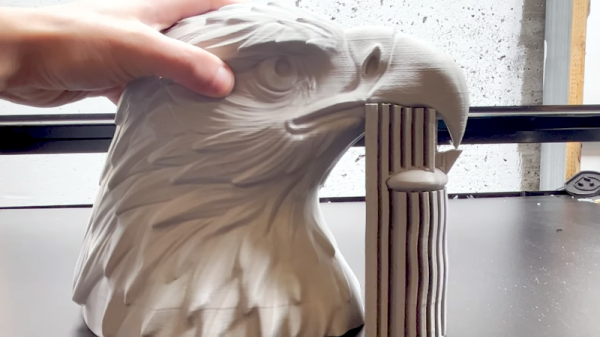
If you use supports for FDM 3D printing, you might find that some designs are more amenable than others to automatically-generated supports. [Slant 3D] , for example, shows a cool-looking eagle with a downward-curved beak that comes to a point. Using traditional supports would allow the print to succeed, but didn’t allow the beak to form correctly. To combat this, he uses something called a “thumbtack” in the design. There are several flavors, as you can see in the video below, and it widens out the small part yet has a tiny contact with the actual part so you can easily remove it.

One of the thumbtacks looks more like a Hersey’s kiss to us. It makes sense. The point can touch the part to support and the fat base gives a nice target for the automatic support feature in your slicer to grab. There’s also a spherical base so you can rotate to odd angles. The final thumbtack looks like an alien spacecraft and provides multiple contact points.

Continue reading “3D Printing Support Gets Down To Tacks”

Modernizing C Arrays For Greater Memory Safety

Lately, there has been a push for people to stop using programming languages that don’t promote memory safety. But as we still haven’t seen the death of some languages that were born in the early 1960s, we don’t think there will be much success in replacing the tremendous amount of software that uses said “unsafe” languages.

That doesn’t mean it’s a hopeless cause, though. [Kees Cook] recently posted how modern C99 compilers offer features to help create safer arrays, and he outlines how you can take advantage of these features. Turns out, it is generally easy to do, and if you get errors, they probably point out unexpected behavior in your original code, so that’s a plus.

We don’t think there’s anything wrong with C and C++ if you use them as you should. Electrical outlets are useful until you stick a fork in one. So don’t stick a fork in one. We really liked the recent headline we saw from [Sarah Butcher]: “If you can’t write safe C++ code, it’s because you can’t write C++.” [Cook’s] post makes a similar argument.  C has advanced quite a bit and the fact that 30-year-old code doesn’t use these new features isn’t a good excuse to give up on C.

Continue reading “Modernizing C Arrays For Greater Memory Safety”

Understanding AI Chat Bots With Stanford Online

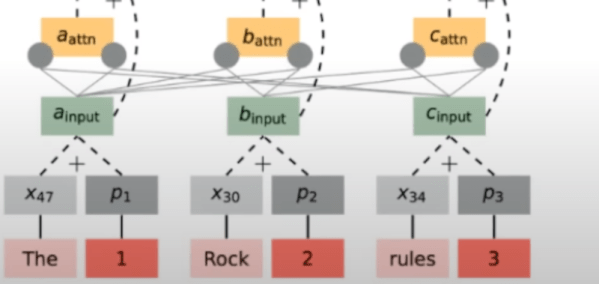
The news is full of speculation about chatbots like GPT-3, and even if you don’t care, you are probably the kind of person that people will ask about it. The problem is, the popular press has no idea what’s going on with these things. They aren’t sentient or alive, despite some claims to the contrary. So where do you go to learn what’s really going on? How about Stanford? Professor [Christopher Potts] knows a lot about how these things work and he shares some of it in a recent video you can watch below.

One of the interesting things is that he shows some questions that one chatbot will answer reasonably and another one will not. As a demo or a gimmick, that’s not a problem. But if you are using it as, say, your search engine, getting the wrong answer won’t amuse you. Sure, you can do a conventional search and find wrong things, but it will be embedded in a lot of context that might help you decide it is wrong and, hopefully, some other things that are not wrong. You have to decide.
Continue reading “Understanding AI Chat Bots With Stanford Online”

Linux Fu: The Shell Forth Programmers Will Love

One of the most powerful features of Unix and Linux is that using traditional command line tools, everything is a stream of bytes. Granted, modern software has blurred this a bit, but at the command line, everything is text with certain loose conventions about what separates fields and records. This lets you do things like take a directory listing, sort it, remove the duplicates, and compare it to another directory listing. But what if the shell understood more data types other than streams? You might argue it would make some things better and some things worse, but you don’t have to guess, you can install cosh, a shell that provides tools to produce and work with structured data types.

The system is written with Rust, so you will need Rust setup to compile it. For most distributions, that’s just a package install (rust-all in Ubuntu-like distros, for example). Once you have it running, you’ll have a few new things to learn compared to other shells you’ve used. Continue reading “Linux Fu: The Shell Forth Programmers Will Love”

Developing Warp Drive Might Take Antifreeze

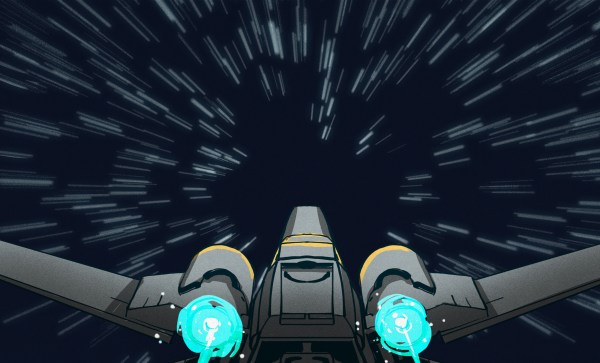
In Star Trek, dilithium crystals — whatever those are — are critical to the operation of a starship’s warp drives. But a Texas professor thinks he can make a baby step towards a warp drive using ethylene glycol, which is commonly found in antifreeze.

While superluminal travel has been regarded as impossible for many years, recent work has suggested ways we might be able to circumvent the light-speed barrier. Unfortunately, all of these mathematical theories require energy and types of matter that we don’t know how to create yet. But [Dr. Chance Glen] believes that by shaping the energy in a specific way through a dielectric, the math can work out so that there’s no exotic negative energy required.

The experiment involves shooting RF energy into an antifreeze container and using a laser interferometer to detect gravity waves.  Of course, that will involve some very sensitive measurements to account for other tiny perturbations that might give false readings. As we’ve seen in the past, that’s a task easier said than done.

Does this make sense? Beats us. Our physics and math are too out of date to make a good guess about how much of this is real and how much is hype. Of course, if he does detect gravity waves, that will get us as close to warp drive as the invention of the telegraph got us to cell phones. Then again, you have to start somewhere.

If you want to know more about the state of rocket engines, including the nascent possibility of warp drives, we’ve discussed that before. Incidentally, if you think the experiment sounds a bit like the the Laser Interferometer Gravitational-wave Observatory (LIGO), you aren’t wrong.

LED Displays May Get Vertical Integration

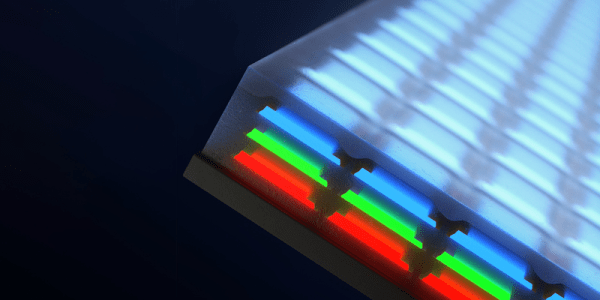
If you zoom into the screen you are reading this on, you’d see an extremely fine pattern of red, green, and blue emitters, probably LEDs of some kind. This somewhat limits the resolution you can obtain since you have to cram three LEDs into each screen pixel. Engineers at MIT, however, want to do it differently. By growing thin LED films and sandwiching them together, they can produce 4-micron-wide LEDs that produce the full range of color, with each color part of a vertical stack of LEDs.

To put things in perspective, a standard TV LED is at least 200 microns across. Mini LEDs measure upwards of 100 microns, and micro LEDs are the smallest of all. A key factor for displays is the pitch — the distance from the center of one pixel to the center of the next. For example, the 44mm version of the Apple Watch has a pitch of around 77 microns. A Samsung Galaxy 10 is just over 46 microns.  This is important because it sets the minimum size for a high-resolution screen, especially if you are building large screens (such as when you build custom video walls (see the video below for more about that).

Continue reading “LED Displays May Get Vertical Integration”