HP-41C, The Forth Edition

If you have an HP-41 — arguably the best calculator ever made, you might not have noticed that there’s a version of Forth for it. The code was written a while back in assembly and will work on anything that actually emulates the device properly, such as a SwissMicros DM41X. [Calculator Clique] shows you how it works in a recent video that you can watch below.

The original code dates back to 1984, but some recent detective work by [Angel Margin] has the code running again. If you know about synthetic programming on the 41C and the oddities of its internal architecture, you can’t help but be impressed.

Of course, Forth is meant to be easy to port over, but if you read about some of the architectural challenges, you start to realize this could be one of the more difficult implementations you’ve ever seen. Don’t forget you have what is, by today’s standards, an extremely limited amount of resources.

That being said, calling the HP41C a calculator is almost a crime. It is really a tiny computer hiding inside a calculator case. Then again, the best calculators always are.

We wonder if the code would run on an emulated 41C? Were you part of the TI calculator gang? No problem.

Continue reading “HP-41C, The Forth Edition”

Retrotechtacular: The Original Weather Channel

The Weather Channel has decided to pull the plug on its automated weather display, a favorite experience for weather geeks everywhere. However, it wasn’t the original weather nerd TV station.  Early cable TV networks had their own low-tech versions of this much longer ago than you might expect. For example, check out the video below which shows one of these weather stations back in 1975.

The audio was from a local FM station and you can enjoy handwritten public service announcements, as well.

Continue reading “Retrotechtacular: The Original Weather Channel”

Hydraulic Press Channel Puts Nuts To The Test

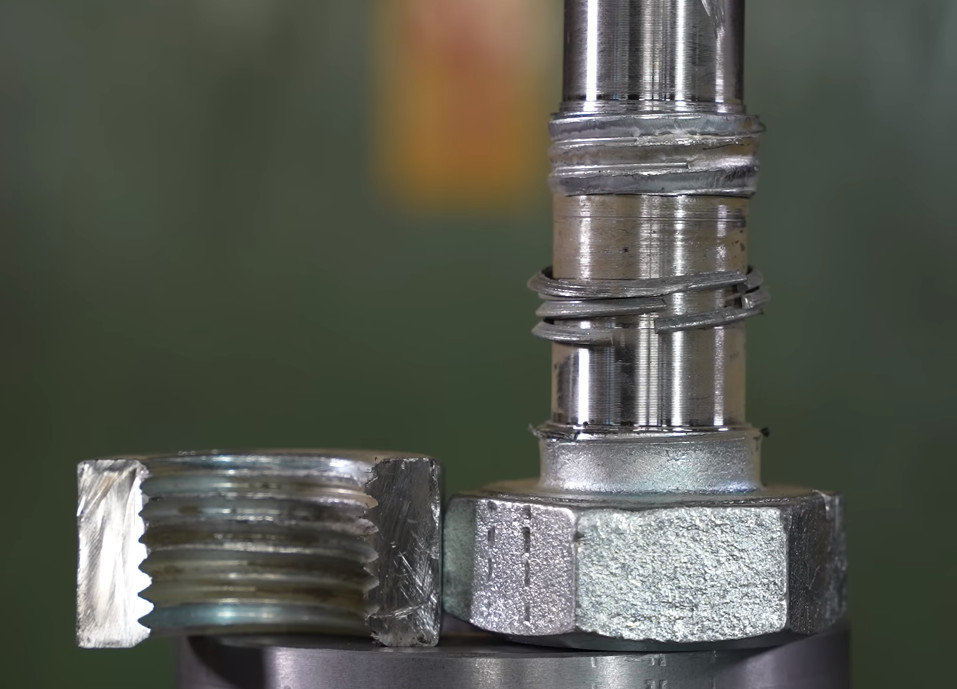
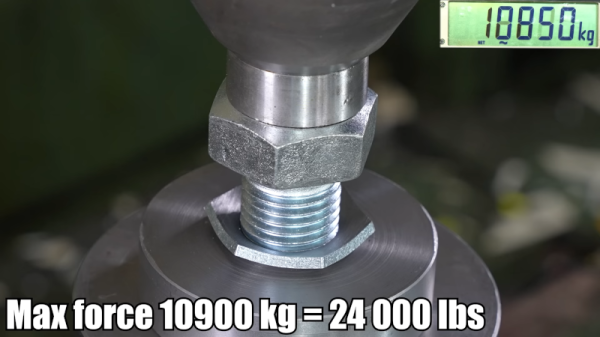
Have you ever wondered how many threads a nut needs to be secure? [Hydraulic Press Channel] decided to find out, using some large hardware and a hydraulic press. The method was simple. He took a standard nut and cut the center out of it to have nuts with fewer threads than the full nut. Then it was on to the hydraulic press.

As you might expect, a single-thread nut gave way pretty quickly at about 10,000 kg. Adding threads, of course, helps. No real surprise, but it is nice to see actual characterization with real numbers. It is also interesting to watch metal hardware bend like cardboard at these enormous pressures.

In the end, he removed threads from the bolts to get a better test and got some surprising results. Examining the failure modes is also interesting.

Honestly, we aren’t sure how valid some of the results were, but it was interesting watching the thread stripping and the catastrophic failures of the samples in the press. It seems like to do this right, you need to try a variety of assemblies and maybe even use different materials to see if all the data fit with the change in the number of threads. We expect the shape of the threads also makes a difference.

Still, an interesting video. We always enjoy seeing data generated to test theories and assumptions. We think of bolts and things as pretty simple, but there’s a surprising amount of technology that goes into their design and construction.

Continue reading Hydraulic Press Channel Puts Nuts To The Test”

If Only The Kids Knew About Pipes

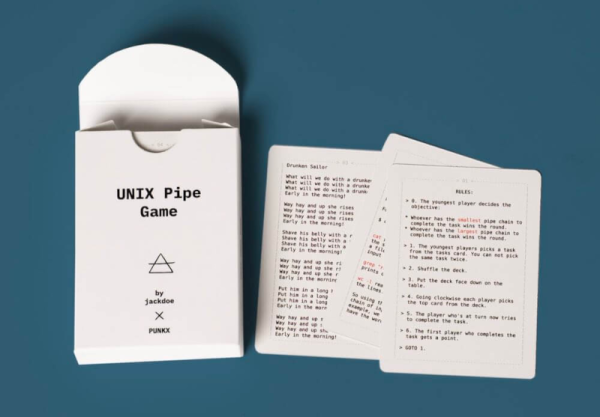
Being a parent is hard work. You need to prepare your child to operate in the world. Reading, writing, arithmetic, and how to make good choices are just the beginning. They also ought to know regular expressions and Unix pipes. [Jackdoe] can help with that last one, thanks to their Unix pipe card game.

As an example, the task “print the most common line from a file” would require the answer:

cat 03.txt | sort | uniq -c | sort -n | tail -1

You can vary the rules to declare whoever has the smallest pipe or the largest pipe that accomplishes the task as the winner. We’d add a house rule that whoever has the fastest pipe ought to get something. We don’t, however, think this card game will make the Vegas tables, unfortunately.

You can print your own card deck and even the box. Or you can buy a nice set, if you don’t want to spend the time. You should probably know about cat, grep, tail, head, wc, sort, and uniq along with their options.

If you want some other esoteric kids’ learning activities, they also have “Programming Time” which teaches algorithms and Python, and “4917” to teach the basics of machine code.

If you want help with the other key skill — regular expressions — check out regexp golf or crosswords.

Whip Up Some Homemade Artisanal Flux

You don’t think much about the power company until you flip the lights on and they don’t come on. The same can be said of soldering flux. You don’t think much about it, usually, until you try soldering without it. Flux has a cleaning action on metal surfaces that allows for a proper solder joint. The problem is, do you have any idea what’s in the flux you are using? We don’t either. [Catsndogs] has a recipe to make your own flux and then you’ll know.

At the heart of rosin flux is basically tree sap. If you live near pine trees, you can source it naturally. If not, you can find it at music instrument stores. Stringed instruments use rosin, so it is readily available. If you do source it yourself, [Catsndogs] reports that it doesn’t matter if it is old or clean.  You do want to pick out as much tree bark and dead ants as you can, though. You essentially dissolve it in alcohol (at least 80% isopropyl or ethanol). Then filter it through filter paper or a coffee filter.

You can adjust the viscosity by allowing the alcohol to evaporate to make the mixture thicker or by adding more alcohol to make it thinner. Thicker flux is good for tacking down SMD parts. As you might expect, this isn’t “no clean” flux. Also, the flux is very flammable, so be careful.

This isn’t the first time we’ve heard of this recipe. Or even the second time. But it is a good reminder that you can make your own free of whatever wacky chemicals are in the commercial preparations.

Art of 3D printer in the middle of printing a Hackaday Jolly Wrencher logo

3D Printering: Managing Multiple Printing Profiles

I know people who have 3D printers that are little more than appliances. They buy it, they print with it, and they don’t change much of anything. That doesn’t describe me and, I’m guessing, it doesn’t describe you either. This does lead to a problem, though, when it comes to slicers. You have to keep changing profiles and modifying them. It can be hard to keep things straight. For example, if you have profiles for different nozzles, you get to make a choice: keep one profile and edit the parts that change, or keep multiple profiles and any common changes have to be propagated to the other profiles.

Part of the reason I want to manage multiple profiles has to do with this mystery object…

I’ve long wanted to create a system that lets me have baseline profiles and then just use specific profiles that change a few items in the baseline. Turns out, I didn’t need to do it. Prusa Slicer and its fork, SuperSlicer, have the capability already. Both of these, of course, are based on Slic3r, but the scripting languages are different and what I’m doing does require G-code scripting. The problem is, this capability is not documented very well and the GUI doesn’t really support it directly, which requires a little sidestepping. I’ll show you how I have things set up and where the limitations are. If you want to try your hand at it, I highly suggest you backup your configuration directory or switch to a new one.

Continue reading “3D Printering: Managing Multiple Printing Profiles”

In Our Own Image: Do We Need Humanoid Robots?

Science fiction is full of things you don’t want to think too hard about. Why do starships with transporters have brigs with forcefields? Why not just beam a prisoner into an enclosed space?  Why do Cylons fly ships with human controls? Why not have a plug in their… well, you get the idea. For that matter, why do Cylons (and Kaylons, and Gort) even look human at all? Why aren’t some Cylons just ships?

Of course, the real reason is so we can identify with them and actors can play them with some cosplay gear and makeup. But real-life robots that are practical rarely look like humans at all.

No one is going to confuse a robot factory arm or a Roomba with a person, yet they are perfectly suited for their purpose. Yet we are fascinated with human-looking robots and continue to build them, like Nadia from IHMC Robotics in the video below. Continue reading “In Our Own Image: Do We Need Humanoid Robots?”