Air Football Looks Pro

If you are an American, you’d probably think of [Silas Hansen’s] project as “air soccer” but most people will prefer air football. Either way, it is like air hockey but more of a football field feel. The project looks great — if you saw this on the shelves of the local toy store, you wouldn’t think anything of it. You can see a video of the game in action, below.

Unsurprisingly, the brains of the game are an Arduino. The case looks good thanks to laser cutting and 3D printing. A Roland printer produced the stickers that really dress the case up, but you could find another artistic way to do the decoration.

Continue reading “Air Football Looks Pro”

3D Printing Concept Car (Parts)

When you want to fabricate something you either start with something and take away what you don’t want — subtractive manufacturing — or you start with nothing and add material, which is additive manufacturing that we usually call 3D printing. Popular Science recently took a look inside Vital Auto, the British lab that uses 3D printing for high-end concept cars from companies like Rolls-Royce, McLauren, Jaguar, and others. In the video below, [Anthony Barnicott], an engineer for Vital, says that the two technologies — additive and subtractive — work best when used together.

As you might expect, they are not using a $200 FDM printer. They have three Formlabs 3Ls that print with resin and five Formlab Fuse 1 selective laser sintering printers. While metal printers are still uncommon in hacker’s workshops, resin printers are now very affordable although your garage printer is probably a good bit smaller than the 3L’s 335x200x300 mm volume. For comparison, an LCD-based AnyCubic Photon X provides just 165x132x80 mm. Of course, you’re looking at about $11,000 for the dual-laser 3L versus about $240 for the Photon.

Vital started building the EP9 electric car concept for NIO, an electric car maker in China. You can imagine that modern manufacturing machines make it possible to create more sophisticated concept cars faster. How many times do you want to tweak a part that takes a machinist eight hours to produce? But if you can just let a machine run overnight and get the result in the morning, you are more likely to change and refine the part.

Vital Auto is an interesting look at how professional fabrication shops are using the same technologies we do, at least at the core. We’ve noted before how these same technologies are making homebrew projects look better than some commercial products not long ago. You can print big things if you break them up, of course. Or, break the bank and buy a really big printer.

Continue reading “3D Printing Concept Car (Parts)”

[Ken Shirriff] Takes A Bite Of The Apple-I

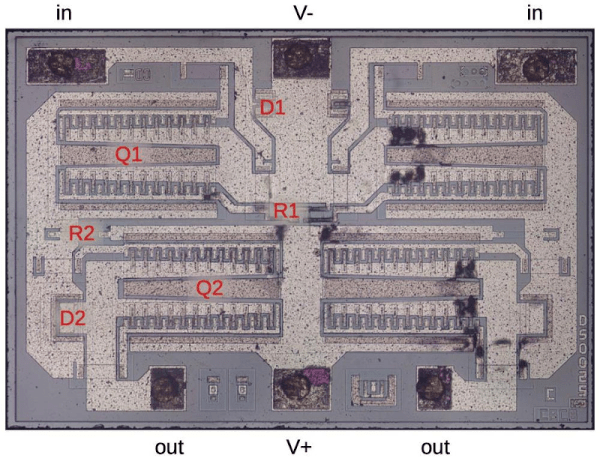
The Apple-I was a far cry from Apple’s later products. A $666 single-board computer, the product had some unique design features including using a shift register for video memory to save money. The shift registers of the day required high-current clock pulses that ranged from -11 to 5V and there was a DS0025 clock driver chip to handle the job. [Ken Shirriff] takes the unusual chip apart for us in a recent blog post.

The use of a shift register as memory isn’t a new idea. Really old computers like EDSAC used mercury delay lines as memory which was essentially a physical shift register. In those cases, the ALU and other processing only had to deal with a bit at a time, further simplifying things. For the Apple, there were seven shift registers to store 6-bits of display data and a cursor position. The 6 bits of character data drove — indirectly — a character generator ROM to convert the data into dots for the display.

Driving all those shift register flip flops requires a lot of clock current, so the DS0025 uses an unusual transistor design. There are 24 separate emitters in two groups. It acts like a large transistor, but you could also consider it as two 12-emitter transistors or 24 separate transistors in parallel. The metal wiring, interestingly enough, tapers because at the start of the conductor, the current for all 12 sub-transistors flows, but by the end, it is only the current for the last sub-transistor, so the conductor doesn’t have to be as wide. In addition, the two transistors have to have matched resistance which requires careful design so the transistors turn on at the same time.

The final result is an inverter that can provide 1.5 amps. This current helps overcome the relatively large capacitance in the shift register’s clock line. The clock rate was 1 MHz and the load capacitance was about 150 picofarads.

We enjoy [Ken’s] posts ranging from mysteries to space hardware. It is always interesting to see what is inside these devices or, at least, what was in the old devices we’ve all seen.

Wireshark HTTPS Decryption

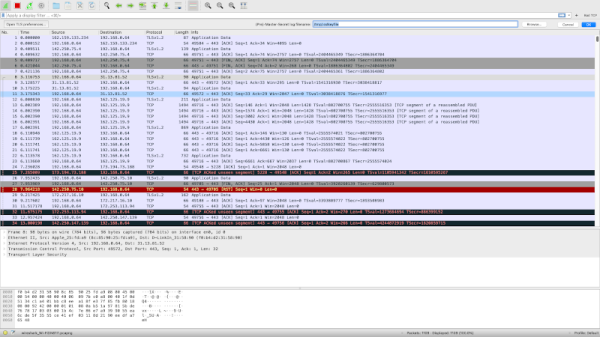
If you’ve done any network programming or hacking, you’ve probably used Wireshark. If you haven’t, then you certainly should. Wireshark lets you capture and analyze data flowing over a network — think of it as an oscilloscope for network traffic. However, by design, HTTPS traffic doesn’t give up its contents. Sure, you can see the packets, but you can’t read them — that’s one of the purposes of HTTPS is to prevent people snooping on your traffic from reading your data. But what if you are debugging your own code? You know what is supposed to be in the packet, but things aren’t working for some reason. Can you decrypt your own HTTPS traffic? The answer is yes and [rl1987] shows you how.

Don’t worry, though. This doesn’t let you snoop on anyone’s information. You need to share a key between the target browser or application and Wireshark. The method depends on the target applications like a browser writing out information about its keys. Chrome, Firefox, and other software that uses NSS/OpenSSL libraries will recognize an SSLKEYLOGFILE environment variable that will cause them to produce the correct output to a file you specify.

How you set this depends on your operating system, and that’s the bulk of the post is describing how to get the environment variable set on different operating systems. Wireshark understands the file created, so if you point it to the same file you are in business.

Of course, this also lets you creep on data the browser and plugins are sending which could be a good thing if you want to know what Google, Apple, or whoever is sending back to their home base using encrypted traffic.

Wireshark and helpers can do lots of things, even Bluetooth. If you just need to replay network data and not necessarily analyze it, you can do that, too.


Hacked GDB Dashboard Puts It All On Display

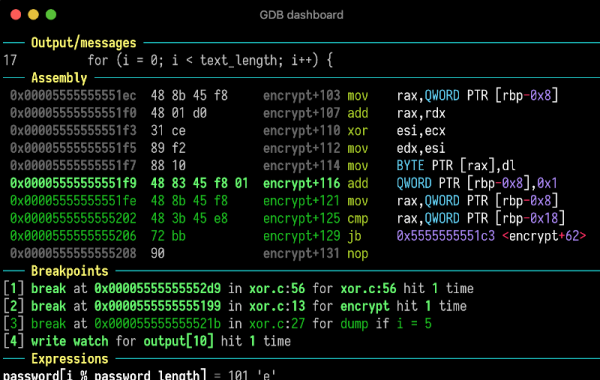
Not everyone is a fan of GUI interfaces. But some tasks really lend themselves to something over a bare command line. Very few people enjoy old command line text editors like edlin or ed. Debugging is another task where showing source files and variables at all times makes sense. Of course, you don’t absolutely have to have a GUI per se. You can also use a Text User Interface (TUI). In fact, you can build gdb — the GNU Debugger — with a built-in TUI mode. Try adding –tui to your gdb command line and see what happens. There are also many GUI frontends for gdb, but [cyrus-and] has an easy way to get a very useful TUI-like interface to gdb that doesn’t require rebuilding gdb or even hacking its internals in any way.

The secret? The gdb program runs a .gdbinit file on startup. By using Python and some gdb commands, [cyrus-and] causes the debugger to have a nice dashboard interface for your debugging sessions. If you install a helper script, you can even get syntax highlighting.

The system uses modules and you can even add your own custom modules and commands, if you like. You can also control what modules appear on each dashboard display. Normally, the dashboard shows when the program stops. For example, on each breakpoint. However, gdb has a hook system that allows you to trigger a dashboard using the appropriately-named dashboard command on other commands, too. Using the layout option to the dashboard command, you can even trigger different modules at different times.

Installation is simple. Just put the .gdbinit file in your home directory. If you want syntax highlights, you need to install Pygments, too. We understand you can even use his under Windows, if you like.

We don’t always take full advantage, but gdb is actually amazing. The flexible architecture makes all sorts of interesting things possible.

IR Remote Transforms To RF

Most consumer remote controls operate using infrared light. This works well assuming the piece of equipment has a line of sight to the remote. But if you have, say a receiver in a cabinet or closet, the IR remote signal can’t reach the sensor. Some equipment has remote receivers that you can leave poking out, but it is still not very handy. That’s why some equipment now uses RF remotes. [Xtropie] used a pair of inexpensive 433 MHz RF modules to convert an IR system to RF. You can see a short video about the project below.

We might have been tempted to simply put an IR LED on the receiver so it could feed IR into the device sensor, but [Xtropie] took a different approach. He found the IR sensor and tied the RF receiver directly into its output. It seems to work, but we probably would have removed the IR sensor to make sure there were no conflicts.

Continue reading “IR Remote Transforms To RF”

Your Vacuum Cleaner Follows You

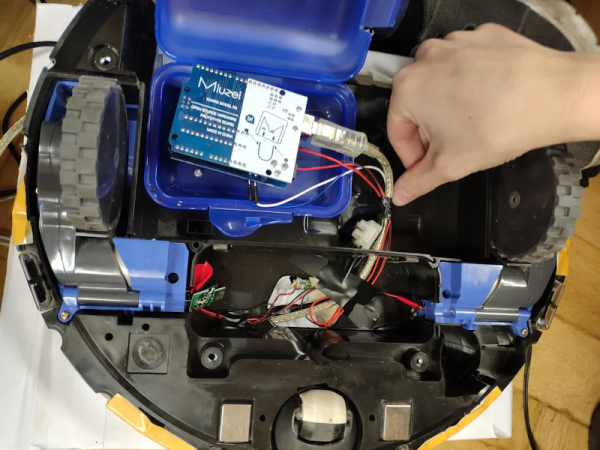
There are several projects you can imagine where it would be useful to have a robot follow you. For example, we’ve always wanted luggage that would trail us at the airport and we’ve seen several coolers that will follow you. [Madmax95] apparently dream of having a medical cart following a patient, though, and that’s good too. But how do you do it? [Max’s] method was to strip down a Roomba and build a work table and electronics on it. An Arduino controls the motor and communicates with a PC. The PC reads video from a Kinect camera on the robot and uses special tracking software to follow the patient.

We could easily imagine all of this project except the tracking. That depended on a service called Nuitrack. There is a free version that only works for 3 minutes, but it costs if you want to use it practically. However, it would still be cheaper than rolling your own if your time has value.

Continue reading “Your Vacuum Cleaner Follows You”