6502 Goes FPGA (Again)

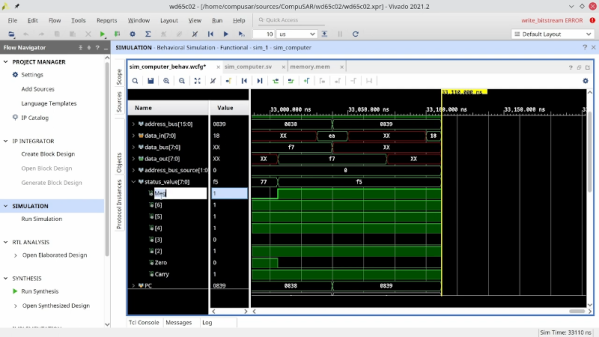
While there has been no shortage of FPGA-based recreations of classic processors, we always enjoy seeing a new approach. Last month [Some Assembly Required] took on the challenge to recreate a classic computer from the ground up and started with a 6502 implementation in Verilog. You can see in the second video below that he’s made good progress and there are apparently more videos to come.

The ROL instruction is the subject of the second video. We liked the approach of looking at what the instruction does and how many cycles it takes on different variants It is always good to make sure you know exactly what you are trying to accomplish before you get started.

Continue reading “6502 Goes FPGA (Again)”

DIY High Flow 3D Printing

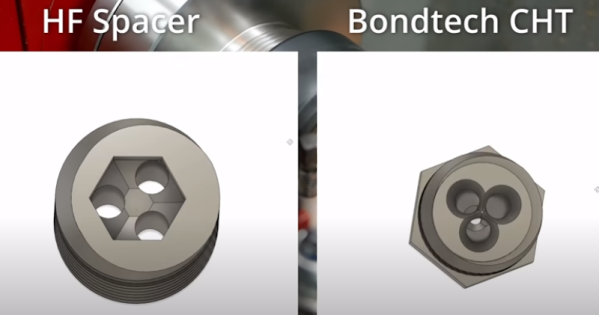
Sometimes we’re impressed by the sheer audacity of a project. [Stefan] rarely disappoints in that area, and his latest video shows him making an adapter to convert a normal 3D printed nozzle into a high-flow nozzle, similar to one you’d find on a Volcano. We say similar because [Stefan] took the trouble to drill three holes in the adapter to increase the melting surface area. The audacious part is that he doesn’t really have the machine shop to drill three tiny precision holes in close proximity — and he shows us the pictures to prove that he didn’t get it right the first (or fifth) time. But he did stick with it and got good results.

Why do such a thing? He wanted to mount the high-efficiency nozzles he’s been experimenting with on the Volcano extruder. The commercial one, in particular, doesn’t come in the extended size. To simplify things, he started with a long brass insert. The conical hex cut offers a natural center point if you are satisfied with a single hole through the center of the adapter. The hex cutout allows you to use a key to install or remove the spacer easily.

The idea behind the longer nozzles is that the filament has more time at temperature and can therefore move faster and still melt. The additional surface area should help, too. Of course, [Stefan] does plenty of testing and you can see the results in the video. A Volcano nozzle started misbehaving around 25 mm/s but at 30 mm/s, things started going bad. The CHT nozzle on the homemade standard spacer stayed working up to 30 mm/s and even at 60 mm/s was doing better than the standard nozzle at 45 mm/s. Sadly, the multiple holes in the special adapter caused worse extrusion performance, presumably by increasing pressure in the extrusion system. However, it did work well in real-life printing. Since the single bore adapter and the CHT nozzle worked great we don’t think it would be worth making the more complex one, as impressive a feat as that was.

[Stefan] thinks a lot about nozzles. He worries about wear, of course. He also built his own version of the high-flow nozzle.

Continue reading “DIY High Flow 3D Printing”

3D Printing Gets Tiny

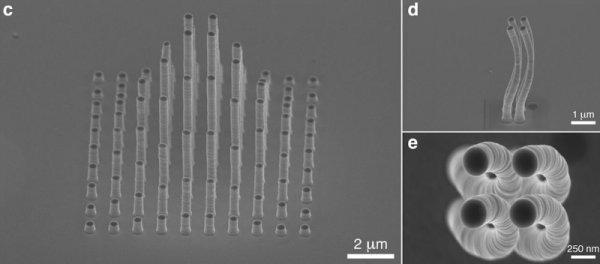
Using a process akin to electroplating, researchers at the University of Oldenburg have 3D printed structures at the 25 nanometer scale. A human hair, of course, is thousands of time thicker than that. The working medium was a copper salt and a very tiny nozzle. How tiny? As small as 1.6 nanometers. That’s big enough for two copper ions at once.

Tiny nozzles are prone to every 3D printer’s bane: clogged nozzles. To mitigate this, the team built a closed-loop control that measured electrical current between the work area and inside the nozzle. You can read the full paper online.

Continue reading “3D Printing Gets Tiny”

Hacking Film Processing With Coffee

Years ago, doing your own darkroom work was the only way to really control what your pictures looked like. In those days, coffee was what kept you going while you mixed another batch of noxious chemicals in the dark and fumbled to load a tank reel by feel. But did you know that you can process black and white film with coffee? Not just coffee, of course. [Andrew Shepherd] takes us through the process using what is coyly known as Caffenol-C.

Apparently, the process is not original, but if you’ve ever wanted to do some film developing and don’t want exotic and dangerous chemicals, it might be just the ticket. The ingredients are simple: instant coffee, washing soda, water and –optionally — vitamin C powder. If nothing else, all of this is safe to pour down your drain, something you probably aren’t supposed to do with conventional developers that contain things like formaldehyde and methyl chloroform.

Continue reading “Hacking Film Processing With Coffee”

Tiny 3D Printed Magnets Show Patterns

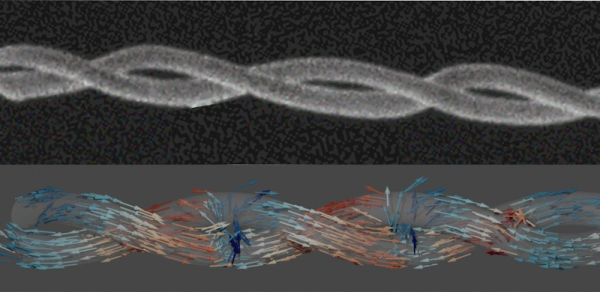
You normally associate a double helix with DNA, but an international team headquartered at Cambridge University used 3D printing to create magnetic double helixes that are about a 1,000 times smaller than a human hair. Why do such a thing? We aren’t sure why they started, but they were able to find nanoscale topological features in the magnetic field and they think it will change how magnetic devices work in the future — especially magnetic storage devices.

In particular, researchers feel this is a step towards practical “racetrack” memory that stores magnetic information in three dimensions instead of two and offer high density and RAM-like access times. You can read the full paper if you want the gory details.

Continue reading “Tiny 3D Printed Magnets Show Patterns”

Lisp In 436 Bytes

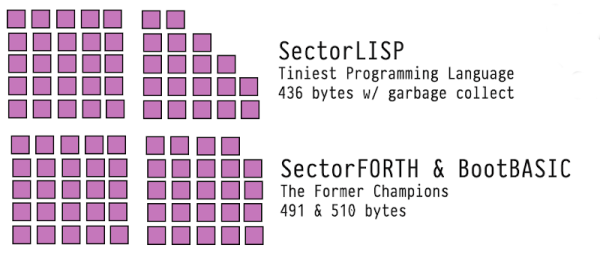
You would assume that any programming language available back in the 1960s would be small enough to easily implement on today’s computers. That’s not always true though, since old languages sometimes used multiple passes. But in some cases, you can implement what would have been a full language decades ago in a tiny footprint. A case in point is a pretty good implementation of Lisp — including garbage collection — in 436 bytes.

SectorLISP claims to be the tiniest real language, beaten only by toy languages that are not really very useful. If you want to, you can try it in your browser, but that version has better error messages and persistent bindings, so it hogs up a whole 509 bytes.

Continue reading “Lisp In 436 Bytes”

OpenCV Knows Where Your Hand Is

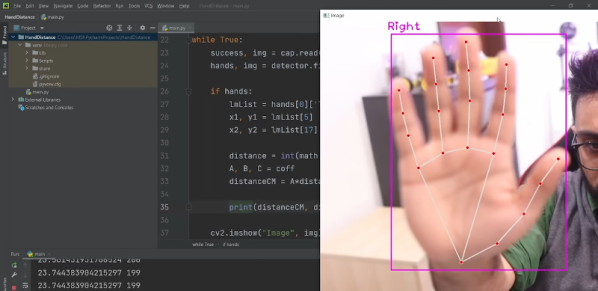
We have to say, [Murtaza]’s example game in his latest video isn’t very exciting. However, the OpenCV technique he uses to track a hand and determine its distance from a single camera is pretty interesting. The demo shows a random button on the screen and you have to use your hand to press the button which then moves so you can try again. The hand measurement seems accurate to a few centimeters which is good enough for many applications.

The Python code is actually quite straightforward. Essentially, the software tracks your hand and by estimating its relative size to determine how far away it is. Of course, your hand might also rotate, and [Murtaza] works through all the cases step-by-step. If we wanted to know a distance, we’d probably turn to ultrasonics or a time of flight sensor. The problem is, those sensors can’t tell your hand from anything else that happens to be in front of it. The use of a single camera to track and locate is pretty impressive.

If you haven’t used OpenCV before, the channel has a lot of tutorials and they are all worth watching. Computer vision is a great technique and can replace a lot of things in some applications. GPS, for example. Or, try this creepier tracking application next Halloween.

Continue reading “OpenCV Knows Where Your Hand Is”