Magnetic Experiments Shows Gradients

You’ve probably heard the term magnetic gradient before, but have you ever seen one? Now you can in [supermagnetman’s] video, below. The key is to use very fine (2 micron) iron filings and special silicone oil. The video is a good mix of whiteboard lectures and practical hands-on experimenting. Just watching him spin the iron filings in the bottle was entertaining. There’s sources in the video description for the oil and the filings if you want to replicate the demonstrations for a classroom or just for your own enjoyment.

It’s one thing to know the math behind magnetic fields. It’s another to be able to use them in practical applications. But a good understanding of the physical manifestation of the magnetic field coupled can help clarify the math and vice versa. There’s a lot of common sense explanations too. For example, the way the filings accelerate as they get closer to the magnet explains why the patterns form the way they do. Iron filings are a traditional way to “see” magnetic fields. Ask anyone who ever had a Wooly Willy.

Iron filings can be fun to play with, although we don’t think we’ve ever had any this fine. If you prefer your magnetic field visualizations to be higher-tech, we have the answer.
Continue reading “Magnetic Experiments Shows Gradients”

Arduino Becomes Superhet With A Little Help From Friends

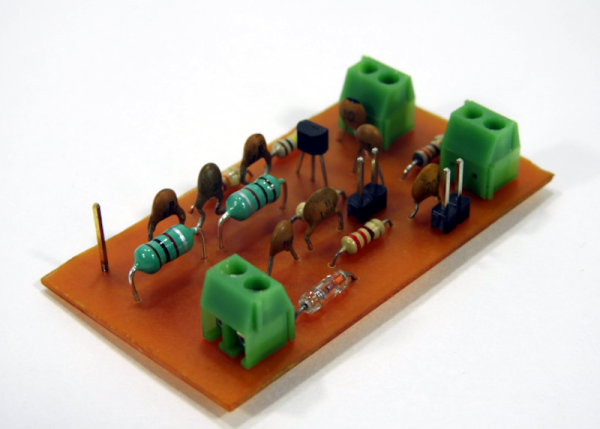
A radio receiver is always a fun project. [Jayakody2000lk] decided that his new superheterodyne design would use an Arduino and it looks like it came out very nicely. The system has four boards. An off-the-shelf Arduino, a Si5351 clock generator board (also off-the-shelf), and two custom boards that contain the IF amplifier and mixer.

The receiver started out in 2015 without the Arduino, and there’s a link in the post to that original design. Using the Si5351 and the Arduino replaces the original local oscillator and there have been other improvements, as well. You can see a video about the receiver below.

Tuning is by a rotary encoder and the current software lets you tune from about 4.75 MHz to a little over 15.8 MHz. Of course, you could change to any frequency the Si5351 can handle as long as the mixer and other components can handle it. The IF frequency is the usual 455 kHz.

If you decide to build this yourself, the design files are on GitHub. Overall a very nice and neat design. We are always amazed how little radio architecture has changed since Edwin Armstrong’s day. Of course, we have better components, even if they aren’t meant for radio purposes.

Continue reading “Arduino Becomes Superhet With A Little Help From Friends”

Axial Flux Motors For Electric Vehicles

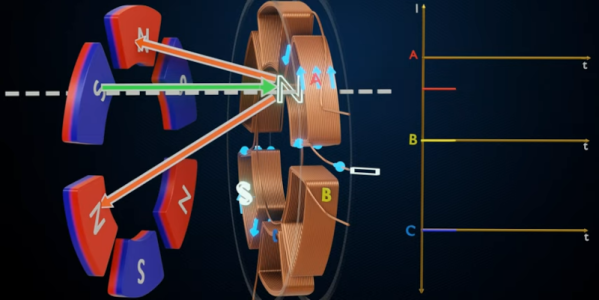
In the everything old is new again folder, [Lesics] has a good overview of axial flux motors. These are promising for electric vehicles, especially aircraft, since the motors should have high torque to weight ratio. The reason this is actually something old is that the early generators built by Faraday were actually of the axial flux type. Soon, though, radial flux generators and motors became the norm.

The simple explanation is that in a radial system, the magnetic flux lines are perpendicular to the axis of rotation. In the axial system, the flux lines are parallel to the axis of rotation. There’s more to it than just that of course, and the video below has nice animations showing how it all works.

While these are not very common, they do exist even today. The Lynch motor, for example, is a type of axial flux motor that dates back to 1979. Usually, the impetus for using an axial flux motor is the ease of construction, but with the right design, they can be quite efficient (up to 96% according to the video).

We’ve seen plenty of PCB motors and most of those are axial in design. Not all of them, though.

Continue reading “Axial Flux Motors For Electric Vehicles”

Dial A For Arduino

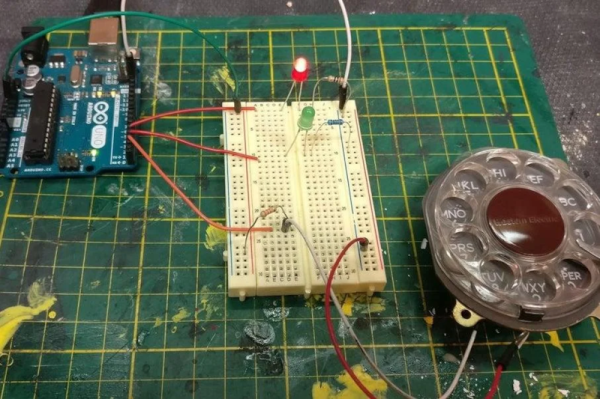
A lot of phrases surrounding phones don’t make sense anymore. With a modern cellphone, you don’t really “hang up” and there’s certainly no “dial” to be had. However, with [jakeofalltrades’] project, you can read an old-fashioned phone dial using an Arduino.

The idea behind a phone dial is actually pretty simple. When you pull the dial back to the stop using one of the numbered holes and release it, it causes a switch to open and close the same number of times as the hole you selected. That is, if you pull back the 5 hole, you should get 5 switch closures. The duration of each switch event and the time between switch events is a function of the speed the dial moves because of its internal spring. The zero hole actually produces ten pulses.

There are standards for how precise the timing has to be, but — honestly — it’s pretty loose since these were not made to be read by precise microcontroller timers. In the United States, for example, the dial was supposed to produce between 9.5 and 10.5 pulses per second, but the equipment on the other end would tolerate anything from 8 to 11.

Even if you don’t want a rotary dial in your next project, the code has some good examples of using ATmega328 timers that you might find useful in another context. However, a dial would add a nice retro touch to any numeric input you might happen to need.

If you need project inspiration, how about a volume control? Or, why not a numeric keypad?

When Benchies Fly

Most of us have printed a few benchies to test our 3D printers. The intrepid little boat has a variety of features that tax different parts of the printing process. However, the guys at [FliteTest] had a different idea. They set out in a competition to build a giant flying benchie. They aren’t quite done, but they did make some interesting progress, as you can see in the video below.

In all fairness, the benchies are not, themselves, 3D printed. Foamboard, however, is a bit more practical.  Inevitably, you can’t help but think of a flying boat when you see the results.

Continue reading “When Benchies Fly”

Python Provides Classic Basic

Back in the late 1970s and early 1980s when you turned on a PC, more often than not, you’d get a Basic prompt. Most people would then load a game from a tape, but if you were inclined to program you could just start writing. [Richpl] wanted that same experience and thus PyBasic was born. Along with some other Github contributors, the system has grown quite a bit and would be a good start at porting classic games or creating a replica vintage computer.

The interpreter lacks specialized hardware-specific features such as sound and graphics, of course, but then again, you could add them. It does have file I/O and also includes some interesting features like an analog of C’s ternary operator.

Continue reading “Python Provides Classic Basic”

Halloween Build: Exquisite Ray Gun Has Sound Effects

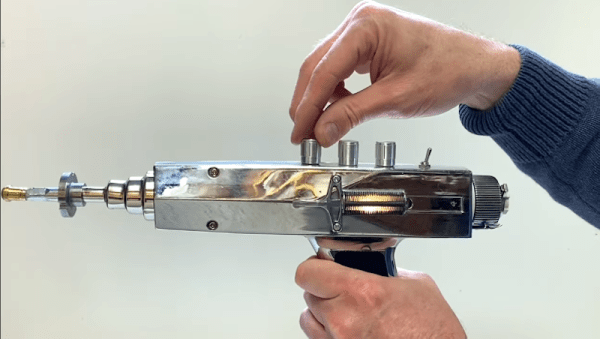
When we first saw [lonesoulsurfer’s] ray gun, we thought it looked oddly familiar. Sure, it looks like a vintage ray gun you might see in a dozen 1950-era movies or TV shows. But still, there was something oddly familiar about it. Turns out, the core piece of it is an old-fashioned timing light used when doing a car tune-up.

This is no unobtrusive Star Trek phaser. It looks substantial and has a cool sound generator that not only gives it something to do but also sports cool control knobs out the top of the gun. The design files for the sound circuit are in a Google drive folder if you want to recreate the build.

Continue reading “Halloween Build: Exquisite Ray Gun Has Sound Effects”