Gladys West Modelled The Earth So That We Can Have GPS

The name Gladys West is probably unfamiliar, but she was part of creating something you probably use often enough: GPS. You wouldn’t think a child who grew up on a sharecropping farm would wind up as an influential mathematician, but perhaps watching her father work very hard for very little and her mother working for a tobacco company made her realize that she wanted more for herself. Early on, she decided that education was the way out. She made it all the way to the Naval Surface Warfare Center.

While she was there she changed the world with — no kidding — mathematics. While she didn’t single-handedly invent satellite navigation, her work was critical to the systems we take for granted today.

Continue reading “Gladys West Modelled The Earth So That We Can Have GPS”
Levitation By Sound

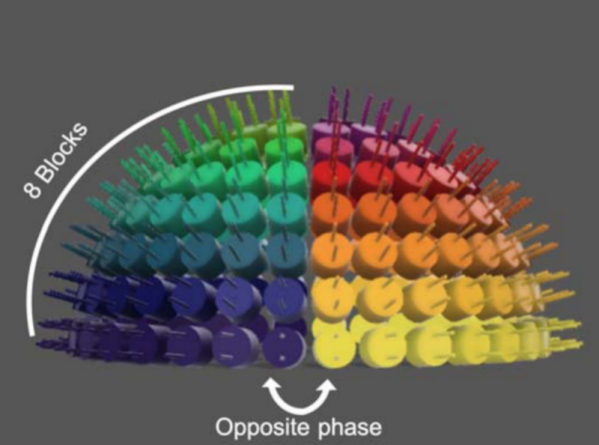
Levitating things with magnets is no great feat these days. We don’t see as many projects with sonic levitation. However, Japanese engineers have a new method to lift objects using sound. The process isn’t totally reliable yet, but it may lead to better methods in the future. You can see a video about the work below.

Manipulating very small items via laser or acoustics isn’t new. However, there are significant limitations to current methods. This new approach uses an array of hemispherical ultrasound transducers. By controlling the amplitude and phase of each transducer, an acoustic trap forms and can pick up a 3 mm polystyrene ball without direct contact.

Manipulating objects without contact interests us for a few reasons, not the least of which is circuit assembly. Robust technology of this type could also add new dimensions to additive manufacturing. Of course, it is a long way from a 3 mm polystyrene ball to a surface mount component. However, you have to admit watching components just float through the air to their final resting places would be something to see.

Not that we haven’t seen sonic levitation before. Magnetic levitation tends to be easier, but also has some limitations.

Continue reading “Levitation By Sound”

Hacking A PIC To Redefine A Microphone’s Transmit Frequency

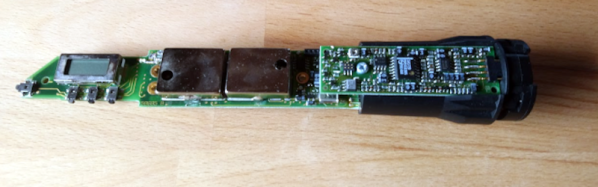
Software defined radio and widespread software-controlled PLL synthesis for RF has been a game changer. Things like the RTL-SDR can be any kind of radio you like on almost any frequency you like. But not every SDR or PLL system opens the configuration doors to you, the end user. That was the problem [vgnotepad] faced when trying to connect a Sennheiser wireless microphone to some receivers. They didn’t use the same frequencies, even though the transmitter was programmable. The solution to that is obvious — hack the transmitter!

The post is only part one of several parts and if you read to the end, you’ll learn a lot about what’s inside the device and how to crack it. Luckily, the device uses a PIC processor, so getting to the software wasn’t a big issue.

Continue reading “Hacking A PIC To Redefine A Microphone’s Transmit Frequency”

The O’Scope Restoration

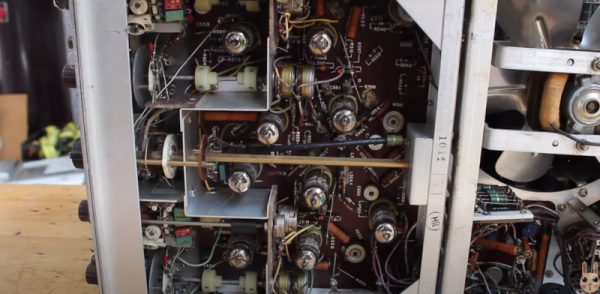
These days, a pretty nice oscilloscope can fit in your toolbox and even a “big” instrument is probably something you can tuck under your arm. But that hasn’t always been the case. Consider this old HP 150A, restored by [USagi Electric]. (Video, embedded below.)

The 10 MHz dual channel scope might not seem very high-tech today, but when HP rolled it out in the 1950s to challenge Tektronix, it was quite respectable. The $1,000 price tag just for the mainframe was pretty respectable, too. Unfortunately, the scope wasn’t very reliable with more than 50 tubes in it, and HP quickly had to develop new entries in the scope market.

Continue reading “The O’Scope Restoration”

Rare Radio Receiver Teardown

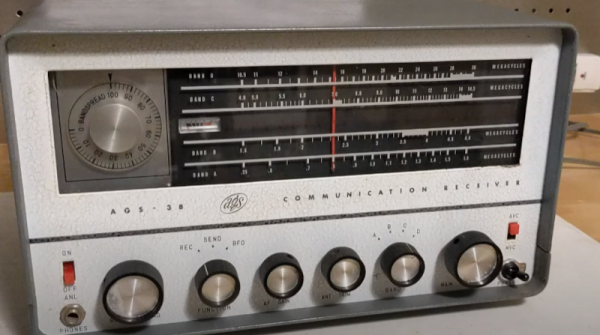
We’ll admit we haven’t heard of the AGS-38, it reminds us of the shortwave receivers of our youth, and it looks like many that were made “white label” by more established (and often Japanese) companies. [Jeff] found a nice example of this Canadian radio and takes it apart for our viewing pleasure. He also found it was very similar to a Layfayette receiver, also made in Japan, confirming our suspicions.

The radio looks very similar to an Eico of the same era — around the 1960s. With seven tubes, radios like this would soon be replaced by transistorized versions.

Continue reading “Rare Radio Receiver Teardown”

3D Printed Material Might Replace Kevlar

Prior to 1970, bulletproof vests were pretty iffy, with a history extending as far as the 1500s when there were attempts to make metal armor that was bulletproof. By the 20th century there was ballistic nylon, but it took kevlar to produce garments with real protection against projectile impact. Now a 3D printed nanomaterial might replace kevlar.

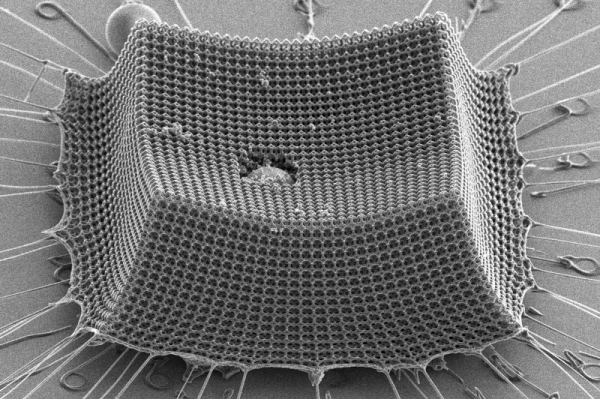
A group of scientists have published a paper that interconnected tetrakaidecahedrons made up of carbon struts that are arranged via two-photon lithography.

We know that tetrakaidecahedrons sound like a modern invention, but, in fact, they were proposed by Lord Kelvin in the 19th century as a shape that would allow things to be packed together with minimum surface area. Sometimes known as a Kelvin cell, the shape is used to model foam, among other things.

The 3D printing, in this case, is a form of lithography using precise lasers, so you probably won’t be making any of this on your Ender 3. However, the shape might have some other uses when applied to conventional 3D printing methods.

We’ve actually had an interest in the history of kevlar. Then again, kevlar isn’t the only game in town.

Pinewood Derby Scale Measures CG

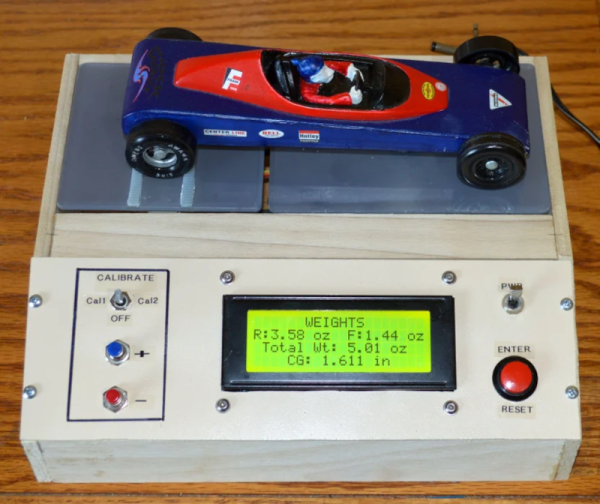
If you suffer from nostalgia, you might remember carving a block of wood into a car, adding some wheels, and racing it against other contestants in a pinewood derby. Today’s derby is decidedly high tech though, and we were impressed with this car scale that also figures out the car’s center of gravity.

Based on an Arduino, of course, along with a pair of HX711 load cells. Why a pair? That’s how the device measures the center of gravity is by weighing the front and rear of the car separately.

Continue reading “Pinewood Derby Scale Measures CG”