Fail Of The Week: The Metal Hot End Upgrade

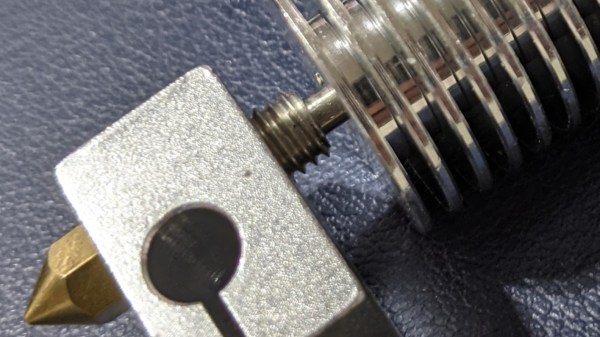
My son, Patrick, has observed on more than one occasion that I do not like 3D printing. That may sound odd, because I built a printer back in 2012 and since then I’ve built a lot of printers and I currently have at least three in my lab. But Patrick correctly realized that I don’t actually enjoy printing things that I need. What I do enjoy is building, fixing and even more importantly improving the printers themselves. If you are reading Hackaday, you probably know how that is. This is the story of an upgrade gone bad, although the ending is happy enough. If you’ve ever thought about moving from a traditional hot end to an all-metal hot end, you might want to hear me out and maybe I can save you some trouble.

A few years ago, I picked up an Anet A8 for a really low price. As printers go, it is adequate. Not bad, but not amazing. But it is a fun printer because you really need to do some work on it to brace the acrylic frame and fix other shortcomings. I merrily improved the printer quite a bit over a relatively short period of time and I also bought a bunch of aluminum extrusion to rebuild the frame to the AM8 plans you can find on Thingiverse.

Continue reading “Fail Of The Week: The Metal Hot End Upgrade”
3D Printer Add On Makes Sharp(ie) Colors

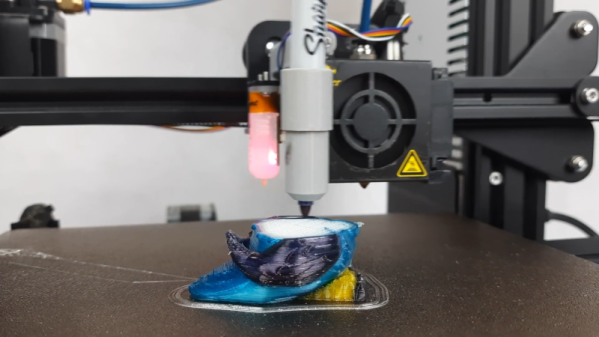
We’ve all seen 3D printed jigs that use a permanent marker to color filament as it goes into the hot end. [Sakati84] has a completely different idea. A holder on the print head can pick up one of several pens and use it to color the layer the hot end just laid down. In the video below, it looks like it works well and, although we imagine it will be a bear to calibrate on height, it seems like something you could replicate with nearly any conventional printer.

Logically, you print a layer with no pen in the holder and when you do pick up a pen, it will need to be somewhat lower than the print nozzle or else you’ll drag around in the fresh plastic.

Continue reading “3D Printer Add On Makes Sharp(ie) Colors”

Orbiter Is Now Open Source

We always have it on our list to learn more about Orbiter. If you haven’t seen it, it is a hyperrealistic space simulator. Granted, you can put it in an easy mode, but its real strength is you can very accurately model spacecraft like the Space Shuttle and have very realistic controls. In order to spur development, the program is now open source.

We think this is interesting for two reasons. First, if you ever wanted to contribute into a project of this scope, here’s your chance. You might not want to write a full-blow space simulator but you might have something to add. However, open source also means you can see how the program works and either reuse it in your own open source projects or just simply learn from the techniques.

Continue reading “Orbiter Is Now Open Source”

Linux Fu: Superpowers For Mere Mortals

You can hardly mention the sudo command without recalling the hilarious XKCD strip about making sandwiches. It does seem like sudo is the magic power to make a Linux system do what you want. The only problem is that those superpowers are not something to be taken lightly.

CC-BY-NC-2.5 by [XKCD]
If you are surfing the web, for example, you really don’t want to be root, because if someone naughty takes over your computer they could do a lot more harm with your root password. But still, there are times when you want to run certain commands that are normally root-only and don’t want to bother with a password. Luckily, sudo can handle that use case very easily.

Why?

As a simple example, suppose you like to shut your computer down at the end of the day. You run the shutdown command from the terminal but it doesn’t work because you aren’t root. You then have to do it again with sudo and if you haven’t logged in lately, provide your password. Ugh.

Continue reading “Linux Fu: Superpowers For Mere Mortals”

Quiet Wings, With Shape Memory Alloy

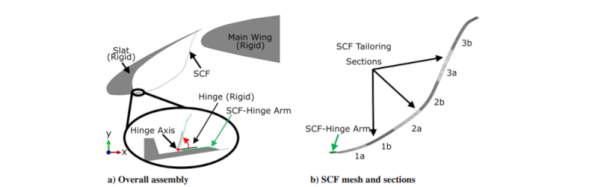
It’s a fact of operating an aircraft, that the make noise. If you’re an aviator you might want to quiet your craft to avoid annoying people nearby, or you might even want to operate in stealth mode. It turns out that there are different sources of noise on a plane depending upon the phase of flight. A NASA study found that when landing, a gap between the wing and leading edge slats causes air to cavitate causing unnecessary noise. Blocking that hole would allow for quieter landings, but there was no material suitable for both normal flight and the landing. That is, until Texas A&M researchers devised a way to use a shape memory alloy to do it.

In addition to two different shape memory alloy configurations, the study looks at a more conventional fiberglass composite, although this would only work for a limited number of wing configurations.

Continue reading “Quiet Wings, With Shape Memory Alloy”

Solder Bridges Aid Desoldering

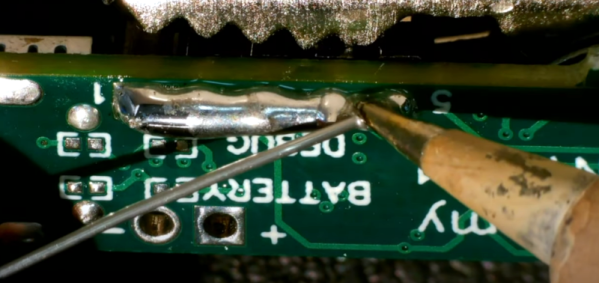
As our own Elliot Williams laid out, many people think that soldering is a key skill for electronics, but we don’t as often think about desoldering. Even if you are perfect in your technique, there’s always the chance you’ll put in a bad part or have a part fail later and it will need replacement. [Robert] has a short video showing his method for removing through-hole components and you can see it below.

This isn’t the first time we’ve seen it, of course. In fact, it is very much like using hot air, although it doesn’t require hot air, just extra solder and a regular iron. Of course, if we knew that connector was bad, we’d have been tempted to cut each pin apart and remove them one at a time. Heating a joint and then slamming your hand on the bench can work wonders.

We always think desoldering pumps are a good idea, but the electric ones tend to be anemic. The ones with the springs are usually better, but still have limitations. In the end, we’ll stick with using hot air, but if all you have is an iron, this method is worth checking out. You might also be interested in the needle method.

Continue reading “Solder Bridges Aid Desoldering”

What Kind Of GPU Are You?

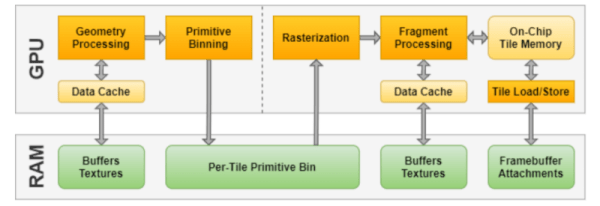
In the old days, big computers often had some form of external array processor. The idea is you could load a bunch of numbers into the processor and then do some math operations on all of the numbers in parallel. These days, you are more likely to turn to your graphics card for number crunching support. You’ll usually use some library to help you do that, but things are always better when you understand what’s going on under the hood. That’s why we enjoyed [RasterGrid’s] post on GPU architecture types.

If you can tell the difference between IMR (immediate mode) and TBR (tile-based) rendering this might not be the post for you. But while we knew the terms, we found a lot of interesting detail including some graphics and pseudo code that clarified the key differences.

Continue reading “What Kind Of GPU Are You?”