Room Temperature Superconductor? Yes, But Not So Fast…

There’s good news and there’s bad news in what we’re about to tell you. The good news is that a team of physicists has found a blend of hydrogen, carbon, and sulfur that exhibit superconductivity at 59F. Exciting, right? The bad news is that it only works when being crushed between two diamonds at pressures approaching that of the Earth’s core. For perspective, the bottom of the Marianas trench is about 1,000 atmospheres, while the superconductor needs 2.6 million atmospheres of pressure.

Granted, 59F is a bit chilly, but it is easy to imagine cooling something down that much if you could harness superconductivity. We cool off CPUs all the time. However, unless there’s a breakthrough that allows the material to operate under at least reasonable pressures, this isn’t going to change much outside of a laboratory.

Continue reading “Room Temperature Superconductor? Yes, But Not So Fast…” →

Grab A Stanford Computer Science Education

There are two reasons to go to school: learn about something and to get a coveted piece of paper that helps you get jobs, or at least, job interviews. With so many schools putting material online, you can do the first part without spending much money as long as you don’t expect the school to help you or grant you that piece of paper. Stanford has a huge computer science department and [Rui Ma] cataloged over 150 computer science classes available online in some form from the University. Just the thing to while away time during the quarantine.

Apparently, [Rui] grabbed the 2020 course catalog to find on-campus classes and found the companion website for each class, organizing them for our benefit. The list doesn’t include the actual online class offerings, which you can find directly from Stanford, although there is another list for that.

Continue reading “Grab A Stanford Computer Science Education” →

Linux Fu: Global Search And Replace With Ripgrep

If you are even a casual Linux user, you probably know how to use grep. Even if you aren’t a regular expression guru, it is easy to use grep to search for lines in a file that match anything from simple strings to complex patterns. Of course, grep is fine for looking, but what if you want to find things and change them. Maybe you want to change each instance of “HackADay” to “Hackaday,” for example. You might use sed, but it is somewhat hard to use. You could use awk, but as a general-purpose language, it seems a bit of overkill for such a simple and common task. That’s the idea behind ripgrep which actually has the command name rg. Using rg, you can do things that grep can do using more modern regular expressions and also do replacements.

A Note on Installing Ripgrep

Your best bet is to get ripgrep from your repositories. When I tried running KDE Neon, it helpfully told me that I could install a version using apt or take a Snap version that was newer. I usually hate installing a snap, but I did anyway. It informed me that I had to add –classic to the install line because ripgrep could affect files outside the Snap sandbox. Since the whole purpose of the program is to change files, I didn’t think that was too surprising, so I did the install.

Continue reading “Linux Fu: Global Search And Replace With Ripgrep” →

Browser Makes Tiny Office Suite

There’s a recent craze of people living in tiny houses of 400 square feet down to as little as 80 square feet. Maybe [zserge] was thinking about that and created a very tiny office suite in which each tool weighs in at less than 1K. If you are guessing you couldn’t squeeze much functionality in C or C++ code or even assembly, you’d be right. The language of choice? HTML and JavaScript. So while the code is small, it relies on a pretty big piece of software. On the other hand, you have a browser open right now, so the incremental cost of using these tools is very small.

We get the idea that there’s not much chance this is going to sweep the shelves of Microsoft Office, Libre Office, and all the many competitors. However, it is a pretty stunning example of what you can do with modern HTML. There’s even a GitHub repo and a subreddit.

Continue reading “Browser Makes Tiny Office Suite” →

The Cable Modem To SDR Transformation

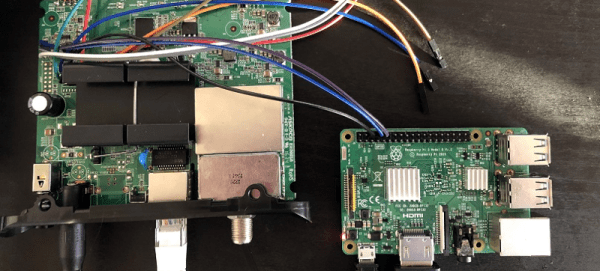
What do you do with an old cable modem in a closet? If you are [stdw] you reverse engineer it and turn it into a software-defined radio. The modem in question was a Motorola MB7220. After looking at a similar project using a different modem, it seemed like it should be doable.

Cracking open the case revealed two likely UART ports, one of which was active. The output from that UART provided a lot of info. The chip was a Broadcom BCM3383 which is a MIPS processor. It had eCos as an operating system. However, the bootloader eventually disables the UART, so there wasn’t much more investigation possible via the serial terminal.

The next step was to dump the flash memory. That required a little solder surgery to prevent the board from starting while the flash chip had power. It appeared that some key credentials and configuration data were present, but they were really backups. After doing a factory reset to remove the backups, the right data was apparent.

After some lengthy exploration, the diagnostic that builds a spectrum display gave up its data. At first, the data was just a small sample of what was really required, but it did show a local FM station as a spectrum. Eventually, the data loss rate was down to about 12% when streaming which is not great, but good enough. You can hear an audio clip of the reception. Not exactly crystal-clear quality, but not bad.

Of course, no one will use this for an FM radio. But it is a fascinating view into how far you can hack into a device like this if you have some skills and patience. There must be something about quarantine that is making people hack old gear, as we just recently saw a similar Netgear hack. Even cheap games aren’t safe.

Electronic Treatment For Diabetes?

If you ask power companies and cell phone carriers how much electromagnetic radiation affects the human body, they’ll tell you it doesn’t at any normal levels. If you ask [Calvin Carter] and some other researchers at the University of Iowa, they will tell you that it might treat diabetes. In a recent paper in Cell Metabolism, they’ve reported that exposing patients to static magnetic and electric fields led to improved insulin sensitivity in diabetic mice.

Some of the medical jargon in a paper like this one can be hard to follow, but it seems they feed mice on a bad diet — like that which many of us may eat — and exposed them to magnetic and electrical fields much higher than that of the Earth’s normal fields. After 30 days there was a 33% improvement in fasting blood glucose levels and even more for some mice with a specific cause of diabetes.

Continue reading “Electronic Treatment For Diabetes?” →

FreeCAD Parametrics Made Simple

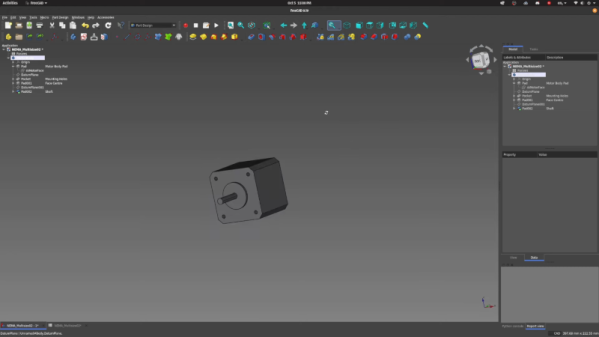
Simple drafting programs just let you draw like you’d use a pencil. But modern programs use parametric models to provide several benefits. One is that you can use parameters to change parts of your design and other parts will alter to take account of your changes. The other advantage is you can use one model for many similar but different designs. [Brodie Fairhall] has a nice video about how to use parameters in FreeCAD.

The nice thing about parameters is they don’t have to be just constants. You can put in formulae as well. For example, you could define one line as being twice as big as another line. You provide various constraints and parameters and FreeCAD works out the shape for you, keeping all the constraints and formulae satisfied.

Continue reading “FreeCAD Parametrics Made Simple” →