Linux Fu: The Linux Android Convergence

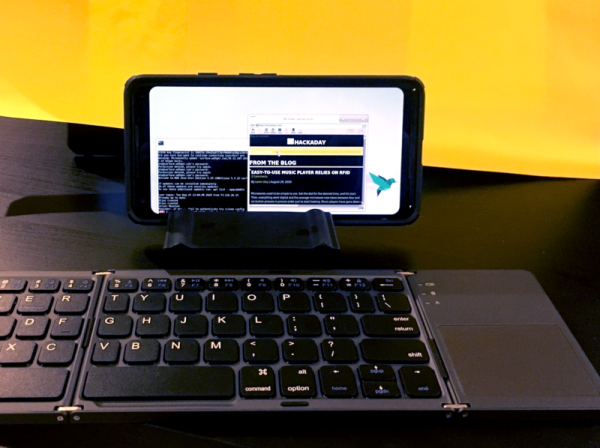
The Android phone that you carry in your pocket is basically a small computer running Linux. So why is it so hard to get to a usable Linux environment on your phone? If you could run Linux, you could turn your cell phone into an ultra-portable laptop replacement.

Of course, the obvious approach is just to root the phone and clean-slate install a Linux distribution on it. That’s pretty extreme and, honestly, you would probably lose a lot of phone function unless you go with a Linux-specific phone like the PinePhone. However, using an installer called AnLinux, along with a terminal program and a VNC client, you can get a workable setup without nuking your phone’s OS, or even having root access. Let’s see what we can do. Continue reading “Linux Fu: The Linux Android Convergence” →

Hacking A Netgear Router

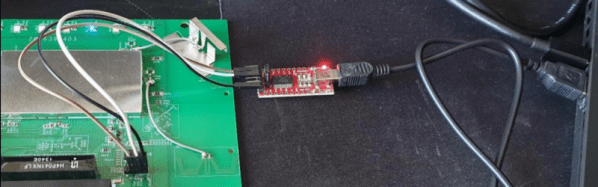
Have you ever wanted to watch someone reverse engineer a piece of hardware and pick up some tips? You can’t be there while [Jeremy] tears open a Netgear N300 router, but you can see his process step by step in some presentation charts, and you’ll get a few ideas for the next time you want to do something like this.

The first part of the presentation might be a little basic for most Hackaday readers, but presumably, the intended audience might not know much about soldering or multimeters. But we enjoyed the methodology used to work out the UART pins on the board. We would have read the baud rate with the scope, which [Jeremy] does, but he also mentions a script to work it out and create a minicom profile that looked interesting.

Continue reading “Hacking A Netgear Router” →

Graphene Generates A Little Power

We never know exactly what to make of university press releases, as we see plenty of them with breathless claims of new batteries or supermaterials, but then we don’t see much else. Sometimes, the claims in the press release don’t hold up in the paper, while other times the claims seem to be impractical for use in real life. We aren’t quite sure what to make of a press release from the University of Arkansas claiming they can draw current from a sheet of freestanding graphene purely from its temperature fluctuations.

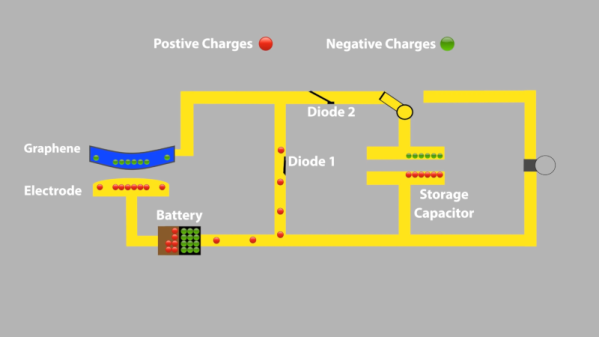
The press release seems to claim that this is a breakthrough leading to “clean, limitless power.” But if you look at the actual paper, normal room temperature is causing tiny displacements in the graphene sheet as in Brownian motion. A scanning tunneling microscope with two diodes can detect current flowing even once the system reaches thermal equilibrium. Keep in mind, though, that this in the presence of a bias voltage and we are talking about nanometer-scale displacements and 20 pA of current. You can see a simple video from the university showing a block diagram of the setup.

Continue reading “Graphene Generates A Little Power” →

Minimal TinyAVR 0 Programming

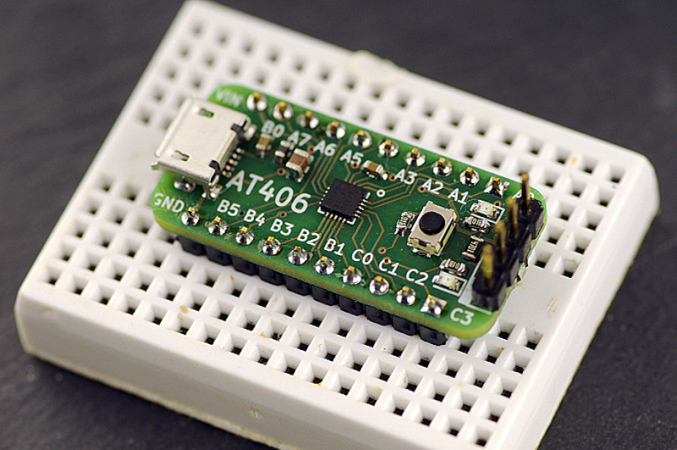
When [Alain] wanted to use some of the new TinyAVR 0 chips — specifically, the Attiny406 — it seemed overkill to use the Windows IDE. There are plenty of sources of information on programming other AVR chips using simple command line tools, but not for these newer 0-series parts which use a new programming protocol known as UPDI. That led to a deep diving into how to program a TinyAVR 0 with a text editor, makefile, and USB-to-serial cable.

The Attiny406 has 4K of flash, 256 bytes of RAM and can run at 20 MHz with no external clock. You might think programming would be similar to a regular AVR part, but these tiny devices use UPDI (Unified Programming and Debug Interface) which uses 3 pins for programming. Older devices used different protocols.

It is very easy to create a UPDI programmer. A USB to logic-level serial cable and a 4.7K resistor is all it takes. There’s Python code that knows how to drive the protocol, too. You can also use the logic-level serial port on the Raspberry Pi with some device tree modifications explained in the code’s documentation.

[Alain] made a nice breakout board for the device. It fits a breadboard, allows for 5V or 3.3V operation, and has an LED and switch. Nothing fancy, but handy. Once you know how to ship a hex file to the chip, the rest is pretty standard. While the AVR version of gcc doesn’t cross-compile for the ATTiny out of the box, there is a device pack from Microchip that enables that feature.

The trend is to go to bigger processors, not smaller, but when you need to cram something in a small space, save a few pennies per unit, or draw very little power, these tiny processors can be just the ticket. The processors may be small, but if you work you can do some pretty big things with them.

Indian RISC-V Chip Is Team’s Third Successful Chip

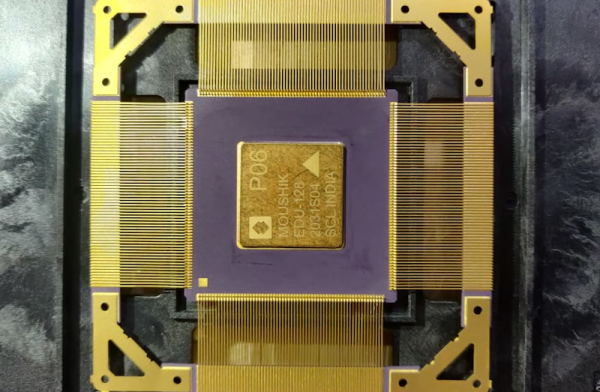
There was a time when creating a new IC was a very expensive proposition. While it still isn’t pocket change, custom chips are within reach of sophisticated experimenters and groups. As evidence, look at the Moushik CPU from the SHAKTI group. This is the group’s third successful tapeout and is an open source RISC-V system on chip.

The chip uses a 180 nm process and has 103 I/O pins. The CPU runs around 100 MHz and the system includes an SDRAM controller, analog to digital conversion, and the usual peripherals. The roughly 25 square mm die houses almost 650 thousand gates.

This is the same group that built a home-grown chip based on RISC-V in 2018 and is associated with the Indian Institute of Technology Madras. We aren’t clear if everything you’d need to duplicate the design is in the git repository, but since the project is open source, we presume it is.

If you think about it, radios went from highly-specialized equipment to a near-disposable consumer item. So did calculators and computers. Developing with FPGAs is cheaper and easier every year. At this rate it’s not unreasonable to think It won’t be long before creating a custom chip will be as simple as ordering a PCB — something else that used to be a big hairy deal.

Of course, we see FPGA-based RISC-V often enough. While we admire [Sam Zeloof’s] work, we don’t think he’s packing 650k gates into that size. Not yet, anyway.

Continue reading “Indian RISC-V Chip Is Team’s Third Successful Chip” →

Retrotechtacular: The $5,000 40 Pound HP Classroom Computer

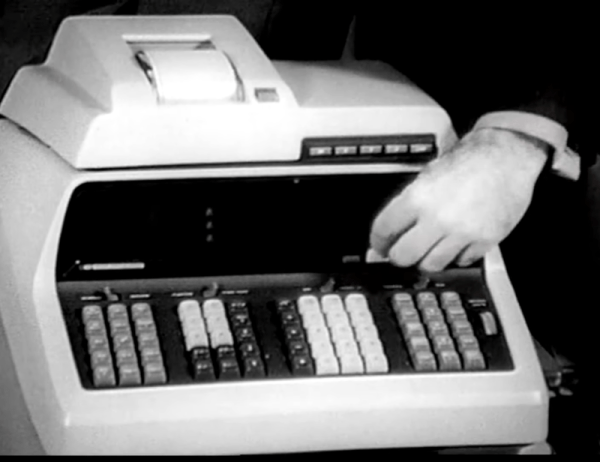
See if you can talk your local school district into buying a computer that costs about $5,000 and weighs 40 pounds. That was HP’s proposition to schools back in 1968 so really it is more like $35,000 today. The calculator had a CRT display for the RPN stack that you could mirror on a big screen. You could also get a printer or plotter add-on. Pretty hot stuff for the ’60s.

The 1970 videos promoting the HP 9100, posted by the [Computer History Archive Project], shows something we’d think of as a clunky calculator, although by the standards of the day it was a pretty good one with trig functions and a crude programming capability.

Continue reading “Retrotechtacular: The $5,000 40 Pound HP Classroom Computer” →

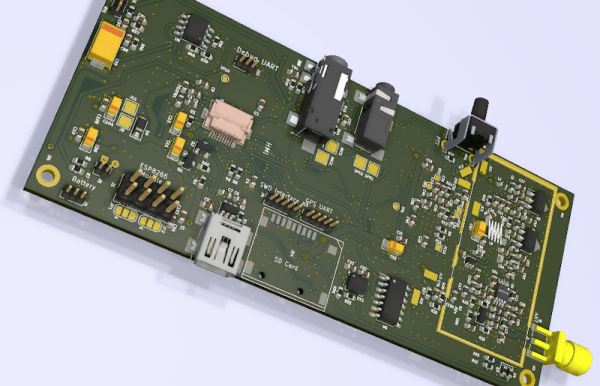
M17 Aims To Replace Proprietary Ham Radio Protocols

While M17 might sound like a new kind of automatic rifle (as actually, it is), we were referring to an open source project to create a ham radio transceiver. Instead of paraphrasing the project’s goals, we’ll simply quote them:

The goal here should be to kick the proprietary protocols off the airwaves, replace DMR, Fusion, D-Star, etc. To do that, it’s not just good enough to be open, it has to be legitimately competitive.

Like some other commercial protocols, M17 uses 4FSK along with error correction. The protocol allows for encryption, streaming, and the encoding of callsigns in messages. There are also provisions for framing IP packets to carry data. The protocol can handle voice and data in a point-to-point or broadcast topology.

Continue reading “M17 Aims To Replace Proprietary Ham Radio Protocols” →