Binary Watch Looks Good

Nothing says tech addict quite like the wearing of a binary watch — and we say that as tech addicts ourselves. However, many of the homebrew binary watches we’ve seen don’t just look nerdy because they are showing the time in binary. They are nerdy because it looks like someone strapped an Arduino to their wrist. Not so with [APTechnologies] “Ultimate Binary Watch.”

While creating a binary clock is not amazing in of itself, we were highly impressed with the look of this watch. The 3D printed case and the use of surface mount LEDs makes a great looking package. We wondered how it would look with a colored plastic cover like you’d find over an old LED clock. On the other hand, the exposed LEDs do have a certain charm to them.
Continue reading “Binary Watch Looks Good”

Cheap Smartwatch Hacking, To Run Your Own Code

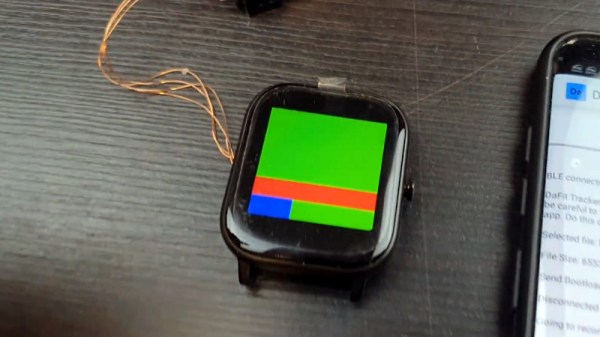
[Aaron Christophel] has been busy, he picked up a P8 smartwatch of the type that many of you will no doubt have seen. They cost almost nothing and do almost… nothing. In all fairness, they do connect to your phone using Bluetooth LE courtesy of a chip from Nordic (the NRF52832), and they can do several simple tasks. But they don’t run applications in the way an Android or Apple watch does. [Aaron] wants to run his own applications, so his YouTube channel has a lot of information about hacking the P8 and other watches with similar chips. In one video you can watch below, he demonstrates how he’s written support for Arduino programming to the devices. What we were really excited about was the second video below where he shows his Android app that can flash the devices via Bluetooth. That means you can potentially hack these devices without opening them up.

The app that normally runs these watches is called Da Fit, so [Aaron] called his utility DaFlasher. This is all early stuff so we expect some coaxing to get everything working, but it has great promise.

Continue reading “Cheap Smartwatch Hacking, To Run Your Own Code”

Linux Command Line Productivity With Tmux

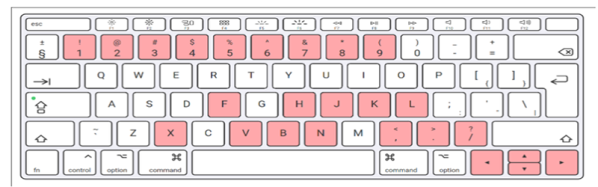
It is no secret that most Linux power users use the shell for many tasks, as for people who know what they are doing, it can be quite efficient. In addition, there are some tasks that can only be carried out from the command line, although their number shrinks every year. However, these days we are spoiled because you can have one X session running lots of terminals at once. If you log into a server, it might not have X. Or you might log into a computer over a slow connection where X is painful to use. What then? The modern answer is the tmux terminal multiplexer, and [zserge] has a thoughtful introduction to how you can use tmux for improved productivity at the command line.

In particular, he shares some configuration and offers sound advice. For example, do you really need a status bar that shows you CPU load at all times? Cool, yes, but not always a practical win.

Continue reading “Linux Command Line Productivity With Tmux”

The United States Air Force Would Like You To Hack Into Their Satellite

The Air Force is again holding its annual “Space Security Challenge” where they invite you to hack into a satellite to test their cybersecurity measures. There are actually two events. In the first one, $150,000 is up for grabs in ten prizes and the final event offers a $100,000 purse divided among the three top participants (first place takes $50,000).

Before you get too excited, you or your team has to first qualify online. The qualification event will be over two days starting May 22. The qualifying event is set up a bit like the TV show Jeopardy. There is a board with categories. When a team solves a challenge in a category it receives a flag that is worth points as well as getting to unlock the next challenge. Once a challenge is unlocked however, any team could potentially work on it. There are more rules, but that’s the gist of it. At the end of the event, the judges will contact the top 10 teams who will then each have to submit a technical paper.

Continue reading “The United States Air Force Would Like You To Hack Into Their Satellite”

Test Equipment, Shim Washers, And A 30 Year Old Space Telescope

This year marks the 30th anniversary of the Hubble Space Telescope. When you see all the great pictures today, it is hard to remember that when it first launched, it was nearly a failure, taking fuzzy pictures. The story of how that problem was fixed while the telescope was whizzing through space is a good one. But there’s another story: how did a $1.5 billion satellite get launched with defective optics? After all, we know space hardware gets tested and retested and, typically, little expense is spared to make sure once a satellite is in orbit, it will work well for a long time.

The problem was with a mirror. You might think mirrors are pretty simple, but it turns out there’s a lot to know about mirrors. For astronomy, you need a first surface mirror which is different from your bathroom mirror which almost certainly reflects off the back of the glass. In addition, the mirrors need a very precise curve to focus light.

Continue reading “Test Equipment, Shim Washers, And A 30 Year Old Space Telescope”

Raspberry Pi Waters Your Lawn, Serves HTML

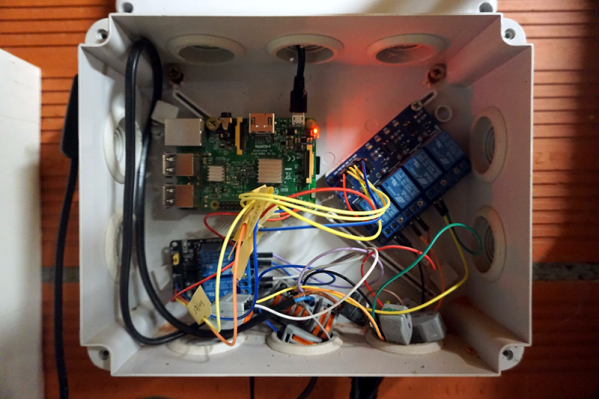
It is easy to take a Raspberry Pi and treat it like a cheap Linux PC or server. Running an ad blocker or a VPN gateway is simple and doesn’t require any real interfacing. However, it is a big leap to actually use the Pi to control something and a good example can go a long way to helping you develop your own projects. [Joeseph Luccisano] posted a tutorial with just that aim. The goal: build a low-cost lawn watering system.

It is an interesting project since it has hardware and software components, of course. But it also has a hydraulic part, so you have to deal with all three domains coming together.

Continue reading “Raspberry Pi Waters Your Lawn, Serves HTML”

Beam Your Program To Another Computer

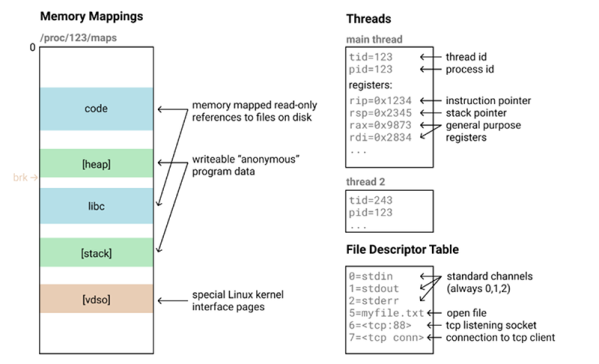
If you’ve programmed much in Linux or Unix, you’ve probably run into the fork system call. A call to fork causes your existing process — everything about it — to suddenly split into two complete copies. But they run on the same CPU. [Tristan Hume] had an idea. He wanted to have a call, telefork, that would create the copy on a different machine in a Linux cluster. He couldn’t let the idea go, so he finally wrote the code to do it himself.

If you think about it, parts of the problem are easy while others are very difficult. For example, creating a copy of the process’s code and data isn’t that hard. Since the target is a cluster, the machines are mostly the same — it’s not as though you are trying to move a Linux process to a Windows machine.

Continue reading “Beam Your Program To Another Computer”