1940s Portable Radio Is A Suitcase

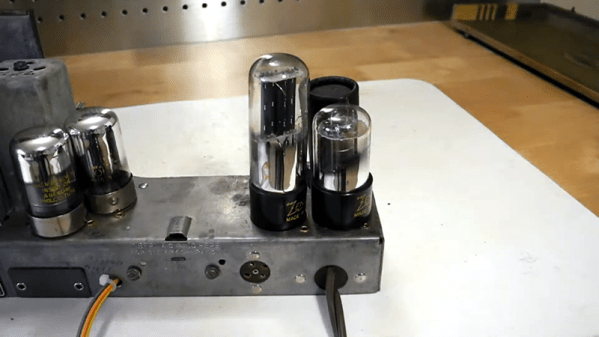
The meaning of the word portable has changed a bit over the years. These days something has to be pretty tiny to be considered truly portable, but in the 1940s, anything with a handle on it that you could lift with one hand might be counted as portable electronics. Zenith made a line of portable radios that were similar to their famous Transoceanic line but smaller, lighter, and only receiving AM to reduce their size and weight compared to their big brothers. If you want to see what passed for portable in those days, have a look at [Jeff Tranter’s] video (below) of a 6G601 — or maybe it is a GG601 as it says on the video page. But we think it is really a 6G601 which is a proper Zenith model number.

According to [Jeff], 225,350 of these radios were made, and you can see that it closes up like a suitcase. The initial 6 in the model number indicates there are 6 tubes and the G tells you that it can run with AC or batteries.

Continue reading “1940s Portable Radio Is A Suitcase”

Retrotechtacular: Predictions That Just Missed It

Few occupations are more fraught with peril than predicting the future. If you are a science fiction author, it might not matter, but if you are trying to design the next game-changing piece of hardware, the stakes are higher.

It seems like, for the most part, even if you manage to get some of the ideas right, the form is often way off. Case in point: telemedicine. Today you can visit a doctor using video conferencing with your phone or a PC for many common maladies. A new idea? Not really. Hugo Gernsback wrote about it in Radio Electronics back in 1955.
Gernsback wrote:

The average medical doctor today is overworked and short-lived. There are never enough doctors anywhere for the world’s constantly multiplying population. Many patients die because the doctor cannot reach them in time, particularly at night and in remote regions.

…[H]e can only see a few [patients] during the day. With increasing traffic congestion, many doctors refuse to make personal calls — execept in emergencies. Even then they arrive often too late. Much of this dilemma will be archaic in the near future, thanks to the Teledoctor.

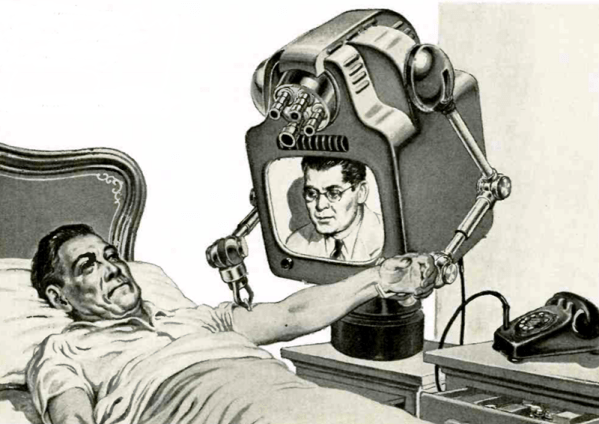
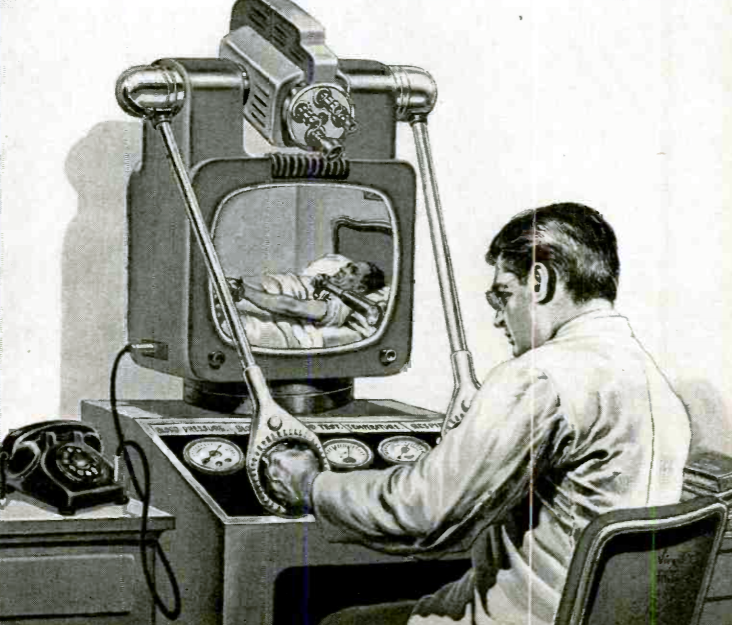
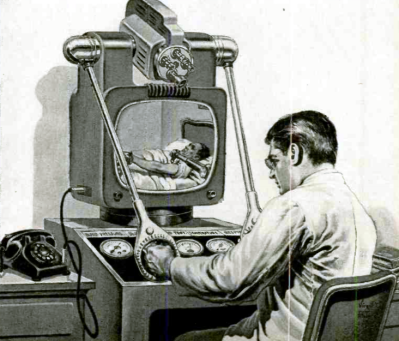
Gernsback envisioned a doctor using what we now call Waldos similar to what people use to manipulate radioactive material. These super mechanical hands (Gernsback’s words) would allow the doctor to write a prescription, pour liquids, or even diaper a baby thanks to a sense of touch built into them.

Oddly enough, Gernsback’s vision included renting a teledoctor from the drugstore for $3.50 a day. This way, the doctor could call on you and then follow up as well. The drug store would deliver the machine and it would — get this — connect to your phone:

A cord with the a telephone plug attached to the teledoctor instrument is now plugged into a special jack on your telephone. Future telephones will be provided with this facility. The TV signals and telehand electronic signals, etc., will all travel over the closed circuit telephone lines.

In a footnote, Gernsback notes that you can’t send a 525-line TV signal on current phone lines, but a 250-350 line picture was possible and that would be sufficient.

Visionary? In some ways, maybe. The basic idea is coming true today, although it isn’t likely doctors will do surgery or inject you remotely in your home anytime soon. The special telephone plug sort of came true and is already obsolete. The images, by the way, are the ones that accompanied the original article in Radio Electronics.

Continue reading “Retrotechtacular: Predictions That Just Missed It”

NanoVNA Is A $50 Vector Network Analyzer

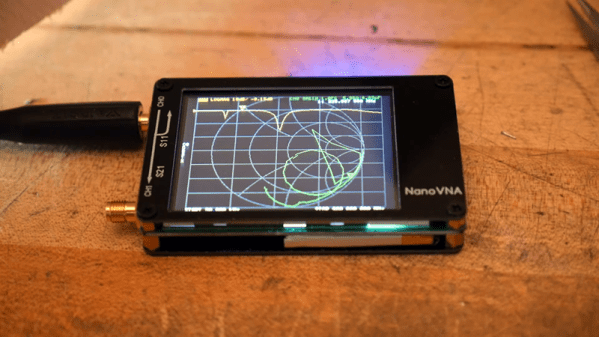
There was a time when oscilloscopes were big and expensive. Now you can get scopes of various sizes and capabilities on nearly any budget. Vector network analyzers — VNAs — haven’t had quite the same proliferation, but NanoVNA may change that. [IMSAI Guy] bought one for about $50 and made a series of videos about it. Spoiler alert: he likes it. You can see one of the several videos he’s posted, below.

NanoVNA is tiny but sweeps from 50 kHz to 900 MHz and has a touch screen. The device uses a rechargeable battery if you need to haul it up to an antenna tower, for example. Just as a quick test, you can see early in the video the analysis of a rubber duck antenna. The device shows return loss as a plot and you can use a cursor to precisely measure the values. It also shows a Smith chart of the reactance.

Continue reading “NanoVNA Is A $50 Vector Network Analyzer”

Field Expedient Soldering Iron Will Do In A Pinch

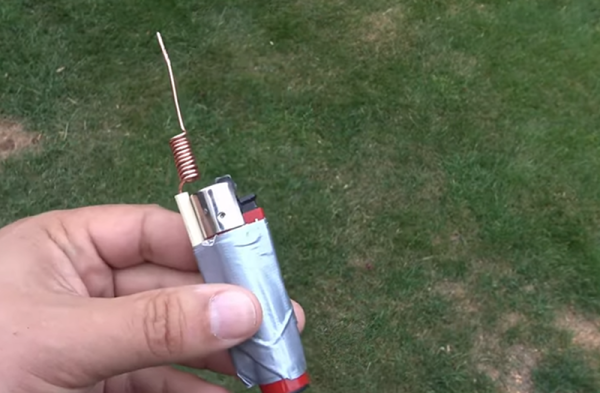
If you think [Dubious Engineering]’s moniker is just a name, have a look at the pretty terrible soldering iron hacked out of a lighter in the video below. No one is suggesting this is a good idea but in an emergency, maybe it would come in handy. We liked the use of a chopstick and the formation of a heat exchanger with the copper wire coil. It was a mild disappointment that you had to drill out the chopstick, but we think you could have figured out a different method with a little thought.

The use of duct tape, of course, lends it instant hacker credibility. We suppose this might be useful not just after the robot uprising, but if you had to make a few quick solder joints far away from power and you don’t have a battery-operated iron.

Continue reading “Field Expedient Soldering Iron Will Do In A Pinch”

3D Printing Glass

For most of us, 3D printing means printing in plastic of some sort — either filament or photo resin. However, we have all wanted to print in other materials — especially more substantial materials. Metal printers exist but they aren’t cheap. However, it is possible to print molds and cast metal parts using them. [Amos Dudley] prints molds. But instead of metal, he casts parts out of glass.

[Amos] covers several techniques. The first is creating a relief (that is a 3D shape that grows out of a base). According to the post, this prevents difficult undercuts. He then casts a mold from silica and uses a kiln to melt glass into the mold. You might expect to do that with a full-size kiln, but you can actually get an inexpensive small kiln that fits in your microwave oven.

Continue reading “3D Printing Glass”

Blue Pill Makes Cheap But Powerful Morse Tutor

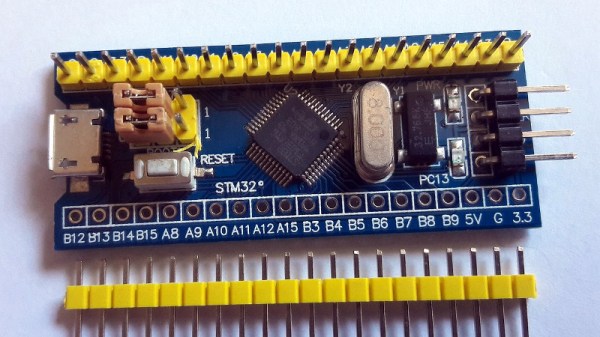
[W8BH] attended a talk by another ham, [W8TEE] that showed a microcontroller sending and receiving Morse code. He decided to build his own, and documented his results in an 8 part tutorial. He’s using the Blue Pill board and the resulting device sends code with paddles, sends canned text, provides an LCD with a rotary knob menu interface, and even has an SD card for data storage.

All the code is on GitHub. If you are interested in Morse code or in learning how to write a pretty substantial application using the Blue Pill and the Arduino IDE (or any other similar processor), this is a great exposition that is also a practical tool.

Continue reading “Blue Pill Makes Cheap But Powerful Morse Tutor”

Recreating Space Cameras

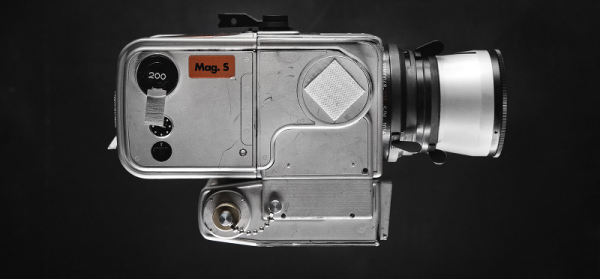
[Cole Price] describes himself as a photographer and a space nerd. We’ll give that to him since his web site clearly shows a love of cameras and a love of the NASA programs from the 1960s. [Cole] has painstakingly made replicas of cameras used in the space program including a Hasselblad 500C used on a Mercury flight and another Hasselblad used during Apollo 11. His work is on display in several venues — for example, the 500C is in the Carl Zeiss headquarters building.

[Cole’s] only made a detailed post about 500C and a teaser about the Apollo 11 camera. However, there’s a lot of detail about what NASA — and an RCA technician named [Red Williams] — did to get the camera space-ready.

Continue reading “Recreating Space Cameras”