Superheterodyne Radios Explained

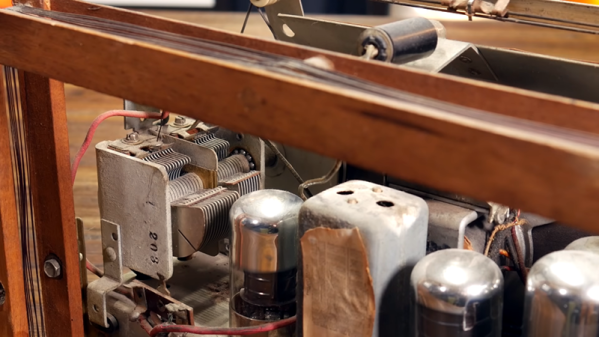
The general public thinks there is one thing called a radio. Sure, they know there are radios that pick up different channels, but other than that, one radio is pretty much like the other. But if you are involved in electronics, you probably know there are lots of ways a radio can work internally. A crystal set is very different from an FM stereo, and that’s different still from a communications receiver. We’d say there are several common architectures for receivers and one of the most common is the superheterodyne. But what does that mean exactly? [Technology Connection] has a casual explanation video that discusses how a superhet works and why it is important. You can see the video, below.

Engineering has always been about building on abstractions. This is especially true now when you can get an IC or module that does most of what you want it to do. But even without those, you would hardly start an electronics project by mining copper wire, refining it, and drawing your own wire. You probably don’t make many of your own resistors and capacitors, neither do you start your design at the fundamental electronic equations. But there’s one abstraction we often forget about: architecture. If you are designing a receiver, you probably don’t try to solve the problem of radio reception; instead you pick an architecture that is proven and design to that.
Continue reading “Superheterodyne Radios Explained”

Wooden Clock To FPGA Conversion

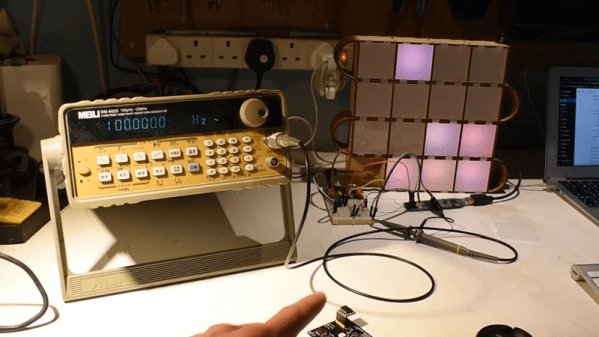
[John] wanted a project to help him learn more about FPGAs. So he started with his wooden clock — made with an Arduino — and ported it over to a Lattice FPGA using Icestorm. What’s nice is that he takes you through the steps he used to simulate the design using the Falsted simulator and then realizing it in the FPGA. Since he’s just starting out, it is a good bet he ran into the same rough edges you will (or did) and sometimes that can really help get you over the hump. You can see a video below, and the code for the project is on GitHub.

For example, after mocking up a circuit design in Falstad he realized he could make one large counter instead of several modules, and he contrasts that to a more modular approach. He also ran into a feature that was simple for the Arduino but difficult for the FPGA. He got it working, but it took some optimization effort to make everything fit in the relatively small FPGA he was using.

Continue reading “Wooden Clock To FPGA Conversion”

Picovoice Puts Smarts Offline In 512K Of Memory

We live in the future. You can ask your personal assistant to turn on the lights, plan your commute, or set your thermostat. If they ever give Alexa sudo, she might be able to make a sandwich. However, you almost always see these devices sending data to some remote server in the sky to do the analysis and processing. There are some advantages to that, but it isn’t great for privacy as several recent news stories have pointed out. It also doesn’t work well when the network or those remote servers crash — another recent news story. But what’s the alternative? If Picovoice has its way, you’ll just do all the speech recognition offline.

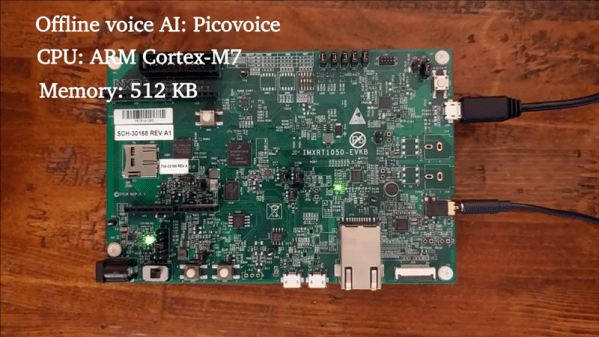
Have a look at the video below. There’s an ARM board not too different from several we have lying around in the Hackaday bunker. It is listening for a wake-up phrase and processing audio commands. All in about 512K of memory. The libraries are apparently quite portable and the Linux and Raspberry Pi versions are already open source. The company says they will make other platforms available in upcoming releases and claim to support ARM Cortex-M, Cortex-A, Android, Mac, Windows, and WebAssembly.

Continue reading “Picovoice Puts Smarts Offline In 512K Of Memory”

Excuse Me, I Have To Feed The Computer

It is a staple of science fiction to see a brain in a jar or other container, maybe used as some sort of computer device. You are probably imagining a brain-powered supercomputer with a room full of humans with electrodes in their heads, or maybe some other primate. The reality though is it might be just a small dish full of single-celled amoeba.

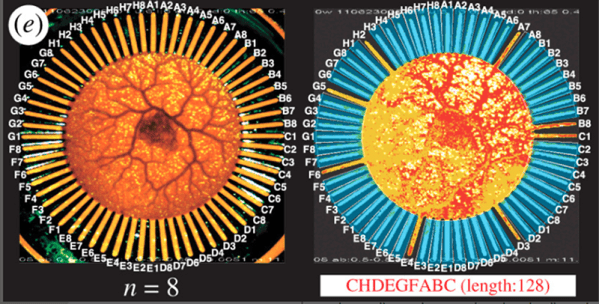
Researchers from China and Japan have successfully made a lowly amoeba solve the traveling salesman problem for 8 cities. We’ll be honest. We don’t totally understand the value to it over traditional methods, but it does prove that you can compute with organic matter. This isn’t just any amoeba, though. It is a particular kind, Physarum polycephalum, that has an unusual property — it can shapeshift, at least to a limited degree. The tiny creature is just like us in that it tries to get things it likes and avoid things it doesn’t like. It likes food, but it doesn’t like light.

Provide food, and the tiny creature will spread out. Shine light on it, and it will retract. That’s the property used to solve the thorny problem, but before we look at how that works it helps to understand the problem it is trying to solve.

Continue reading “Excuse Me, I Have To Feed The Computer”

Cybersecurity And Insurance

Insurance is a funny business. Life insurance, for example, is essentially betting someone you will die before your time. With the recent focus on companies getting hacked, it isn’t surprising that cybersecurity insurance is now big business. Get hacked and get paid. Maybe.

The reason I say maybe is because of the recent court battle between Zurich and Mondelez. Never heard of them? Zurich is a big insurance company and Mondelez owns brands like Nabisco, Oreo, and Trident chewing gum, among others.

It all started with the NotPetya ransomware attack in June of 2017. Mondelez is claiming it lost over $100 million dollars because of the incident. But no problem! They have insurance. If they can get the claim paid by Zurich, that is. Let’s dig in and try to see how this will all shake out.

Continue reading “Cybersecurity And Insurance”

Ion Powered Airplane: Not Coming To An Airport Near You

Not that we don’t love Star Trek, but the writers could never decide if ion propulsion was super high tech (Spock’s Brain) or something they used every day (The Menagerie). Regardless, ion propulsion is real and we have it today on more than one spacecraft. However, MIT recently demonstrated an ion-powered airplane. How exciting! An airplane with no moving parts that runs on electricity. Air travel will change forever, right? According to [Real Engineering], ion-propelled (full-sized) aircraft run into problems with the laws of physics. You can see the video explaining that, below.

To understand why, you need to know two things: how ion drive works and how the engines differ when using them in an atmosphere. Let’s start with a space-based ion engine, a topic we’ve covered before. Atoms are turned into ions which are accelerated electrically. So the ion engine is just using electricity to create thrust exhaust instead of burning rocket fuel.

Continue reading “Ion Powered Airplane: Not Coming To An Airport Near You”

3D-Printing Wankel Engine From Mazda’s Beloved “Rotary Rocket”

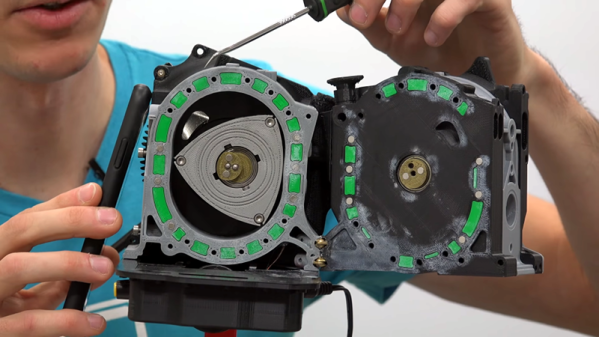
Although there was briefly a company called Rotary Rocket, the term is much better known as a nickname for the Mazda RX-7 — one of the few cars that used a Wankel, or rotary, engine. If you ever wondered how these worked, why not print a model? That’s what [Engineering Explained] did. They printed a 1/3 scale model and made a video explaining and demonstrating its operation. The model itself was from Thingiverse, created by [EricThePoolBoy].

One thing we really liked about the model was the use of lights to show the different stages of combustion. Cool air intake is a blue light, hot air is red, and so on. It really helps visualize what’s happening. You can watch the video below.

If you haven’t seen a Wankel before, it is a clever design. It has very few moving parts and offers very smooth power transfer and high power to weight ratio. The downside, though, is that the engine deliberately burns oil to lubricate and seal, so it is difficult to meet emission standards and requires a lot of oil. The fuel efficiency of current designs is not very good either, especially since manufacturers will often trade fuel efficiency for better emissions.

If you’d like to read more about the Wankel, check out our earlier post (and the 165 comments attached). We also looked at — or rather through — another Wankel earlier this year.

Continue reading “3D-Printing Wankel Engine From Mazda’s Beloved “Rotary Rocket””