Tiny Websites Have No Server

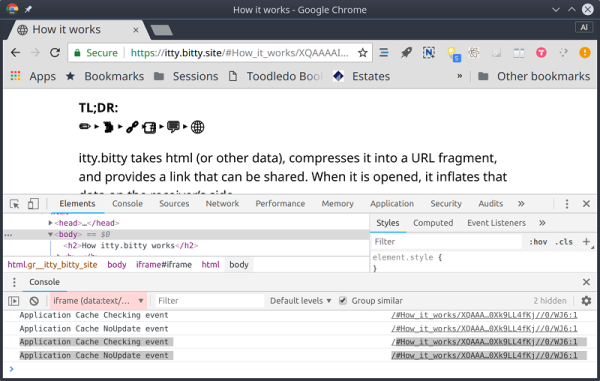
A big trend in web services right now is the so-called serverless computing, such as Amazon’s Lambda service. The idea is you don’t have a dedicated server waiting for requests for a specific purpose. Instead, you have one server (such as Amazon’s) listening for lots of requests and on demand, you spin up an environment to process that request. Conceptually, it lets you run a bit of Javascript or some other language “in the cloud” with no dedicated server.  https://itty.bitty.site takes this one step farther. The site creates self-contained websites where the content is encoded in the URL itself.

Probably the best example is to simply go to the site and click on “About itty bitty.” That page is itself encoded in its own URL. If you then click on the App link, you’ll see a calculator, showing that this isn’t just for snippets of text. While this does depend on the itty.bitty.site web host to provide the decoding framework, the decoding is done totally in your browser and the code is open source. What that means is you could host it on your own server, if you wanted to.

At first, this seems like a novelty until you start thinking about it. A small computer with an Internet connection could easily formulate these URLs to create web pages. A bigger computer could even host the itty.bitty server. Then there’s the privacy issue. At first, we were thinking that a page like this would be hard to censor since there is no centralized server with the content. But you still need the decoding framework. However, that wouldn’t stop a sophisticated user from “redirecting” to another — maybe private — decoding website and reading the page regardless of anyone’s disapproval of the content.


Continue reading “Tiny Websites Have No Server”

Tinkercad Coding Tricks To Automate Modeling

If you want to do a quick design for 3D printing, Tinkercad is pretty easy to use. Although it was briefly in danger of going out of business, it was bought by AutoDesk who have made a lot of improvements. It is possible to program and simulate an Arduino in the same tool — which always strikes us as an odd juxtaposition. However, [Chuck] shows us in the video below how you can use the same Codeblocks to automate Tinkercad 3D modeling thanks to a beta feature in the software. Think of it as a GUI-based OpenSCAD in your browser.

You have to start a Codeblocks project, and when you do you can pick a starter design or just press the button for a new design to get a blank slate. The blocks look like other Scratch-related programming languages. You can create variables, repeat groups of commands, and create items. [Chuck] mentions the starter codes have no comments in them, which is a fair critique. There is a comment block you can use.

Continue reading “Tinkercad Coding Tricks To Automate Modeling”

A 38-Year-Old Vocoder Project

It is hard to remember that scant decades ago, electronic magazines — the pre-Internet equivalent of blogs — featured lots of audio circuits based on analog processing. Music synthesizers were popular for example, because microcontrollers were expensive and unable to perform digital signal processing tasks in the way you would use them today. [Julian] has been trying to build a vocoder from that era from ETI magazine. Along the way, he’s making videos documenting what he’s found and how’s he resolving issues.

The circuit generates levels for particular input frequencies. It does so with a two-op-amp bandpass filter, a two-op-amp rectifier, and then an op-amp lowpass filter. That’s five op-amps for each band (there are 14 bands) plus the support circuitry. And that’s just the input section! Today, you would simply sample the signal and do a fast Fourier transform (FFT) to get the same kind of data.

Continue reading “A 38-Year-Old Vocoder Project”

Circuit VR: Simple Buck Converters

The first thing I ever built without a kit was a 5 V regulated power supply using the old LM309K. That’s a classic linear regulator like a 7805. While they are simple, they waste a lot of energy as heat, especially if the input voltage goes higher. While there are still applications where linear regulators make sense, they are increasingly being replaced by switching power supplies that are much more efficient. How do switchers work? Well, you buy a switching power supply IC, add an inductor and you are done. Class dismissed. Oh wait… while that might be the best way to do it from a cost perspective, you don’t really learn a lot that way.

In this installment of Circuit VR, we’ll look at a simple buck converter — that is a switching regulator that takes a higher voltage and produces a lower voltage. The first one won’t actually regulate, mind you, but we’ll add that in a future installment. As usual for Circuit VR, we’ll be simulating the designs using LT Spice.

Interestingly, LT Spice is made to design power supplies so it has a lot of Linear Technology parts in its library just for that purpose. However, we aren’t going to use anything more sophisticated than an op amp. For the first pass, we won’t even be using those.

Continue reading “Circuit VR: Simple Buck Converters”

Calculus And A Calculator

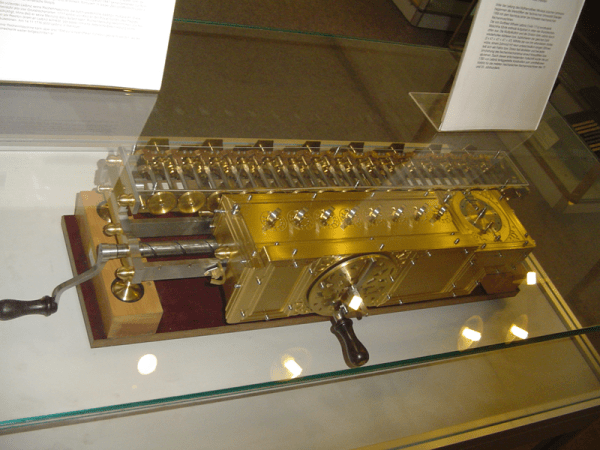
Earlier this year, [Dan Maloney] went inside mechanical calculators. Being the practical sort, [Dan] jumped right into the Pascaline invented by Blaise Pascal. It couldn’t multiply or divide. He then went into the arithmometer, which is arguably the first commercially successful mechanical calculator with four functions. That was around 1821 or so. But [Dan] mentions it used a Leibniz wheel. I thought, “Leibniz? He’s the calculus guy, right? He died in 1716.” So I knew there had to be at least a century of backstory to get to the arithmometer. Having a rainy day ahead, I decided to find out exactly where the Leibniz wheel came from and what it was doing for 100 years prior to 1821.

If you’ve taken calculus you’ve probably heard of Gottfried Wilhelm Leibniz (who would have been 372 years old on July 1st, by the way). He’s the guy that gave us the notation we use in modern calculus and oddly was one of two people who apparently figured out calculus, the other being Issac Newton. Both men, by the way, accused each other of stealing, although it is more likely they both built on the same prior work. When you are struggling to learn calculus, it is sometimes amazing that not only did someone think it up, but two people thought it up at one time. However, Leibniz also built what might be the first four function calculator in 1694. His “stepped reckoner” used a drum and some cranks and the underlying mechanism found inside of it lived on until the 1970s in other mechanical calculating devices. Oddly, Leibniz didn’t use the term stepped reckoner but called the machine Instrumentum Arithmeticum.

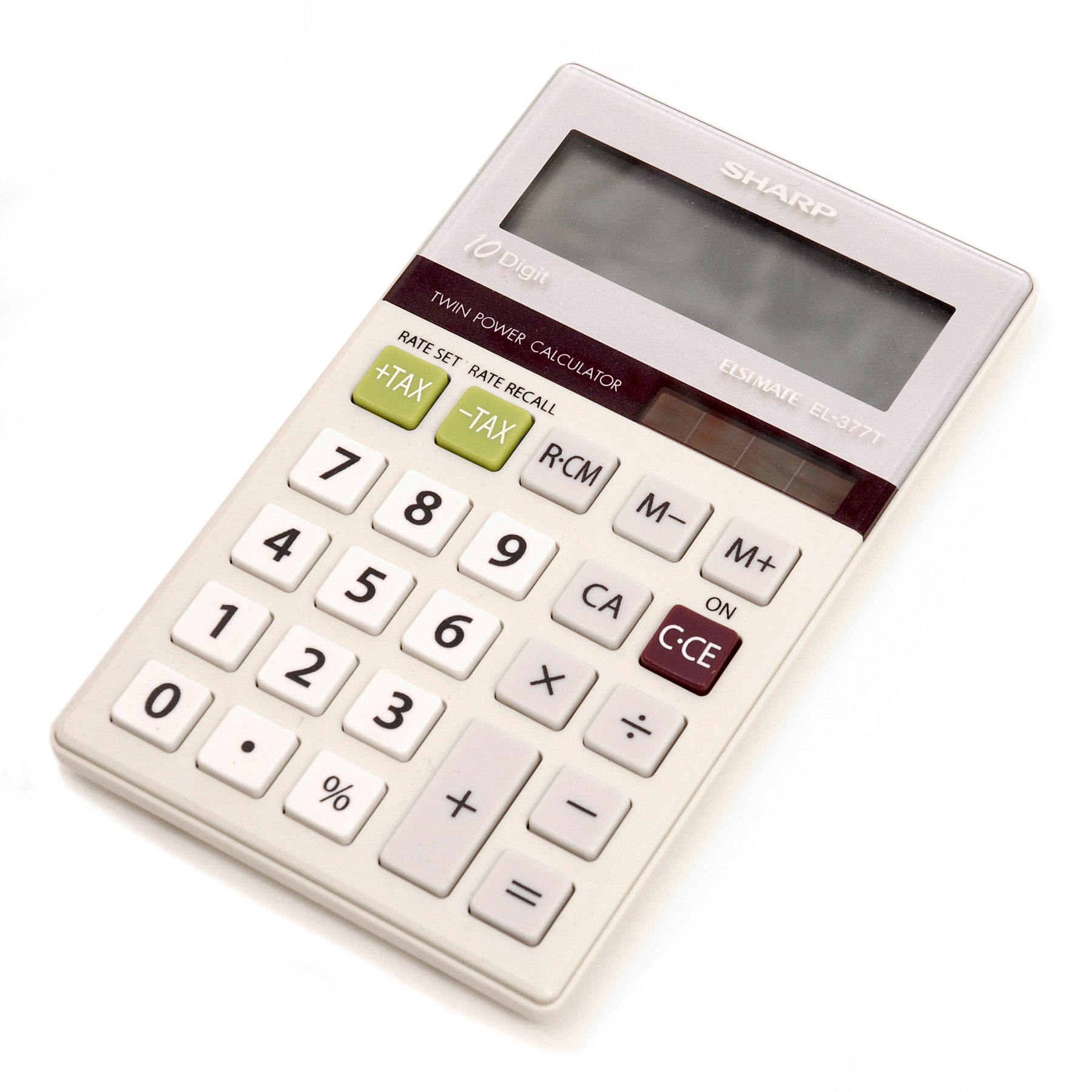
Many of us remember when a four function electronic calculator was a marvel and not even very inexpensive. Nowadays, you’d have to look hard to find one that only had four functions and simple calculators are cheap enough to give away like ink pens. But in 1694, you didn’t have electronics and integrated circuits necessary to pull that off.

Continue reading “Calculus And A Calculator”

These Capacitors Are A Cheap Gimmick

If you search through an electrical engineering textbook, you probably aren’t going to find the phrase “gimmick capacitor” but every old ham radio operator knows about them. They come in handy when you need a very small capacitor of unknown value. For example, if you are trying to balance the stray capacitance in a circuit, you might not know exactly what value you need, but you know it won’t be very much. That’s when you want a gimmick capacitor.

A gimmick capacitor is made by taking two strands of insulated wire and twisting them together; the length and the tightness of the twist determine the capacitance. Tightening or loosening the twist, or trimming some of the wire off, makes it tunable.

These are most commonly found in RF equipment or high-speed logic because of the small capacitance involved — usually about 1 to 2 pF per inch of twist or so. The thicker the insulation, the less capacitance you’ll get, so it is common to use magnet wire or something else with a thin insulating layer. You can take this one step further and decrease the spacing by stripping down one wire as long as it isn’t going to touch anything else.

Obviously, the insulation needs to be good enough for the voltage on them, an important consideration in tube circuits, for instance. But other than that, a gimmick capacitor is a straightforward tool to have in your box of design tricks. Can we take this further? Continue reading “These Capacitors Are A Cheap Gimmick”

Load Bank Teardowns Show Danger

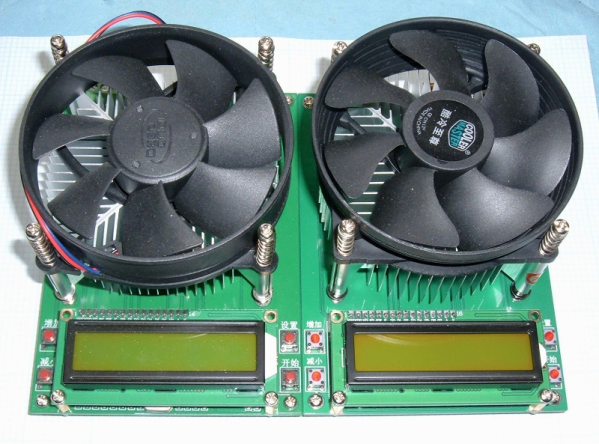
[Syonyk] has been acquiring some large load banks to test power supplies and battery packs. These devices consist of a big current sink, a measurement device, and a fan. He picked up two similar-looking boards from the usual Chinese sources, both rated for 150W, both for about $30. Upon closer examination, though, he found that one was really a bargain and the other was likely to blow up.

The loads are rated for 60V and as you can see from the photos, appear virtually identical at a glance. They offer a configurable cut-off voltage and even use 4-wire measurement to avoid problems with voltage drop through the power cables.

Continue reading “Load Bank Teardowns Show Danger”