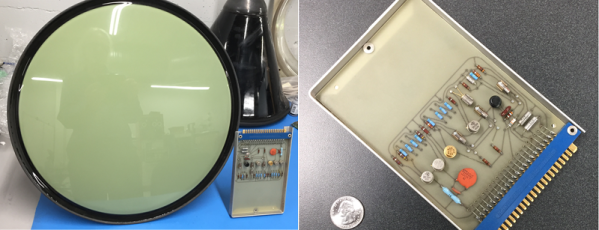
Refurbishing A DEC 340 Monitor

Back in the “good old days” movie theaters ran serials. Every week you’d pay some pocket change and see what happened to Buck Rogers, Superman, or Tex Granger that week. Each episode would, of course, end in a cliffhanger. [Keith Hayes] has started his own serial about restoring a DEC 340 monitor found in a scrap yard in Australia. The 340 — not a VT340 — looks like it could appear in one of those serials, with its huge cabinets and round radar-like display. [Keith] describes the restoration as “his big project of the year” and we are anxious to see how the cliffhangers resolve.

He’s been lucky, and he’s been unlucky. The lucky part is that he has the cabinet with the CRT and the deflection yoke. Those would be very difficult to replace. The unlucky part is that one entire cabinet of electronics is missing.


Continue reading “Refurbishing A DEC 340 Monitor”

What Is Our Martian Quarantine Protocol?

If you somehow haven’t read or watched War of the Worlds, here’s a spoiler alert. The Martians are brought down by the common cold. You can argue if alien biology would be susceptible to human pathogens, but if they were, it wouldn’t be surprising if aliens had little defense against our bugs. The worrisome part of that is the reverse. Could an astronaut or a space probe bring back something that would ravage the Earth with some disease? This is not science fiction, it is both a historically serious question and one we’ll face in the near future. If we send people to Mars are they going to come back with something harmful?

A Bit of News: Methane Gas Fluctuations on Mars

What got me thinking about this was the mounting evidence that there could be life on Mars. Not a little green man with a death ray, but perhaps microbe-like life forms. In a recent press release, NASA revealed that they not only found old organic material in rocks, but they also found that methane gas is present on Mars and the amount varies based on the season with more methane occurring in the summer months. There’s some dispute about possible inorganic reasons for this, but it is at least possible that the variation is due to increased biological activity during the summer.

Continue reading “What Is Our Martian Quarantine Protocol?”

The Colpitts Oscillator Explained

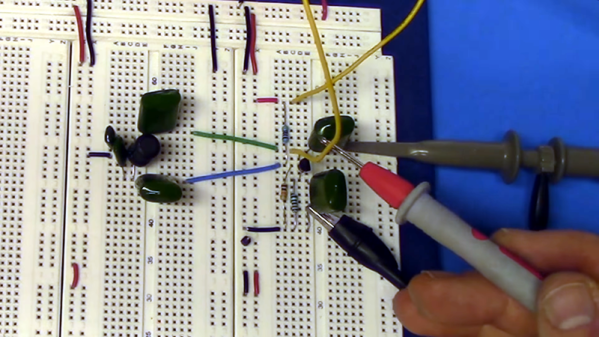
The Colpitts oscillator is a time-tested design — from 1918. [The Offset Volt] has a few videos covering the design of these circuits including an op-amp and a transistor version. You can find the videos below.

You can tell a Colpitts oscillator by the two capacitors in the feedback circuit. The capacitors form an effective capacitance for the circuit (assuming you have C1 and C2) of the product of C1 and C2 divided by the sum of the two capacitors. The effective capacitance and the inductance form a bandpass filter that is very sharp at the frequency of interest, allowing the amplifier to build up oscillations at that frequency.

Continue reading “The Colpitts Oscillator Explained”

Learn Six Oscilloscope Measurements With One Arduino

We won’t mention names, but we are always dismayed to see people twist knobs randomly on a scope until it shows a good picture. These days, there’s the dreaded auto button, too, which is nearly as bad. If you haven’t spent the time to learn how to properly use a scope [Bald Engineer] has a great introduction to making six measurements with an Arduino as a test device.

To follow along you’ll need an Arduino UNO and a two-channel (or better) scope. Actually, most of the measurements would probably work on any Arduino, but there are some that require the separate USB to serial chip like that found on the UNO and similar boards.

The six measurements are:

  1. The auto reset programming pulse
  2. Capture and decode serial data
  3. Noise on the power rail
  4. Observe probe loading effects
  5. PWM duty cycle
  6. The timing of pin manipulation code

Some of these measurements use a bit of Arduino code, while others just make use of the circuitry on the board no matter what software is running.

Not only does the post show you where to make the measurements and what the result should look like, there’s also a discussion of what the measurement means and some suggested things to try on your own.

If you go through this post, you might also enjoy learning more about probes. If you are feeling adventurous, you can even build your own current probe.

FPV-Rover 2.0 Has 3D Printed Treads And Plenty Of Zip

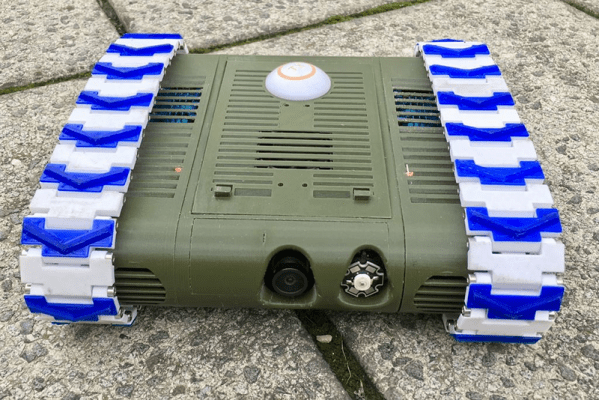
[Markus_p] has already finished one really successful 3D printed tracked robot build. Now he’s finished a second one using standard motors and incorporating what he learned from the first. The results are pretty impressive and you can see a video demo of the beast, below.

Most of the robot is PLA, although there are some parts that use PETG and flex plastic. There is an infrared-capable camera up front and another regular camera on the rear. All the electronics are pretty much off the shelf modules like an FPV transmitter and an electronic controller for the motors. There’s a servo to tilt the camera, as you can see in the second video.

The body fits together using nuts and magnets. The robot in the video takes a good beating and doesn’t seem to fall apart so it must be sufficient. What appealed to us was the size of the thing. It looks like it would be trivially easy to mount some processing power inside or on top of the rover and it could make a great motion base for a more sophisticated robot.

We’ve seen some similar projects, of course. This tracked robot uses mind control. And OpenWheel is a great place to get treads and other locomotion designs.

Continue reading “FPV-Rover 2.0 Has 3D Printed Treads And Plenty Of Zip”

3D Printer Tech Cuts Paper

While 3D printing has been a great thing all by itself, it has also made electromechanical hardware a commodity item. Instead of raiding an old printer for motors and rods of unknown provenance, you can now buy everything very inexpensively due to the economy of scale and offshore manufacturing.

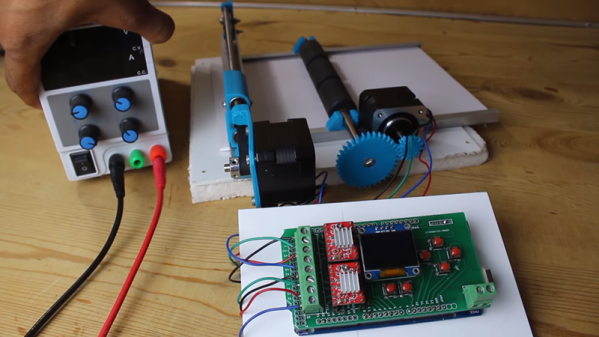
[Mr. Innovation] proves this point with his recent paper cutting machine which feeds and slices paper strips with user-selected width and quantity. He did steal one roller assembly from an old printer, but most of it is straight out of a 3D printer build. There’s NEMA stepper motors, modular motor driver boards, smooth rods, belts, and pulleys.

The blade of the cutter is just a standard snap off box cutter blade. It is angled so it doesn’t drag when the motor pulls it back to the home position after a cut. Honestly, we might have made the paper mechanism retract the paper a bit at that point, but that would be simple to add to the device’s firmware.

Continue reading “3D Printer Tech Cuts Paper”

Portable Ham Radio Design Fosters Experiments

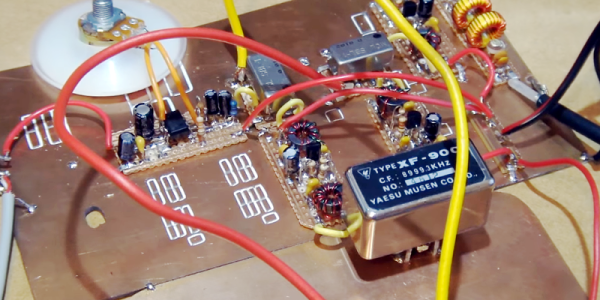
[Charlie Morris] has been busy building a portable ham radio rig and documenting his progress in a series of videos. You can see the first one below. There’s four parts (more if you count things like part 4 and part 4a as two parts) so far and it is always interesting to see inside a build like this, where the choices and tradeoffs are explained.

The first part covers the Si5351 VFO and the associated display. There’s very little to the VFO other than off-the-shelf modules including an Arduino. You can also see the portable Morse code key which is actually a micro switch. The second part experiments with audio amplifiers. [Charlie] looked at the NE5534 vs discrete amplifiers. He was shooting for lowest current draw that was usable. Other parts discuss the RF amplifier and the receiver. Despite the VFO, there is quite a bit of non-module parts by the time things start shaping up.

Continue reading “Portable Ham Radio Design Fosters Experiments”