Hakko FX-901: Better Than TS-100?

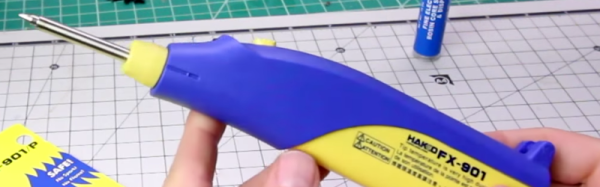
You’ve surely seen the TS-100 soldering iron. It has an OLED display, an ARM processor, and will run with an external battery pack. They are not too pricey, but at $80 or so they aren’t exactly an impulse buy, either. [Drone Camps RC] used one in the field and decided to try a Hakko FX-901 instead. He did a video review that you can see below.

The FX-901 is about half the price of a TS-100. Granted, it doesn’t have a fancy display and you can’t hack it to play Tetris. However, it does take batteries (including rechargeable) without an external pack. The manufacturer claims up to two hours of use and that it will melt solder in 40 seconds. From the video, the iron actually melted solder in under 30 seconds. The two hours, by the way, is with rechargeables. Alkaline AA batteries should give about 70 minutes of operation.

Continue reading “Hakko FX-901: Better Than TS-100?”

Antenna Basics By Whiteboard

Like a lot of people, [Bruce] likes radio controlled (RC) vehicles. In fact, many people get started in electronics motivated by their interest in RC. Maybe that’s why [Bruce] did a video about antenna basics where he spends a little more than a half hour discussing antennas. You can see the video below.

[Bruce] avoids any complex math and focuses more on intuition about antennas, which we like. Why does it matter that antennas are cut to a certain length? [Bruce] explains it using a swing and a grandfather clock as an analogy. Why do some antennas have gain? Why is polarization important? [Bruce] covers all of this and more. There’s even a simple experiment you can do with a meter and a magnet that he demonstrates.

Continue reading “Antenna Basics By Whiteboard”

Theremin In Detail

[Keystone Science] recently posted a video about building a theremin — you know, the instrument that makes those strange whistles when you move your hands around it. The circuit is pretty simple (and borrowed) but we liked the way the video explains the theory and even dives into some of the math behind resonant frequencies.

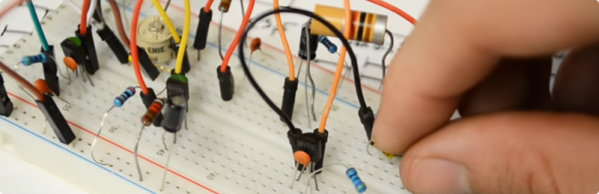
The circuit uses two FETs for the oscillators. An LM386 amplifier (a Hackaday favorite) drives a speaker so you can use the instrument without external equipment. The initial build is on a breadboard, but the final build is on a PCB and has a case.

Continue reading “Theremin In Detail”

Microchip ICD4 REview

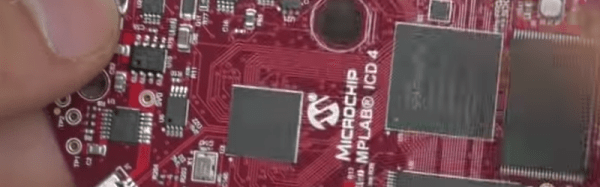
[Mike] is an avid PIC developer and replaced his ICD3 debugger for an ICD4. He made a video with his impressions and you can see it below. [Mike] found the heavy aluminum case with a sexy LED attractive, but wondered why he was paying for that in a development tool. He was also unhappy that they replaced the ICD3 cable connections with new connectors. Finally, he wished for the pin out to be printed on the case.

On the other hand, the ICD4 will also do JTAG and handle the Atmel parts (which Microchip acquired). [Mike] opens the box and shows the inside of the device before actually using it for the intended task.

Continue reading “Microchip ICD4 REview”

Hardware For Deep Neural Networks

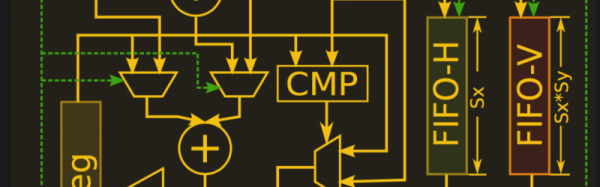
In case you didn’t make it to the ISCA (International Society for Computers and their Applications) session this year, you might be interested in a presentation by [Joel Emer] an MIT  professor and scientist for NVIDIA. Along with another MIT professor and two PhD students ([Vivienne Sze], [Yu-Hsin  Chen], and [Tien-Ju Yang]), [Emer’s] presentation covers hardware architectures for deep neural networks.

The presentation covers the background on deep neural networks and basic theory. Then it progresses to deep learning specifics. One interesting graph shows how neural networks are getting better at identifying objects in images every year and as of 2015 can do a better job than a human over a set of test images. However, the real key is using hardware to accelerate the performance of networks.

Hardware acceleration is important for several reasons. For one, many applications have lots of data associated. Also, training can involve many iterations which can take a long time.

Continue reading “Hardware For Deep Neural Networks”

Language Parsing With ANTLR

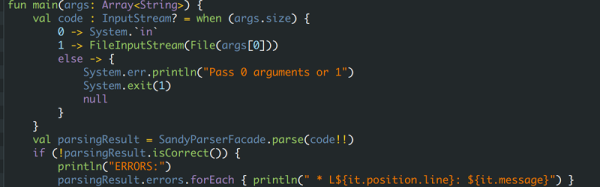
There are many projects that call out for a custom language parser. If you need something standard, you can probably lift the code from someplace on the Internet. If you need something custom, you might consider reading [Federico Tomassetti’s] tutorial on using ANTLR to build a complete parser-based system. [Frederico] also expanded on this material for his book, but there’s still plenty to pick up from the eight blog posts.

His language, Sandy, is complex enough to be a good example, but not too complex to understand. In addition to the posts, you can find the code on GitHub.

Continue reading “Language Parsing With ANTLR”

Raspberry Pi AI Plays Piano

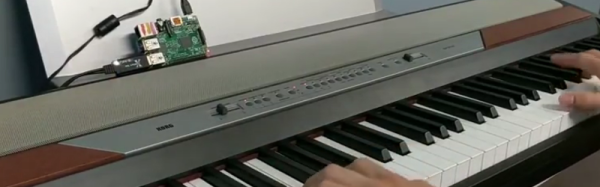
[Zack] watched a video of [Dan Tepfer] using a computer with a MIDI keyboard to do some automatic fills when playing. He decided he wanted to do better and set out to create an AI that would learn–in real time–how to insert style-appropriate tunes in the gap between the human performance.

If you want the code, you can find it on GitHub. However, the really interesting part is the log of his experiences, successes, and failures. If you want to see the result, check out the video below where he riffs for about 30 seconds and the AI starts taking over for the melody when the performer stops.

Continue reading “Raspberry Pi AI Plays Piano”