Digital Clock Goes With The Grain

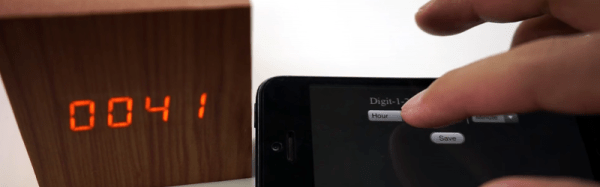
This good-looking clock appears to be made out of a block of wood with LED digits floating underneath. In reality, it is a block of PLA plastic covered with wood veneer (well, [androkavo] calls it veneer, but we think it might just be a contact paper or vinyl with a wood pattern). It makes for a striking effect, and we can think of other projects that might make use of the technique, especially since the wood surface looks much more finished than the usual 3D-printed part.

You can see a video of the clock in operation below. The clock circuit itself is nothing exceptional. Just a MAX7218 LED driver and a display along with an STM32 ARM processor. The clock has a DHT22 temperature and humidity sensor, as well as a speaker for an alarm.

Continue reading “Digital Clock Goes With The Grain”

IMSAI 8080 Resurrection

When MITS introduced the Altair 8800–about 43 years ago–it spawned the first personal computer clone: the IMSAI 8080. The clone had several improvements and MITS had difficulty filling orders for real Altairs, so they sold pretty well. [IMSAI Guy] has one of these vintage computers that has been in storage for over 30 years. He’s restoring the thing and there are 26 (and counting) videos of his progress. You can see the second video below, but be sure to check out the others, too.

The IMSAI is famous for being in the movie Wargames. We miss computers with switches and LEDs on a working front panel.

Continue reading “IMSAI 8080 Resurrection”

The Internet Of Cigars

We know, we know. They are bad for you. You shouldn’t start, but some people do love a cigar. And a fine cigar is pretty particular about drying out. That’s why tobacconists and cigar aficionados store their smokes in a humidor. This is anything from a small box to a large closet that maintains a constant humidity. Of course, who could want such a thing these days without having it connected to the Internet?

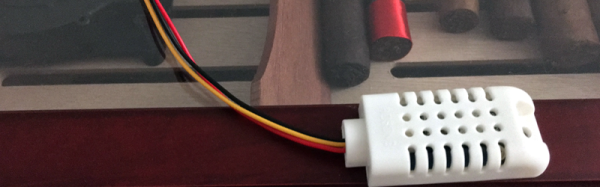
This fine-looking humidor uses a Raspberry Pi. When the humidity is low, an ultrasonic humidifier adds moisture to the air. If it gets too high, a fan circulates the air until it balances out. Who knew cigar smoking could be so high-tech? The humidity sensor is an AM2302. There’s also a smart USB hub that can accept commands to turn the fan and humidifier on and off.

The wooden cabinet was an existing humidor, apparently. [Atticakes] says he spent about $100 total but that a commercial equivalent would have been at least $250. You can find his source code on GitHub.

If you are vehemently anti-cigar, we should point out that there are other uses for such a device. Because of Denver’s low humidity, for example, the Colorado Rockies baseball team store game balls in a large humidor.

For the record, a zip lock bag can do in a pinch. Without something, the experts say the cigar starts to change negatively in two or three days.

First networkable humidor we’ve seen? Hardly. If you need something to light that stogie, we suggest a laser.

Sense Hat Comes Alive

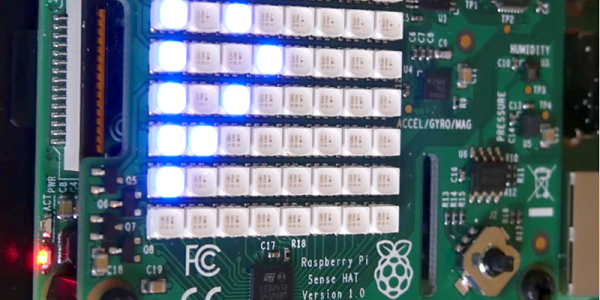
Remember the Raspberry Pi Sense Hat? Originally designed for a mission to the International Space Station, the board has quite a few sensors onboard as well as an 8×8 RGB LED matrix. What can you do with an 8×8 screen? You might be surprised if you use [Ethan’s] Python Sense Hat animation library. You can get the full visual effect in the video below.

The code uses an array to represent the screen, which isn’t a big deal since there are only 64 elements. Turning on a particular element to animate, say, a pong puck, isn’t hard with or without the library. Here’s some code to do it with the library:

for x in range(0,7):
 ect.cell(image,[0,x],[randint(0,255), randint(0,255), randint(0,255)],0.1)
 ect.cell(image,[0,x],e,0.1)
for x in range(7,0, -1):
 ect.cell(image,[0,x],[randint(0,255), randint(0,255), randint(0,255)],0.1)
 ect.cell(image,[0,x],e,0.1)

Each loop draws a box with a random color and then erases it before going to the next position. The second for loop makes the puck move in the opposite direction. You can probably deduce that the first argument is the screen array, the second is the position. The third argument sets the color, and the final argument sets an animation timer. Looking at the code, though, it does look like the timer blocks which is probably not going to work for some applications.

If that’s all there was, this wouldn’t be worth too much, but you can also draw triangles, circles, and squares. For example:

ect.circle(image,(4,4), 3, [randint(0,255), randint(0,255), randint(0,255)], 0.1)

We covered the Sense Hat awhile back. Of course, it does a lot more than just light up LEDs as you can see from this weather dashboard.

Continue reading “Sense Hat Comes Alive”

Hack Your Hot Air Station

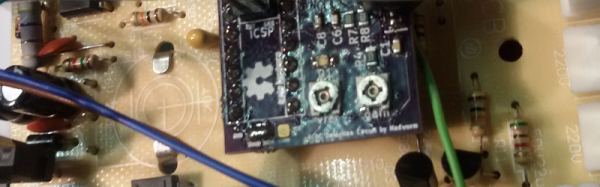
It used to be hot air soldering gear was exotic, but not anymore. There are plenty of relatively inexpensive choices. Many of these appear to be the same despite having different brand names and model numbers. One that is common and inexpensive is the 858D. These run about $50. [Gabse] has one and decided to upgrade it using some open source controller hardware and software. There wasn’t a complete guide, so he created one himself.

According to the original GitHub page, the controller will work with the Youyue-858D and any clones. However, there are others like the Atten 858D that use a different controller. In addition, there have been several variants. [Gabse’s] guide is for the latest version. Information on other versions and brands might be on this discussion board thread.

Continue reading “Hack Your Hot Air Station”

Ohm? Don’t Forget Kirchhoff!

It is hard to get very far into electronics without knowing Ohm’s law. Named after [Georg Ohm] it describes current and voltage relationships in linear circuits. However, there are two laws that are even more basic that don’t get nearly the respect that Ohm’s law gets. Those are Kirchhoff’s laws.

In simple terms, Kirchhoff’s laws are really an expression of conservation of energy. Kirchhoff’s current law (KCL) says that the current going into a single point (a node) has to have exactly the same amount of current going out of it. If you are more mathematical, you can say that the sum of the current going in and the current going out will always be zero, since the current going out will have a negative sign compared to the current going in.

You know the current in a series circuit is always the same, right? For example, in a circuit with a battery, an LED, and a resistor, the LED and the resistor will have the same current in them. That’s KCL. The current going into the resistor better be the same as the current going out of it and into the LED.

This is mostly interesting when there are more than two wires going into one point. If a battery drives 3 magically-identical light bulbs, for instance, then each bulb will get one-third of the total current. The node where the battery’s wire joins with the leads to the 3 bulbs is the node. All the current coming in, has to equal all the current going out. Even if the bulbs are not identical, the totals will still be equal. So if you know any three values, you can compute the fourth.

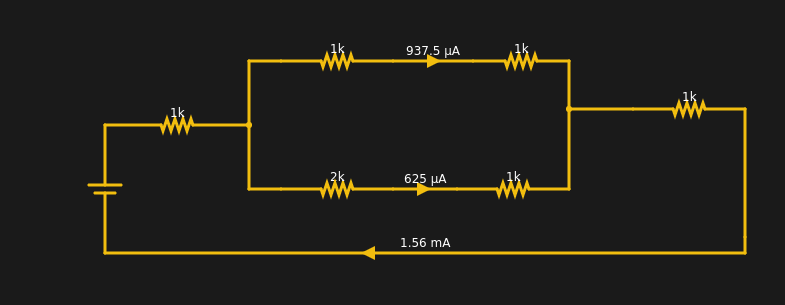
If you want to play with it yourself, you can simulate the circuit below.

The current from the battery has to equal the current going into the battery. The two resistors at the extreme left and right have the same current through them (1.56 mA). Within rounding error of the simulator, each branch of the split has its share of the total (note the bottom leg has 3K total resistance and, thus, carries less current).

Continue reading “Ohm? Don’t Forget Kirchhoff!”

Radar Sensors Put To The Test

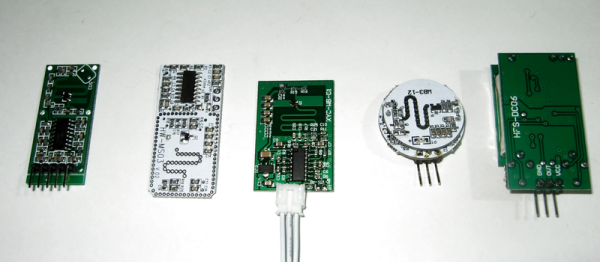
[Andreas Spiess] picked up a few inexpensive radar sensors. He decided to compare the devices and test them and–lucky for us–he collected his results in a video you can see below.

The questions he wanted to answer were:

  • Are they 3.3 V-compatible?
  • How much current do they draw?
  • How long to they show a detection?
  • How far away can they detect the motion of a typical adult?
  • What is the angle of detection?
  • Can they see through certain materials?
  • Can the devices coexist with other devices in the same area? What about WiFi networks?

Good list of questions, and if you want to know the answers, you should watch the video.

Continue reading “Radar Sensors Put To The Test”