Your Next Desktop… QNX?

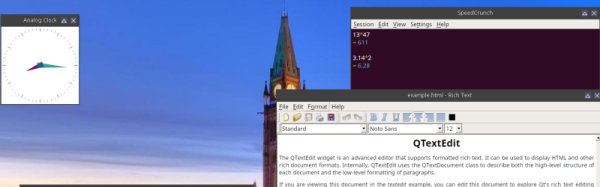
QNX has a long checkered history as an embedded operating system. QNX was always famous for being a real time operating system with a microkernel architecture. That is, kernel functions run as a set of coordinated tasks instead of as a single piece of code. A recent release of QNX 7 (see video, below) allows it to run on 64-bit desktop computers and [elahav] decided to tackle turning this embedded RTOS into a desktop operating system.

That might sound far-fetched, but QNX is a POSIX-compliant system and has all the features you’d expect in a system like Linux or BSD. It just isn’t aimed at the desktop market and therefore doesn’t have a lot of tools for running the desktop. QNX isn’t the kind of RTOS you’ll find on an Arduino. It is more common in things like automobile systems (for example, it runs General Motor’s OnStar system).

He started with a mini ITX board and installed QNX. Usually, you develop for an embedded system on a workstation and then just ship the code over to the target system, but [elahav] took the time to get a build system working on the target. There was one problem. The built-in vi editor was primitive by modern standards. He is usually an emacs user, but even vim would be better than the “stock” vi. While an emacs port would be possible, it would also require porting over a lot of libraries, so his first project was to get the vim source code to compile.

Turned out not to be as easy as he had hoped. The build system expected certain GNU tools that didn’t exist yet (although standard versions of the tools, like grep, did exist). So he had to figure out how to cross compile vim. In retrospect, [elahav] decided he should have just ported the GNU tools first. He did have to remove some old code from vim that was aimed at an older version of QNX.
Continue reading “Your Next Desktop… QNX?”

How To Reverse Engineer A Chip

Have you ever wondered how you could look at a chip and map out its schematic? [Robert Baruch] wants to show you how he does it and he does in a new video (see below).  The video assumes you know how to expose the die because he’s made a video about that before.

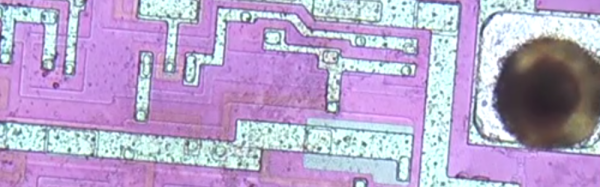
This video focuses on using his Beaglebone-driven microscope stage to get high-resolution micrographs stitched together from smaller shots. A 3D-printed sample holder keeps the part from moving around. Luckily, there’s software to stitch the images together. Once he has the die photo, he will etch away the metal to remove the passivation, the metal layer, and the silicon dioxide under the metal and takes another set of photos.

Continue reading “How To Reverse Engineer A Chip”

Copper Foil Makes Music–With A Little Help

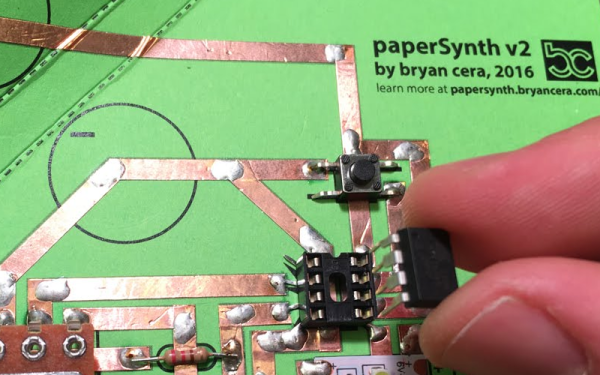
Craft stores are often the source of odd inspiration. In the stained glass section, we’ve seen the copper foil, and even used it to prototype some RF circuits on the tops of shoeboxes. However, we could never get a good method for connecting ICs to the relatively thick foil. [Bryan Cera] did it though. His paperSynth uses some paper and cardboard for a substrate, copper foil, and an ATtiny CPU to make music. You can see the device in operation in the video, below.

The copper foil is sticky and it isn’t conductive on the back, so anywhere the foil is supposed to touch, you need a blob of solder. We wouldn’t trust the insulation by itself to cross wires, but with a bit of insulating material between–a piece of paper or electrical tape, for example–you could probably cross with impunity. For an RF circuit, you might even make low-value capacitors like that.

Continue reading “Copper Foil Makes Music–With A Little Help”

Restoring A Japanese Oscilloscope

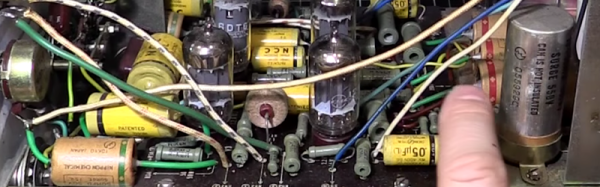
Oscilloscopes have come a long way. Today’s scope is more likely to look like a tablet than an old tube-based instrument. Still, there’s something about looking into a glowing green tube, especially if you’ve done the work to resurrect that old hollow state device. [NFM] picked up a Kikusui OP-31C–a vintage Japanese scope at a second-hand store. He made a video of his restoration efforts that you can see below.

The scope actually powered up and worked the first time. Of course, unlike a modern scope, the OP-31C has to warm up before it will show up. However, the pots needed cleaning and as a precaution, he replaced the old oil and electrolytic capacitors.

The big transformer and the coarse-looking single sided circuit board certainly will bring back memories if you are old enough. [NFM] had a schematic of the scope and takes you on a tour of the innards, although his schematic had some subtle differences from the actual unit, possibly due to some repair work.

He was going to rebuild one of the large electrolytic “can” capacitors to keep the outer shell with newer (and smaller) modern capacitors. However, he found a very similar modern capacitor and used that, instead.

We think it would have been more fun if the scope didn’t work. However, it was still a great tear down of the old tube-based device. This is a bigger device than the last old scope tear down we looked at. Not that we haven’t seen smaller ones (although, the link in the post has moved).

Continue reading “Restoring A Japanese Oscilloscope”

STM32 Analog Converter Phase Noise

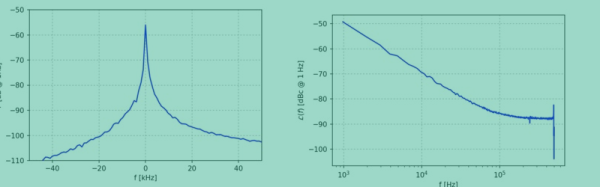
[Avian] has been using STM32 ARM processors to sample RF for a variety of applications. At first, he was receiving relatively wide TV signals. Recently, though, he’s started dealing with very narrow signals and he found that his samples had a lot of spread in the frequency domain that he didn’t expect.

What followed was some detective work that resulted in a determination that phase noise was the culprit. But why? [Avian] took some measurements and noticed that the phase noise almost exactly matched the phase noise specification for the STM32’s phase locked loop (PLL).

Unfortunately, there didn’t seem to be a good way to avoid using the PLL without major changes to the rest of the circuit. However, it was quite the learning experience and something to be aware of when counting on built-in converters for high-accuracy measurements.

One of the best things about this post is the references to more information. There’s a great explanation of phase noise, as well as a specific application note about clock jitter and analog converters.

We’ve talked about phase noise in direct digital synthesis a few times. But usually, it is pretty obvious like when you are asking a CPU to double as an RF transmitter. [Avian’s] post was a bit more of a detective story.

TI 99/4A Weather Station

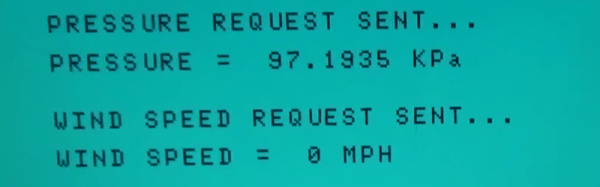
If you still have a drawer full of slap bracelets from the 1990s because, you know, they might come back, then you’ll appreciate [Vorticon’s] latest project. Sure, we see lots of weather stations, but this one is controlled by a TI 99/4A computer. This home computer from the 1980s was actually ahead of its time with a 16-bit processor.

The sensors use Xbee modules and an Arduino Uno. Of course, the Uno has more power than the TI computer, but that’s not really the point, right? He’s made a series of videos detailing the construction (you can see the first one below, but there are five, so far).

Continue reading “TI 99/4A Weather Station”

Teensy And 3D Printer Make Beautiful Music Together

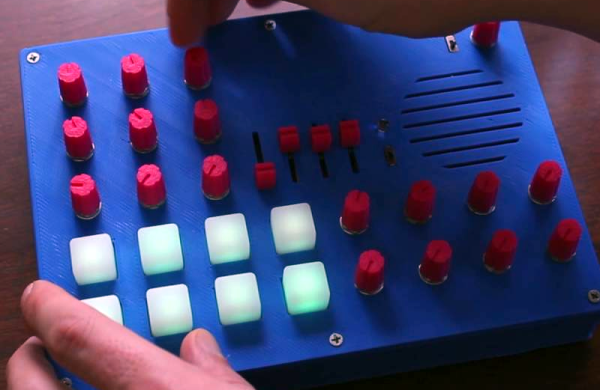
[Otermrelik] wanted to experiment with the Teensy audio library and adapter. That, combined with his 3D printer, led to a very cool looking build of the teensypolysynth. The device looks like a little mini soundboard with sliders and 3D printed knobs. You can see (and hear) it in the video below.

The Teensy audio library supports several output devices including several built-in options and external boards like the audio adapter used here. The library does CD-quality sound, supports polyphonic playback, recording, synthesis, mixing, and more.

Continue reading “Teensy And 3D Printer Make Beautiful Music Together”