Speakers Make A LASER Scanning Microscope

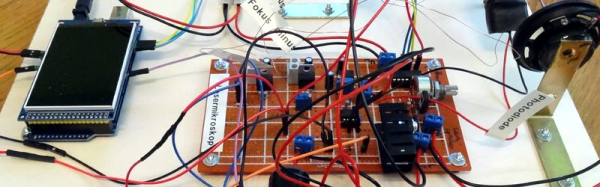
We’ve seen a lot of interest in LSM (LASER Scanning Microscopes) lately. [Stoppi71] uses an Arduino, a CD drive, and–of all things–two speakers in his build. The speakers are used to move the sample by very small amounts.

The speakers create motion in the X and Y axis depending on the voltage fed to them via a digital analog converter. [Stoppi71] claims this technique can produce motion in the micron range. His results seem to prove that out. You can see a video about the device, below.

Continue reading “Speakers Make A LASER Scanning Microscope”

Giving Linux The Remote Boot

A lot of embedded systems are running Linux on platforms like Raspberry Pi. Since Linux is fully functional from a command line and fully network-capable, it is possible to run servers that you’ve never had physical access to.

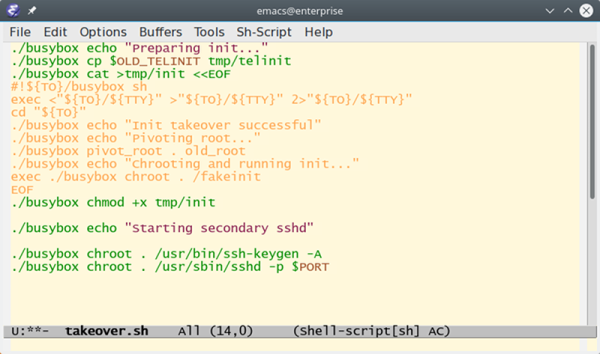
There are a few problems, though. Sometimes you really need to reboot the box physically. You also need to be at the console to do things like totally install a new operating system. Or do you? Over on GitHub, user [marcan] has a C program and a shell script that allows you to take over a running system without using any software on the root filesystem. It starts an ssh server and you can remotely unmount the main drive, do any maintenance you want and –presumably–reboot into a new operating system.

Continue reading “Giving Linux The Remote Boot”

CheetahBeam: More Proof That Cats Are Your Overlord

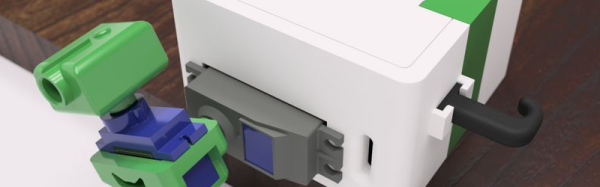
We don’t know what cats see when they see a red laser beam, but we know it isn’t what we see. The reaction, at least for many cats — is instant and extreme. Of course, your cat expects you to quit your job and play with it on demand. While [fluxaxiom] wanted to comply, he also knew that no job would lead to no cat food. To resolve the dilemma, he built an automated cat laser. In addition to the laser module, the device uses a few servos and a microcontroller in a 3D printed case. You can see a video, below. Dogs apparently like it too, but of course they aren’t the reason it was built.

If you don’t have a 3D printer, you can still cobble something together. The microcontroller is an Adafruit Pro Trinket, which is essentially an Arduino Pro Mini with some extra pins and a USB port.

Continue reading “CheetahBeam: More Proof That Cats Are Your Overlord”

3D Printed Rockets Are A Gas

We’ve probably all made matchstick rockets as kids. And around here anything that even vaguely looks like a rocket will get some imaginary flight time. But [austiwawa] is making some really cool 3D printed rockets that use common CO2 cartridges as a propellant. You can see them in action in the video below.

You might think just sticking a CO2 cylinder in a 3D printed jacket isn’t such a big deal, but [austiwawa] really went the extra mile. He read up on how to make the rocket stable (by manipulating the center of gravity versus the center of pressure) and explains what he had to do to get the rockets flying like you’d expect.

In addition, the launch tube is pretty interesting. A 3D printed part holds a sharp point and a spring. You lock the spring and when released it punches a clean hole in the propellant casing. The actual tube is a long piece of PVC pipe. From the video, it looks like these little rockets fly pretty high.

Judging from the video, the rocket body and launcher came from TinkerCAD. The way [austiwawa] put the fins on was both simple and clever.

Of course, you could also use Coke and propane, if you like. We’ve also seen some pretty cool setups with compressed air. Check out the rockets in action after the break,

Continue reading “3D Printed Rockets Are A Gas”

Baofeng Handy Talkie Meets GNU Radio

There was a time when just about every ham had a pricey VHF or UHF transceiver in their vehicle or on their belt. It was great to talk to friends while driving. You could even make phone calls from anywhere thanks to automatic phone patches. In 1980 cell phones were uncommon, so making a call from your car was sure to get attention.

Today, ham radio gear isn’t as pricey thanks to a flood of imports from companies like Baofeng, Jingtong, and Anytone. While a handheld transceiver is more of an impulse buy, you don’t hear as much chat and phone calls, thanks to the widespread adoption of cell phones. Maybe that’s why [Bastian] had bought a cheap Baofeng radio but never used it.

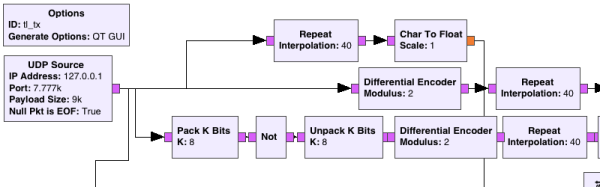
He was working on a traffic light project and wanted to send an RF signal when the light changes. He realized the Baofeng radio was cheap and cheerful solution. He only needed a way to have the PC generate an audio signal to feed the radio. His answer was to design a UDP packet to audio flow graph in GNU Radio. GNU Radio then feeds the Baofeng. The radio’s built-in VOX function handles transmit switching. You can see a video demonstration, below.

Continue reading “Baofeng Handy Talkie Meets GNU Radio”

The Smartest Computer Was On Star Trek

There have been a lot of smart computers on TV and movies. We often think among the smartest, though, are the ones on Star Trek. Not the big “library computer” and not the little silver portable computers. No, the smart computers on Star Trek ran the doors. If you ever watch, the doors seem to know the difference between someone walking towards it, versus someone flying towards it in the middle of a fist fight. It also seems to know when more people are en route to the door.

Granted, the reason they are so smart is that the doors really have a human operating them. For the real fan, though, you can buy a little gadget that looks like an intercom panel from the Enterprise. That would be cool enough, but this one has sound effects and can sense when someone walks into your doorway so they can hear the comforting woosh of a turbolift door.

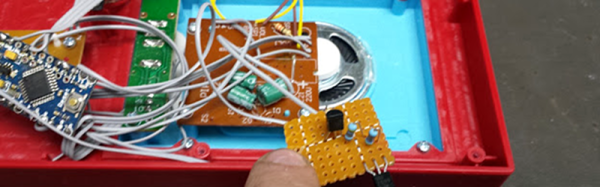
Of course, for the real hacker, that’s not good enough either. [Evan] started with this $25 gadget, but wanted to control it with an Arduino for inclusion in his hackerspace’s pneumatic door system. He did a bit of reverse engineering, a bit of coding, and he wound up in complete control of the device.

Continue reading “The Smartest Computer Was On Star Trek”

Acoustic Mirrors: How To Find Planes Without RADAR

A lot of science museums and parks feature something called an acoustic mirror. The one at Houston’s Discovery Green park is called the listening vessels. [Doug Hollis] created two acoustic mirrors 70 feet apart, pointing at each other. If you stand or sit near one of the vessels, you can hear a whisper from someone near the other vessel. The limestone installations (see right) are concave and focus sound like a parabolic mirror will focus light.

mirrorJust a science curiosity, right? Maybe today, but not always. The story of these devices runs through World War II and is an object lesson in how new technology requires new ways of thinking about things.



Continue reading “Acoustic Mirrors: How To Find Planes Without RADAR”