Hollow State Receiver

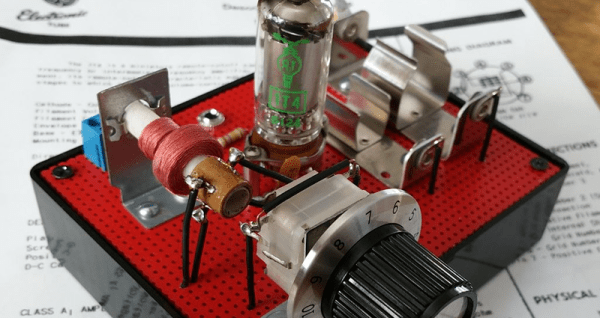
[Netzener] received a Radio Shack P-Box one tube receiver as a gift. However, at the time, his construction skills were not up to the task and he never completed the project. Years later, he did complete a version of it with a few modern parts substitutions. The radio worked, but he was disappointed in its performance. Turns out, the original Radio Shack kit didn’t work so well, either. So [Netzener] did a redesign using some some old books from the 1920’s. The resulting radio — using parts you can easily buy today — works much better than the original design.

The most expensive part of the build was a 22.5 V battery, which cost about $25. However, you can get away with using three 9 V batteries in series if you want to save some money. The battery provides the plate voltage for the 1T4 vacuum tube. A more conventional AA battery drives the tube’s filament. The original Radio Shack design relied on a variable inductor for tuning. These are difficult to find now, so [Netzener] uses a more conventional adjustable coil and a common tuning capacitor.

As an extra touch, [Netzener] painted the perf board to look as much like the original Radio Shack kit as possible. You can see from the pictures, it came out looking very good. If this isn’t challenging enough for you, maybe you want to roll your own tube. Or maybe you should just settle for the socket.


Continue reading “Hollow State Receiver”

Fictional Hacking: Michael Westen

I don’t know if it is true or not today, but in fiction, spies depend on lots of high-tech gadgets. I do know that during World War II, the various secret services like the OSS and the SOE did have gadgets like secret transmitters and concealed weapons. But, like [James Bond’s] grenade-launching ink pen, to [Maxwell Smart’s] shoe phone, those gadgets came from some organized lab. (When you watch the video below, remember that at that time, a personal phone going off in a theater was unknown as cell phones were years in the future.)

Continue reading “Fictional Hacking: Michael Westen”

Simple ECG Proves You Aren’t Heartless After All

We don’t think of the human body as a piece of electronics, but a surprising amount of our bodies work on electricity. The heart is certainly one of these. When you think about it, it is pretty amazing. A pump the size of your fist that has an expected service life of nearly 100 years.

All that electrical activity is something you can monitor and–if you know what to look for–irregular patterns can tell you if everything is OK in there. [Ohoilett] is a graduate student in the biomedical field and he shares some simple circuits for reading electrocardiogram (ECG) data. You can see a video fo the results, below.

Continue reading “Simple ECG Proves You Aren’t Heartless After All”

All About Eve

Most programming languages today look fairly similar. There’s small differences, of course (Python using spaces, Ruby and Perl have some odd-looking constructs). In the 1960s and 1970s, though, a lot of programming languages were pretty cryptic. Algol, APL, and LISP are great examples of unusual looking programming languages. Even FORTRAN and PL/1 were hard to read. RPG and COBOL were attempts to make programming more accessible, although you could argue that neither of them took over the world. Most programming languages today have more similarity to FORTRAN than either of those two languages.

A new programming language, Eve, claims to be based on years of research in programming from a human perspective instead of from the computer’s. The result is a language that works by pattern matching instead of the usual flow of control. It is also made to live inside of Markdown documents that can serve as documentation. You can see a video about Eve, below.

Neither of these are totally new ideas. SNOBOL, AWK, and Prolog all have some pattern-matching involved. [Donald Knuth] was promoting literate programming back in the 1980s. However, Eve understands modern constructs like web browsers.

Continue reading “All About Eve”

Personal Compass Points To Your Spawn Point

A conventional compass points north (well, to magnetic north, anyway). [Videoschmideo]  wanted to make a compass that pointed somewhere specific. In particular, the compass — a wedding gift — was to point to a park where the newlywed couple got engaged. Like waking up in a fresh new Minecraft world, this is their spawn point and now they can always find their way back from the wilderness.

The device uses an Arduino, a GPS module, a compass, and a servo motor. Being a wedding gift, it also needs to meet certain aesthetic sensibilities. The device is in an attractive wooden box and uses stylish brass gears. The gears allow the servo motor to turn more than 360 degrees (and the software limits the rotation to 360 degrees). You can see a video of the device in operation, below.

Continue reading “Personal Compass Points To Your Spawn Point”

Retrotechtacular: FAX As A Service In 1984

If you tell someone these days to send you something via FAX, you are likely to get a look similar to the one you’d get if you asked them to park your horse. But in 1984, FAX was a mysterious new technology (well, actually, it wasn’t, but it wasn’t yet common to most people).

fed-ex_zapFedEx–the people who got famous delivering packages overnight–made a bold move to seize a new market: Zapmail (not to be confused with the modern mass mailing service). The idea was simple (you can see a commercial for it in grainy VHS splendor below): Overnight is great, but sometimes you need something sent across the country now. A FedEx driver picks up your documents, carries them to a FedEx office. There the documents FAX to another FedEx office where another driver delivers the printed copy. The process took two hours to get a paper document from one side of the continent to another.

Continue reading “Retrotechtacular: FAX As A Service In 1984”

Drum On A Chip–Not That Kind Of Chip

Comedian Mitch Hedberg had a theory about Pringles potato chips. His theory is the company formed to make tennis balls. But instead of a truckload of rubber, someone accidentally sent them potatoes, so they made the best of it. Certainly the Pringles can is an iconic brand all by itself. The cans also have a lot of hacker history, since they are commonly used for WiFi cantennas (even though it might not be the best choice of cans). People also use them to build pinhole cameras, macro lenses, and a variety of cannon-like devices.

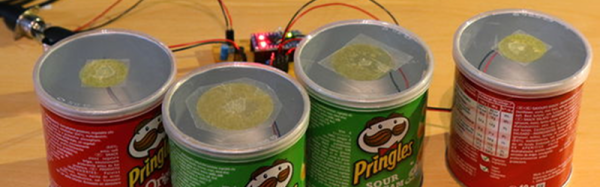
[Ian H] uses the short Pringles cans to build a drum kit. Clearly, the little cans aren’t going to make very much sound on their own, but with a piezo speaker element used in reverse, the cans become touch sensors that feed an Arduino and drive a MIDI device. You can see a video of the result, below.

Continue reading “Drum On A Chip–Not That Kind Of Chip”