Semisolid Lithium Ion Batteries Promise Better Cars, Solar

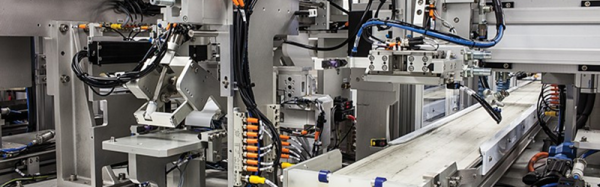
Lithium-ion batteries make possible smaller and lighter electronics. Unfortunately, they are also costly to produce. In a conventional lithium-ion battery, many thin layers create the finished product much like filo dough in baklava. A startup company called 24M thinks they have the answer to making less expensive lithium-ion batteries: a semisolid electrode made by mixing powders and liquid to form an electrolyte goo.

Not only will the batteries be cheaper and faster to create, but the cost of the factory will be less. Currently, 24M has a pilot manufacturing line, but by 2020 they expect to scale to produce batteries that cost less than $100 per kilowatt hour (today’s costs are about $200 to $250 for conventional batteries). Under $100, the batteries become competitive with the cost of internal combustion engines, according to the article.

Continue reading “Semisolid Lithium Ion Batteries Promise Better Cars, Solar” →

Quad Serial Adapter

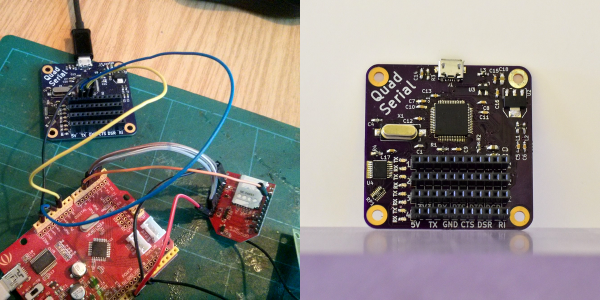
Despite concerted efforts to kill them, serial ports are alive and well, especially in embedded system. True, most of them end in a USB port, these days, but there’s still a lot of gear with a DE-9 (it isn’t a DB-9, despite the common use of the word) or a TTL-serial port lurking around. [James Fowkes] got tired of managing a bunch of USB to serial adapters, so he decided to build his own FT4232 breakout board that would provide four serial ports from a USB connection.

The small board has transmit and receive LEDs for each port along with EMI and ESD protection on the USB port. The ports are all TTL serial, serving the modern hacker, and the 3.3V pins are 5V tolerant.

Continue reading “Quad Serial Adapter” →

Making Graphene More Practical

[James Tour] and others at Rice University announced an improved form of graphene that uses nanoscale rivets. The material incorporates carbon nanotubes along with carbon spheres that encase iron nanoparticles. The nanotubes provide strength and higher conductivity overall, while the spheres let the material transfer more easily.

Typically, placing graphene on something involves using chemical vapor deposition on a polymer layer before transferring to another site. The polymer tends to degrade the graphene’s properties. This new material doesn’t require this intermediate step. In addition, the spheres allow interfacing to the graphene more readily.

Continue reading “Making Graphene More Practical” →

Retrotechtacular: The Incredibly Difficult Task Of Copying A Document

It seems hard to imagine, but in the early part of the 20th century, there weren’t a lot of great options for creating copies of documents. The most common method was to use carbon paper to create multiple copies at once from a typewriter or a line printer. All that changed with a company called Haloid. Never heard of them? They later became the Xerox company.

The underlying technology dates back to 1938 (invented by a physicist who was also a lawyer). In 1944, they produced a practical copier and shortly thereafter sold the rights to Haloid. The Haloid company originally made photographic copy machines that used wet chemistry.

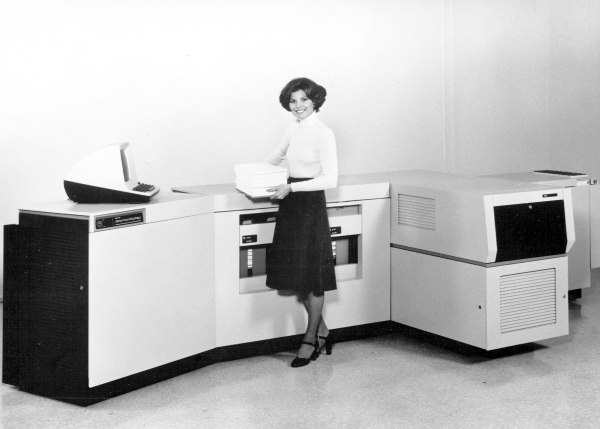
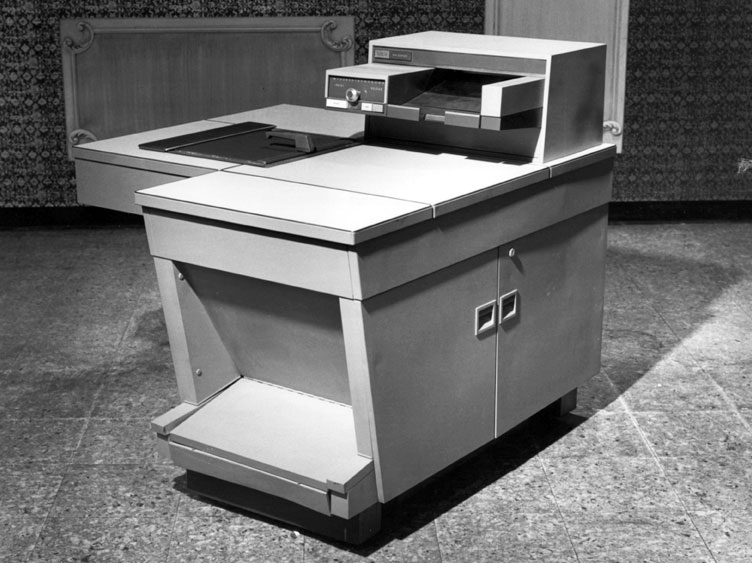
In 1959, the Xerox 914 (so called because it could copy a 9″ x 14″ document) came on the scene (that’s it, below). The 650 pound copier could make seven copies per minute and came with a fire extinguisher because it had a tendency to burst into flames. If you didn’t want to spend the $27,500 price tag, you could rent for only $25/month (keep in mind that in 1959, $25 would buy about 25 pounds of T-bone steaks). You can see a commercial for the 914 in the video below.
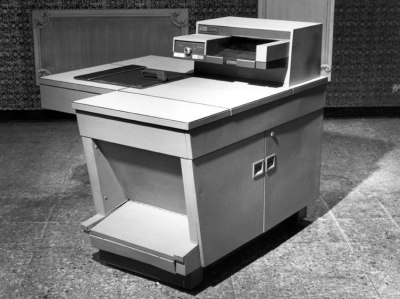
Xerox_914

In the commercial, you’ll see them make a big deal out of the fact that the print was dry. That’s because a lot of previous machines used actual photographic processes with wet chemistry. Obviously, that also took special paper.

Even Further Back

If the copier didn’t exist until recently, how did people make copies before? Turns out there were lots of ways to make copies of varying degrees of bad quality or extreme trouble. In some sense, the best copies were made by scribes just writing down a second copy of things. There were a variety of machines that would capture what you wrote and make a copy by mechanical or other means. A polygraph (not the lie detecting kind) allowed Thomas Jefferson to write letters and make a copy. The machine moved a pen to match the movements of the author’s pen, thus making a near perfect copy. With a few adjustments, this became the pantograph which not only does the same job, but also can shrink or enlarge the copy. Carbon paper was widely used to make multiple copies of handwritten and typewritten documents.

Continue reading “Retrotechtacular: The Incredibly Difficult Task Of Copying A Document” →

Simple Beetle Robot Uses Smoking Soldering Iron

As robot projects go, [creative ideas km]’s isn’t going to impress many Hackaday readers. Still, as an art project or something to do with the kids, it might be fun. But the reason it caught our interest wasn’t the actual robot, but the improvised soldering iron used in its construction.

The robot itself isn’t really autonomous. It is just a battery, a motor, and a switch. The motor vibrations make the robot scoot around on its bent copper wire legs. Some hot glue holds it all together, but the electrical wiring is soldered.

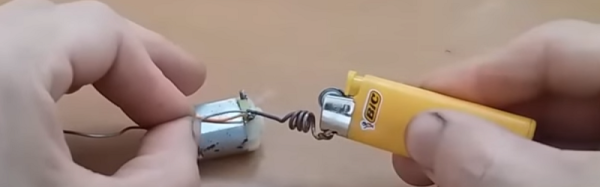
If you look at the video below, you’ll see the soldering is done with an unusual method. A disposable lighter generates a flame that hits an attached copper wire with a coil wound in it. The coil acts as a heat exchanger, and the wire becomes a soldering iron tip.

Continue reading “Simple Beetle Robot Uses Smoking Soldering Iron” →

Perovskite Solar: Coming Soon?

Making solar cells out of silicon is difficult. There’s plenty of manufacturing steps, many of them at very high temperatures, and you need a high vacuum and a clean room. However, perovskite solar cells–cells made with hybrid organic-inorganic materials in a perovskite crystal structure–are relatively easy to make using wet chemistry involving solvents or vapor deposition.

In theory, silicon solar cells could be 30% efficient, but in reality, 25% seems to be a practical limit with commercial cells typically topping out at 20%. Perovskite cells are nearly that high now, and could be higher by stacking thin layers, each sensitive to different wavelengths of light.

A recent development at the Lawrence Berkeley National Laboratory may lead to even more efficient perovskite cells. Researchers found that certain crystal structures had a much higher efficiency than other structures. The problem now is figuring out how to produce the crystals to increase the prevalence of that structure.

Continue reading “Perovskite Solar: Coming Soon?” →

Ham Antenna Rises To The Occasion

There was a time when you could do what you wanted in your yard and hams could build giant antenna farms. These days, there are usually laws or deed restrictions that stop that from happening. Even if you can build an antenna, you might want to quickly put up something temporary in an emergency.

[Eric’s] solution? Suspend a wire from a weather balloon filled with helium from the local WalMart. The 8 foot balloon took two containers (18 cubic feet) of gas before it would rise sufficiently. Once you have a floating balloon, the rest of the concept is simple: connect a wire (100 feet of 26 gauge), use a tuner to match the load to the transmitter, and you have instant antenna.

Continue reading “Ham Antenna Rises To The Occasion” →