Roundup: Retro Computers In Your Browser

There are two things that keep me from expanding my collecting old computers: the cost and the space required to house them. I do have my old original TRS-80, and an old serial terminal (see the video below). However, I got rid of my Data General hardware and I lost my old 1802 COSMAC Elf in some flooding. There have been a few replica retro computers of various degrees of fidelity and they are usually cheaper and smaller than the originals. I have a replica Altair, a replica Elf, and a replica KIM-1.

However, it is hard to justify the expense and the cost of either the real things or the replicas. It is even worse with the really large machines, some of which require special power or cooling and are hard to keep running. Another option, of course, is software simulation. Options like SIMH and Hercules work well, but they aren’t always graphical and it is a lot of work to set up a machine just to play with for a few hours or to show a student how it was done in the good old days.

Continue reading “Roundup: Retro Computers In Your Browser” →

Mystery FPGA Circuit Feels The Pressure

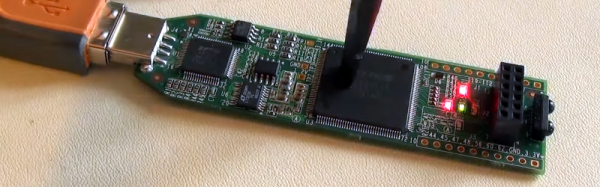
You have an FPGA circuit and you want the user to interact with your circuit by pushing a button. Clearly, you need a button, right? Not so fast! [Clifford Wolf] recently found a mysterious effect that lets him detect when someone pushes on his iCEstick board.

The video below shows the mystery circuit (which is just the stock iCEstick board), which appears to react any time you flex the PC board. The Verilog implements a simple ring oscillator (basically an inverter with its output tied to its input).

Continue reading “Mystery FPGA Circuit Feels The Pressure” →

School Of Friends Use Thought Control On A Shark

[Chip Audette] owns (at least) two gadgets: one of those remote control helium-filled flying shark (an Air Swimmer), and an OpenBCI EEG system that can read brain waves and feed the data to a PC. Given that information, it can hardly surprise you that [Chip] decided to control his flying fish with his brain.

Before you get too excited, you have to (like [Chip]) alter your expectations. While an EEG has a lot of information, your direct thoughts are (probably) not readable. However, certain actions create easily identifiable patterns in the EEG data. In particular, closing your eyes creates a strong 10Hz signal across the back of the head.

Continue reading “School Of Friends Use Thought Control On A Shark” →

If You Could Build A Clock In World Of Goo…

[Orson Scott Card] once wrote “…time flows through all lives equally.” You have to wonder what he would think if he saw Rhei, a fluid clock that is part prototype, part dynamic installation, and part moving sculpture. The developers [Damjan Stanković], and [Marko Pavlović] say that time flows, and thanks to the fluid-based numerals on the clock face, that seems to be an appropriate tag line (if you can’t visualize it, check out the video below).

Continue reading “If You Could Build A Clock In World Of Goo…” →

STM32 JavaScript Peeks And Pokes

A lot of people find scripting languages very productive and we’ve seen quite a few chips now supporting what you normally think of as a scripting language. These high-level abstraction languages are great, until they aren’t. When you need to go under the abstraction and do something complex or you need every cycle of performance, you might have to break your normal tools.

The Espruino is an ARM processor (an STM32) that has JavaScript on board. However, [Gordon Williams] shows how you can use peeks and pokes to access the hardware directly when the need arises. The names derive from another popular abstraction’s escape hatch. The old BASIC languages allowed direct memory access using keywords peek and poke. [Gordon] shows some examples of accessing the timer for PWM, and even looks at the STM32 reference manual to show how he knew where to peek and poke to begin with.

Continue reading “STM32 JavaScript Peeks And Pokes” →

Mid-Priced Hardware Gets Serious About Software Defined Radio

Regular Hackaday readers are used to seeing the hacks that use a cheap USB TV dongle as a software defined radio (SDR). There’s plenty of software that will work with them including the excellent GNU Radio software. However, the hardware is pretty bare-bones. Without modifications, the USB dongle won’t get lower frequencies.

There’s been plenty of other SDR radios available but they’ve had a much heftier price tag. But we recently noticed the SDRPlay RSP, and they now have US distribution. The manufacturer says it will receive signals with 12-bits of resolution over the range of 100 kHz to 2 GHz with an 8MHz bandwidth. The USB cable supplies power and a connection to the PC. The best part? An open API that supports Windows, Linux, Mac, Android, and will even work on a Raspberry Pi (and has GNU Radio support, too).

Continue reading “Mid-Priced Hardware Gets Serious About Software Defined Radio” →

Arduino Teaches Morse Code

You may wonder why anyone would want to learn Morse code. You don’t need it for a ham license anymore. There are, however, at least three reasons you might want to learn it anyway. First, some people actually enjoy it either for the nostalgia or the challenge of it. Another reason is that Morse code can often get through when other human-readable schemes fail. Morse code can be sent using low power, equipment built from simple materials or even using mirrors or flashlights. Finally, Morse code is a very simple way to do covert communications. If you know Morse code, you could privately talk to a concealed computer on just two I/O lines. We’ll let you imagine the uses for that.

In the old days, you usually learned Morse code from an experienced sender, by listening to the radio, or from an audio tape. The state of the art today employs a computer to randomly generate practice text. [M0TGN] wanted a device to generate practice code, so he built it around an Arduino. The device acts like an old commercial model, the Datong D70, although it can optionally accept an LCD screen, something the D70 didn’t have.

You can see the project in operation in the video below. Once you learn how to read Morse code, you might want to teach your Arduino to understand it, too. Or, you can check out some other Morse-based projects.

Continue reading “Arduino Teaches Morse Code” →