Tiny Arduino Drone Even Has An FPV Camera

In the turmoil of today’s world, drones are getting bigger, badder, and angrier. [Max Imagination] has gone the other way with his work, though, building a teeny Arduino drone that can fit in the palm of your hand. Even if you have a small hand!

The drone is based around an Arduino Pro Mini, and uses an MPU6050 IMU for motion sensing and flight control. Communication with the drone is via an NRF24L01. Four small coreless motors are used for propulsion, driven by tiny MOSFETs, and the whole assembly is run via a teeny 220 mAh lithium-polymer battery. Oh, and there’s an FPV camera so you can put on some goggles and see where it’s going!

Control is via MultiWii software, written specifically for building multirotor craft. [Max] flies the craft using a controller of his own creation, again using an NRF24L01 for communication.

It’s a neat build, and a titchy one too! Tiny drones have a character all their own, even if they can’t really stand up to windier outdoor environments. Video after the break.

Continue reading “Tiny Arduino Drone Even Has An FPV Camera”

VAR Is Ruining Football, And Tech Is Ruining Sport

The symbol of all that is wrong with football.

Another week in football, another VAR controversy to fill the column inches and rile up the fans. If you missed it, Coventry scored a last-minute winner in extra time in a crucial match—an FA Cup semi-final. Only, oh wait—computer says no. VAR ruled Haji Wright was offside, and the goal was disallowed. Coventry fans screamed that the system got it wrong, but no matter. Man United went on to win and dreams were forever dashed.

Systems like the Video Assistant Referee were brought in to make sport fairer, with the aim that they would improve the product and leave fans and competitors better off. And yet, years later, with all this technology, we find ourselves up in arms more than ever.

It’s my sincere belief that technology is killing sport, and the old ways were better. Here’s why. Continue reading “VAR Is Ruining Football, And Tech Is Ruining Sport”

You Can Run BASIC On An Old HP 4592 Protocol Analyzer

What do you do when you find an ancient piece of test gear and want to have fun? Well, you can always try getting BASIC running on it, and that’s precisely what [David Kuder] did.

The HP4952A Protocol Analyzer actually looks a lot like an old computer, even if it was never meant for general-purpose use. The heart of the machine is a Zilog Z80 CPU, though, so it shares a lot in common with microcomputers of its era.

Among other hacks, [David] worked to get Microsoft Basic-80 running on the machine. Initially, he was only able to get it up and running on the display, with no way to read the keyboard, disk, or access the serial port. Eventually, by diving into the nitty-gritty of the machine, he was able to at least get the keyboard working along with some basic BASIC programs. Usable memory is just 8KB, but you can do a fair bit with that when you’ve only got a 32×16 display for output anyway!

It’s a neat hack and one that was extendable to the HP4957A as well. We’ve seen similar machines on these pages before, too! If you’ve got your own neat retro hacks on the boil, don’t hesitate to drop us a line!

[Thanks to Christopher Zell for the tip!]

Boneblocker Is A Big LED Wall That Rocks

[Nick Lombardy] took on a job almost every maker imagines themselves doing at some point. He built a giant LED wall and he did a damn fine job of it, too. Introducing BoneBlocker.

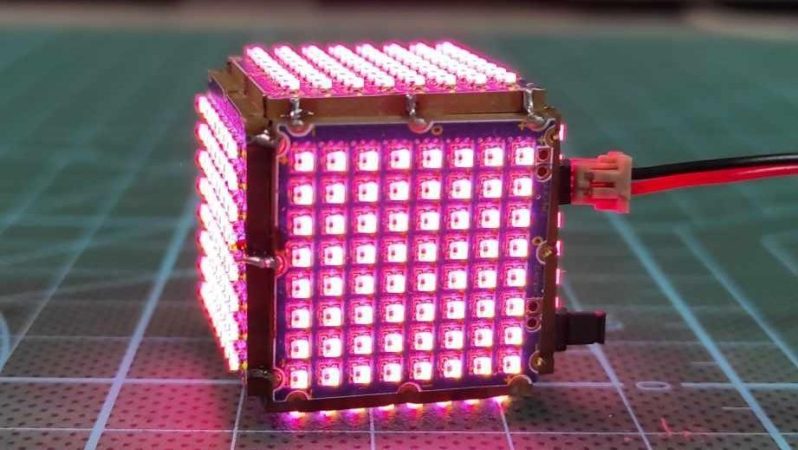
BoneBlocker is an 8 x 14 wall of glass blocks that lives at a bar called The Boneyard. Each block was given a length of WS2812B LED strip. 30 LED/meter strips were chosen, as initial maths on the 60 LED/meter strips indicated the whole wall would end up drawing 1.5 kW. Discretion, and all that.

The glowing game controller.

The whole display is run from a WT32-ETH01 board, which is a fast ESP32-based module that has onboard Ethernet to boot. [Nick] used the WLED library as he’d seen others doing great things with it, performance-wise. He ended up using one board per column to keep things fast, but he reckons this was also probably a little bit of overkill.

His article steps through the construction of the wall, the electronics, and the software required to get some games working on the display. The final result is quite something. Perhaps the best bit is his explanation of the custom controller he built for the game. Dig into it, you won’t be disappointed.

In particular, we love how the glass blocks elevate this display to a higher aesthetic level. We’ve seen other great projects tread this same route, too. Video after the break.

Continue reading “Boneblocker Is A Big LED Wall That Rocks”

Pi Pico Gets A ZX Spectrum Emulator

The Pi Pico is a capable microcontroller that can do all kinds of fun and/or useful things. In the former vein, [antirez] has ported a ZX Spectrum emulator to the Pi Pico.

ZX2040, as it is known, is a port of [Andre Weissflog’s] existing ZX spectrum emulator. It’s designed for use on the compact embedded Pi Pico platform, using ST77xx TFT displays. To that end, it has a UI optimized for small, low resolution screens and minimal buttons. After all, very few Pi Picos come with a full QWERTY keyboard attached.

Certain hacks are necessary to make it all work; the chip is overclocked to get things humming fast enough. The emulator also runs upscaling or downscaling in realtime as needed. This allows the emulator to run with a variety of displays, almost none of which are a direct match for the ZX Spectrum’s original resolution of 256×192 pixels.

Code is on Github for the curious, including a great run down from [antirez] on everything that makes it tick. If you want to play ZX Spectrum games on a keychain, you’d do well to start here. There are other projects to emulate it on the Pico, too! Video after the break.

Continue reading “Pi Pico Gets A ZX Spectrum Emulator”

3D Printed Adapter Helps You Eat Chicken Nuggets On The Highway

So often, we see 3D printers used to create some nifty little tool for a tricky little job. Maybe it’s to lock cams together for a timing belt change, or to work as a jig for soldering some complex device. However, some hacks are even simpler than that. [maker_guy] realized that eating nuggets in the car could be easier than ever with a little printed adapter.

The print is simple. It’s a round caddy for the nugget sauces given out by Chick-fil-A restaurants. Why round? Because it lets the nugget sauce sit neatly in your car’s cupholder at an accessible height. Put the sauce tub in the adapter, peel it open, and you can dip to your heart’s content.

So simple, yet a game changer all the same.

No more delicately balancing Zesty Buffalo by the gearstick while you try and chow down. Nor will your seat covers be tainted with Honey Mustard!

“Not a hack!” you scream. “It’s frivolous nonsense!” To that I say, are you a nugget eater or not? I myself partake, and I can absolutely see the value in this. You see, us journalists work hard. We’re often stuck eating substandard food in our cars on the way from one thing to another, like so many others in busy professions. If a smart little 3D-printed adapter can make mealtime easier and save some mess, I’m calling that a win.

You should never be afraid to use your creativity to make tools to improve your life. Parts are on Thingiverse if you need to print your own. Mod it to suit McDonald’s product if you need. Heck, print in black and it’d look like a stock part of the car!

You don’t have to like this simple adapter, but you can’t deny its utility! Share your own nifty little adapter ideas in the comments.

How Additional Aerodynamic Drag Helped Make GTA III Work On PS2

The PlayStation 2 was a revelation when it hit the market in 2000, and yet by modern standards, it’s almost hopelessly weak. In fact, it’s so under-powered, Rockstar developers had to pull every trick in the book to make Grand Theft Auto III even work on the platform.

The story comes to us from developer [Obbe Vermeij]. He explains that the PlayStation 2 couldn’t keep the entire open-world game map in its tiny 32 MB of RAM. Instead, models had to be streamed from the DVD drive as the player moved around the world. However, even the DVD drive wasn’t fast enough. If the player moved too quickly, they would outpace the system’s ability to load new assets, and the world would fall apart. Roads would vanish, buildings simply wouldn’t appear before the player passed by them.

According to [Obbe], getting around this challenge was the job of one [Adam Fowler]. He notes that even optimizing the layout of data on the DVD wasn’t enough to help. Nifty hacks had to be employed to slow the player down. Road networks were changed to stop the player speeding towards areas that needed lots of new models. In other areas, vehicles in the game would experience a nearly-imperceptible 5% increase in air drag to dull their speed. This was chosen as a more invisible solution; cutting engine power directly was audible to players as the audio changed.

It shows you just how hard developers had to work back when resources were far more constrained than they are today!