Calculating Pi On The 4004 CPU, Intel’s First Microprocessor

These days we are blessed with multicore 64-bit monster CPUs that can calculate an entire moon mission’s worth of instructions in the blink of an eye. Once upon a time, though, the state of the art was much less capable; Intel’s first microprocessor, the 4004, was built on a humble 4-bit architecture with limited instructions. [Mark] decided calculating pi on this platform would be a good challenge. 

It’s not the easiest thing to do; a 4-bit processor can’t easily store long numbers, and the 4004 doesn’t have any native floating point capability either. AND and XOR aren’t available, either, and there’s only 10,240 bits of RAM to play with. These limitations guided [Mark’s] choice of algorithm for calculating the only truly round number. Continue reading “Calculating Pi On The 4004 CPU, Intel’s First Microprocessor”

2022 Sci-Fi Contest: A Friendly Wall Drawing Robot

Drawing on walls is fine for children, but adults tend to get bored quickly with such antics. Even more so when they realize who is responsible for cleaning up afterwards. Instead, consider delegating those duties to a friendly helper by the name of Fumik, as [engineer2you] has done.

Fumik, who looks like a cute little jellyfish, can draw pictures up to 5 meters wide and 3 meters high, making for a massive canvas. Powered by an Arduino Mega 2560 outfitted with a CNC shield, a pair of stepper motors drive pulleys with toothed belts to move Fumik to various positions along the wall. Another smaller stepper motor is used to drive the pen forwards and backwards as needed. Fumik can be programmed to trace out various designs in SVG format. These must be converted to code and programmed into the Arduino, at which point Fumik can begin work, drawing on the wall with its pen.

It’s a fun build, and based on photos shared by [engineer2you,] Fumik is quite able at drawing clean and neat designs without a lot of smudging or jagged lines. As a bonus, it’s easy to swap out the pen, so multicolored designs can be drawn in multiple passes.

We’ve seen other robot drawing builds before, too, like this capable portrait artist. Video after the break.

Continue reading “2022 Sci-Fi Contest: A Friendly Wall Drawing Robot”

Multicolor Drawbot Highlights Importance Of Limit Switches

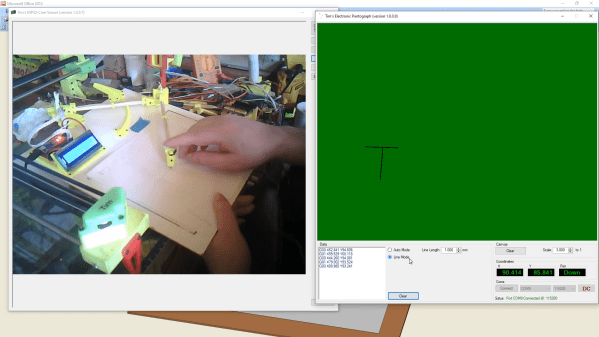
Plotters and drawing robots are fun projects that let you create art with all the precision and perfection that computer numerical control can deliver. [TUENHIDIY] demonstrates that ably with the Multicolor DrawBot.

The build relies on a simple XY Cartesian design, using a pair of NEMA 17 stepper motors. It’s built in the typical CoreXY fashion, running GRBL firmware on an Arduino Uno.

Where [TUENHIDIY] gets creative is in the pen itself. Rather than using a simple ballpoint or marker, instead, a retractable multicolor pen is used instead. With the multicolor pen on board, [TUENHIDIY] notes the importance of limit switches in the design. These allow the the ‘bot to make multiple passes, each time in a different color, to build up a multicolor image. Without the limit switches in place, it would be impossible to line up each following pass.

We’d love to see the build taken even further with a servo-based system for switching colors automatically. As it is, though, [TUENHIDIY] has a capable plotter that can deliver tidy multicolor artworks.

One of the more curious applications of plotters of late are those used to send faux handwritten letters through the postal system.  Video after the break.

Continue reading “Multicolor Drawbot Highlights Importance Of Limit Switches”

2022 Sci-Fi Contest: Motorized AT-AT Walker Gets Around With Servos

The AT-AT Walker was one of the more fearsome weapons of the Star Wars universe, even if it was incredibly slow and vulnerable to getting tangled up in Rebel tow cables. However, you can build your own small-scale example using servos for propulsion, as [Luke J. Barker] ably demonstrates.

Taking off the outer shell reveals the servo motors driving the leg linkages.

The build is a remix of the motorized AT-AT from [LtDan] on Thingiverse, originally powered by a 90 rpm DC gearmotor. [Luke] remixed the design, setting it up to be driven by eight servomotors instead. They’re controlled from a SparkFun RedBoard Edge, an Arduino-compatible microcontroller board that fits rather neatly inside the AT-AT shell.

Programmed with a simple sine-wave walk cycle, the AT-AT ambles along in a ponderous manner. It’s altogether very much like the real fictitious thing, albeit without the scorching sizzle of blaster fire ringing out across a frozen plain.

Quadruped vehicles never really caught on for military use, but that’s not to say nobody ever tried. Video after the break.

Continue reading “2022 Sci-Fi Contest: Motorized AT-AT Walker Gets Around With Servos”

2022 Sci-Fi Contest: Nixie Calculator Is Resplendent In Walnut Enclosure

The Nixie tube is one of the most popular display technologies amongst the hacker and maker set. Glowing numerals can warm even the coldest heart, particularly when they’re energized with hundreds of volts. [ohad.harel] used these glorious displays to build the TORI Nixie Calculator, with beautiful results. 

The build uses seven IN-12 Nixie tubes for numerals, along with an IN-15A which displays mathematical symbols like +, %, and M. It’s equipped with a 32-key keyboard using mechanical key switches. Everything is wrapped up in a beautiful walnut enclosure that fits the tubes and keyboard perfectly, giving the final build a nice mid-century aesthetic.

Impressively, it goes beyond the basic usual calculator functions, also handling conversions between metric and imperial units. It’s a nice feature that would make it a wonderful tool to have on one’s desk beyond the simple aesthetic charm of the Nixie tubes.

Nixie projects never seem to die. Their beauty and warmth captivates builders to this day. Indeed, we’ve even seen some makers go to the trouble of creating new tubes from scratch!

PiSquare Lets You Run Multiple HATs On A Raspberry Pi

The Raspberry Pi’s venerable 40-pin header and associated HAT ecosystem for upgrades has been a boon for the platform. It’s easy to stack extra hardware on to a Pi, even multiple times in some cases. However, if you want to run multiple HATs, and wirelessly at that, the PiSquare might just be the thing for you.

The PiSquare consists of a board featuring both RP2040 and ESP-12E microcontrollers. It interfaces with Raspberry Pi HATs and even lets you run multiple of the same HAT on a single Raspberry Pi, as it’s not actually directly using the UART, SPI, or I2C interfaces on the host Pi itself. Instead, the PiSquare communicates wirelessly with the Pi, handling the IO with the HAT itself.

It’s unclear how this works on a software level. Simply using existing software tools and libraries for a given Raspberry Pi HAT probably won’t work with the wireless PiSquare setup. However, for advanced users, it could serve a useful purpose, allowing one Raspberry Pi to command multiple HATs without the fuss of having to run more single-board computers where just one will do. Boards will be available on Kickstarter for those interested in the device.

We’ve seen other creative things done with the Raspberry Pi and the HAT system, too. If you’ve been cooking up your own neat hacks for the platform, drop us a line!

2022 Sci-Fi Contest: A Hand-Following Robot, Powered By Arduino

If there’s one thing audiences love in sci-fi, it’s a cute robot companion that follows the heroes around. If you want one of your own, starting with this build from [mircemk] could be just the ticket.

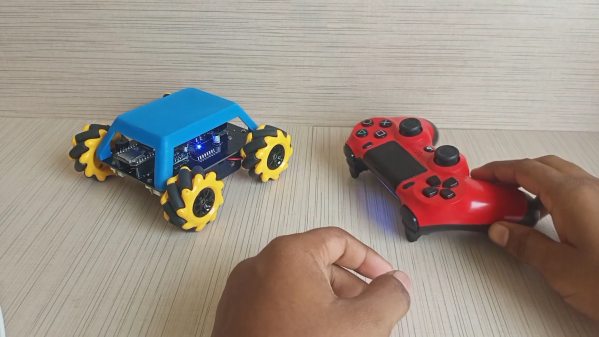
The build relies on the classic Arduino Uno microcontroller, which talks to a HC-SR04 ultrasonic sensor module and two infrared sensors in order to track a human target and follow it around. Drive is thanks to four DC gear motors, driven by a L293D motor driver, with a two-cell lithium battery providing power for everything onboard.

The robot works in a simple manner, following a hand placed in front of the robot’s sensors. First, the robot checks for the presence of an object in front using the ultrasonic sensor. If something is detected, the twin infrared sensors mounted left and right are used to guide the robot, following the hand.

It’s not a sophisticated algorithm, and it won’t really let your robot follow you down a crowded street. However, it’s a great project to learn on for beginners and could serve as a great entry into more advanced projects using face tracking or other techniques. Video after the break. Continue reading “2022 Sci-Fi Contest: A Hand-Following Robot, Powered By Arduino”