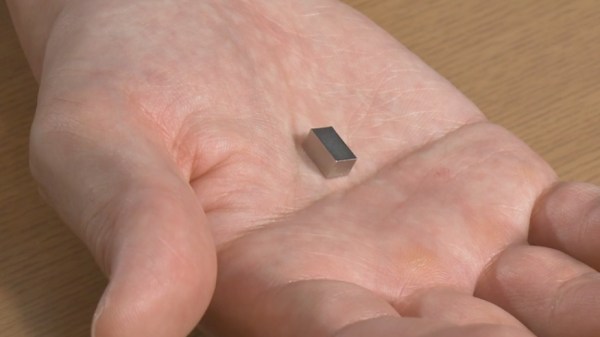
Solid state batteries have long been promised to us as the solution to our energy storage needs. Theoretically capable of greater storage densities than existing lithium-ion and lithium-polymer cells, while being far safer to boot, they would offer a huge performance boost in all manner of applications.
For those of us dreaming of a 1,000-mile range electric car or a 14-kilowatt power drill, the simple fact remains that the technology just isn’t quite there yet. However, Murata Manufacturing Co., Ltd. has just announced that it plans to ship solid state batteries in the fall, which from a glance at the calendar is just weeks away.
It’s exciting news, and we’re sure you’re dying to know – just what are they planning to ship, and how capable are the batteries? Let’s dive in.
Liquid nitrogen is fun stuff to play with, as long as you’re careful and avoid freezing your own fingers off and shattering them on the workbench. As the liquid turns to gaseous nitrogen at around -196 C, [The Action Lab] figured that it could be used to propel a simple steam engine at room temperature. Testing this out had amusing results.
The device under test is a Hero’s Engine, otherwise known as an aeolipile. This consists of a hollow sphere filled with water, fitted with a series of nozzles that shoot out steam when the vessel is heated. Via the rocket principle, this causes the device to rotate about its axis.
When filled with water and heated with a candle, the aeolipile spun at up to 2520 RPM. [The Action Lab] next tested it filled with water in a vacuum chamber, with the low pressure causing the water to boil at room temperature. The effect was less impressive however, with the engine spinning at a much slower rate.
The best result was with liquid nitrogen inside the engine. With the nitrogen quickly boiling at room temperature, the aeolipile quickly spun up to a great speed. The engine stand had to be steadied to avoid it tipping over, before the seal at the top of the engine blew off from overpressure.
Video feedback is perhaps best known for its appearance in the film clip to Bohemian Rhapsody. It’s not a particularly popular effect that you see too often, as it’s rather messy to set up what with cameras filming screens and what not. Regardless, the effects possible are glorious, as demonstrated by [Dave Blair] and his amazing video feedback kinetic sculpture.
No computer is involved at all in the process – it’s just classic, old school video feedback. It’s produced by pointing a camera at a screen and feeding the image back to that same screen. Three cameras are combined with twin video switchers and a beam-splitting pane of glass, along with a source image via an HDMI input.
By turning and spinning the various cameras, [Dave] is able to generate beautiful curving fractal-like effects using the source imagery, with a rainbow of color melting and warping together as he interacts with the sculpture. It’s a beautiful effect and something we’re surprised we don’t see more of in the video industry.
Hopefully [Dave] is enlisted to put his machine to work on the next [Doja Cat] film clip so we can get more of this goodness. Video after the break.
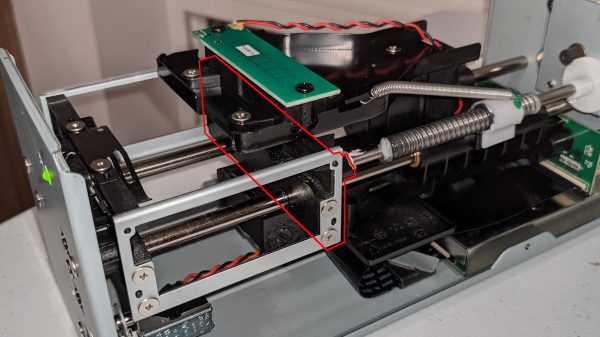
Scanning film is great for archival purposes as well as sharing said photos digitally. However, if you’re scanning 120 film, aka medium format, it can be expensive to get the requisite hardware. 35mm scanners are comparatively more common, so [Christian Chapman] decided to modify one to suit medium film instead.
The hack is for the Plustek 8100, and requires modifying the scanner in two ways. Firstly, the driver has to be scanned to sweep a longer range to take into account the bigger film. Secondly, a part of the film carriage has to be replaced so it doesn’t show up in the scanners field of view.
The former is achieved by using the sane-genesys scanner software backend, which can be easily modified to adjust the scan length values appropriately. The latter is achieved via 3D printing replacement components that fit without blocking the requisite area.
If you’re an automotive enthusiast of taste, you can’t stand the idea of fitting a janky aftermarket stereo into your nice, clean ride. Flashy, modern head units can spoil the look of a car’s interior, particularly if the car is a retro, classic, or vintage ride.
Thus, we’re going to look at how to modify your existing stock car stereo to accept an auxiliary cable input or even a Bluetooth module. This way, you can pump in the latest tunes from your smartphone without a fuss, while still maintaining an all-original look on the dash.
Fundamentals
A simple Bluetooth module designed for wiring into car audio systems. There are two wires for 12 V power from the vehicle, and the audio signal is sent out over the RCA plugs. The RCA plugs can be cut off and the module hard wired inside your stereo if you have room. Cutting off the plastic case can help too.
Depending on your choice of audio player, you may prefer a 3.5 mm aux jack, or you might want to go with Bluetooth audio if your smartphone no longer has a headphone port. Whichever way you go, the process of modifying the stereo is largely the same. To achieve your goal, you need to find a way of injecting the audio signal into the head unit’s amplifier stage, while making sure no other audio sources are getting sent there as well.
Whether that audio source is a 3.5 mm jack or a Bluetooth module doesn’t matter. The only difference is, in the latter case, you’ll want to buy a Bluetooth module and hardwire it in to the auxiliary input you create, while also splicing the module into the stereo’s power supply. In the case of a simple headphone jack input, you simply need to wire up an aux cord or 3.5 mm jack somewhere you can get to it, and call it done.
This guide won’t cover every stereo under the sun, of course. Edge cases exist and depending on the minute specifics of how your original car radio works, these exact methods may or may not work for you. However, this guide is intended to get you thinking conceptually about how such mods are done, so that you can investigate the hardware in front of you and make your own decisions about how to integrate an external audio input that suits your usage case. Continue reading “How To Modify Your Car Stereo For Bluetooth Or Aux-In”→
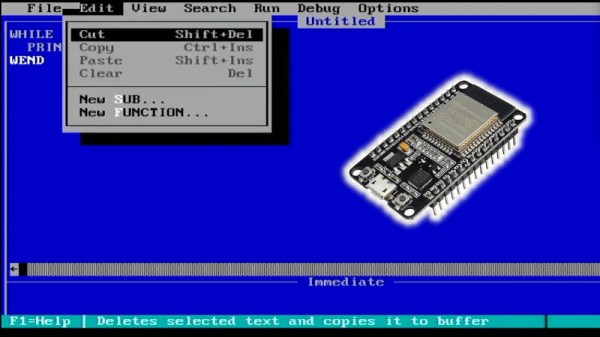
The IBM PC spawned the basic architecture that grew into the dominant Wintel platform we know today. Once heavy, cumbersome and power thirsty, it’s a machine that you can now emulate on a single board with a cheap commodity microcontroller. That’s thanks to work from [Fabrizio Di Vittorio], who has shared a how-to on Youtube.
The full playlist is quite something to watch, showing off a huge number of old-school PC applications and games running on the platform. There’s QBASIC, FreeDOS, Windows 3.0, and yes, of course, Flight Simulator. The latter game was actually considered somewhat of a de facto standard for PC compatibility in the 1980s, so the fact that the ESP32 can run it with [Fabrizio’s] code suggests he’s done well.
It’s amazingly complete, with the ESP32 handling everything from audio and video to sound output and keyboard and mouse inputs. It’s a testament to the capability of modern microcontrollers that this is such a simple feat in 2021.
The Atari VCS 800 is a modern product, a hybrid of a PC and a games console. Fundamentally, its a bunch of modern chips in a box running Linux that will let you browse the web or emulate some old games. Now, thanks to [ArcadeHustle], you can have persistent root access to the VCS 800 at your leisure.
The trick is simple, and begins by interrupting the systemd startup scripts on boot. One can then merge files into the /etc directory to achieve root access, either by the tty terminal or over TCP. It’s all wrapped up in the script available at the Github link above.
You can actually run a variety of OSs on the hardware, as it’s powered by an AMD Ryzen R1606G CPU and runs straightforward PC architecture. However, if you want to customize the existing OS to do your bidding, this hack is the way to go.
Hacking to get root access is key if you want to get anywhere with a system. We’ve seen it done on thin clients as well as car infotainment systems to give the owner full control over the hardware they own. If you’ve got your own root exploit you’d like to share, do drop us a line, won’t you?