South Australia Vs. Too Much Home Solar

Once upon a time, the consensus was that renewable energy was too expensive and in too sparse supply to be a viable power source to run our proud, electrified societies on. Since then, prices of solar panels have tanked, becoming more efficient along the way, and homeowners have been installing them on their rooftops in droves.

Where once it was thought we’d never have enough solar energy, in some cities, it’s becoming all too much. In South Australia, where solar output can be huge on a sunny day, electricity authorities are facing problems with grid stability, and are taking measures to limit solar output to the grid.

Isn’t More Usually Better?

The problem faced by South Australian utilities is one of how to properly control an electrical grid with many thousands of distributed power sources. Typically, in conventional modern power grids, voltage and frequency is controlled within set limits by carefully matching the supply from major power plants with the demand from users. Fast-response plants can be brought online to meet shortfalls, and switched off when demand drops, and everything hums along nicely.

Unfortunately, solar power isn’t so easy to throttle, and even less so when it’s coming from thousands of separate households each with their own rooftop install and an inverter to feed back into the grid. This has led to authorities contemplating measures such as charging homeowners to export energy to the grid in peak periods in an effort to slow the huge uptake of home solar systems. Export limits have also been proposed for suburbs with the highest concentration of home solar, as substations in certain residential areas struggle to cope under the huge inflows of energy. Continue reading “South Australia Vs. Too Much Home Solar” →
PHP Gets A Demoscene Engine Of Its Very Own

When we think demoscene, our first thought is typically of 80s computers, particularly the Commodore 64 and Amiga 500 which were widely regarded as the awesomest of their time. However, you can write a demo on any platform you wish, and [OxABADCAFE] has done just that – in PHP.

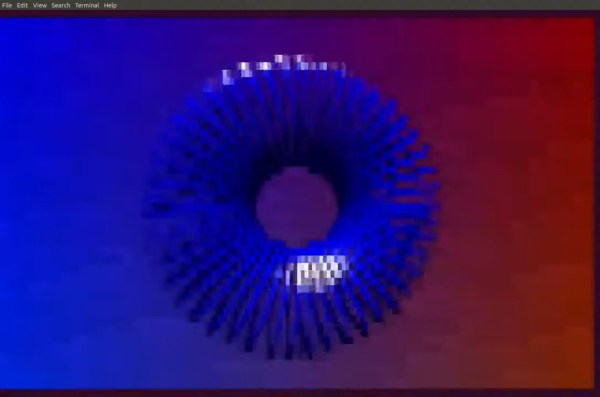
Pretty, no?

Going by PDE, standing for Pointless, Portable, or PHP Demo Engine, the code is available on GitHub for the curious. The code is set up for RGB ASCII terminal output, for a beautifully old-school aesthetic. Demo sequences can be programmed in JSON files, with the code executing a default in-built demo if none is provided.

There’s no audio yet, so you’ll have to cool your thumping chiptune jets until that’s available in a later release. With that said, we look forward to more development expanding what can be done with the engine – after all, there’s nothing more demoscene than pushing the limits. Video after the break.

Continue reading “PHP Gets A Demoscene Engine Of Its Very Own” →

How To Build A Turbo Car The Cheap, 90s Way

If you want to coax more power out of your car’s engine, a turbocharger is a great way to go about it. Taking waste energy from the exhaust and using it to cram more air into the engine, they’re one of the best value ways to make big gains in horsepower.

However, unlike simpler mods like a bigger exhaust or a mild cam swap, a turbocharger install on a naturally aspirated, fuel-injected engine often requires a complete replacement of the engine management system, particularly on older cars. This isn’t cheap, leaving many to stick to turbocharging cars with factory tuneable ECUs, or to give up altogether. In the 1990s, aftermarket ECUs were even more expensive, leading many to avoid them altogether. Instead, enthusiasts used creative hacks to make their turbo builds a reality on the cheap, and there’s little stopping you from doing the very same today.

Continue reading “How To Build A Turbo Car The Cheap, 90s Way” →

Lego Wheels And Tracks Benchmarked For Your Pleasure

For many people, Lego is their first entry into the world of engineering. With the Technic line of building blocks complete with all manner of gears and shafts and wheels, there’s a ton of fun to be had while learning about the basic principles of mechanical things. The [Brick Experiment Channel] takes Lego quite seriously in this context, and has collected data concerning the performance of a variety of Lego wheels and tracks.

The testing setup is simple. A small vehicle is fitted with a particular set of Lego wheels or tracks. Then, it’s placed on an inclined wooden board. The angle of inclination is then increased until the vehicle neither climbs the board nor slips down it. This angle can then be used to calculate the coefficient of friction of the given tyre or track set. [Brick Experiment Channel] filmed this testing and collected data on 33 different wheel and track combinations, publishing it in the description of the Youtube video.

Interestingly, the date of release of the various parts is recorded with the data. This is interesting as one would expect older rubber parts to lose grip with age, however, the release date of the parts obviously does not correspond with the manufacturing date, so the utility of this is somewhat unclear. There’s also some surprising results, with what appear to be soft, flat and smooth rubber wheels performing somewhat worse than those with curved profiles that you’d expect to have less contact patch. Regardless, it’s the best data we’ve ever seen in this field and we think it’s great that it was collected and shared with the broader Lego community. We look forward to seeing more of this in future, as it’s obviously something of great use to builders. We can imagine it would have proved handy when [Brick Experiment Channel] built their obstacle climbing rover. Video after the break.

Continue reading “Lego Wheels And Tracks Benchmarked For Your Pleasure” →

Two-Player PVC Racing Rig Plays Daytona USA

SEGA’s Daytona USA is that big orange arcade racing machine you remember from the 90s that still seems to hang on in cinemas and pizza joints worldwide. Its controls may be floaty and physics unrealistic, but it’s probably the one racing game that almost everyone has played at one point or other. [Tom Tilley] decided to build a PVC racing rig for the game during his travels in Thailand.

As a bonus, the lightweight rigs can be broken up and transported easily by scooter.

PVC pipe is used to whip up the frames for the budget simulator, inside which each player sits. Different sizes of PVC pipe and various adapters are used to create a basic steering wheel, to which a potentiometer is attached, while the centering mechanism is simply a rubber band. The pedals are built similarly and fitted with microswitches. The build relies on a cheap USB gamepad that mimics the typical PlayStation Dual Shock design, with the pot and switches wired in place of the existing thumbstick and buttons. A computer running the PC version of Daytona USA is then used to complete the setup, along with a projector for split-screen fun.

It’s certainly not a high-end simulator by any means, but for the price of some pipes and cheap controllers, [Tom] was able to create a two-player racing rig for a fraction of the cost to hire the real arcade machine for a weekend. The kids that playtested the system certainly seemed to have a good time, as well. We’ve seen similar low-tech builds before, too – with impressive results. Video after the break.

Continue reading “Two-Player PVC Racing Rig Plays Daytona USA” →

Could Seven Gamers Play Quake On Just One 1996 SGI Machine?

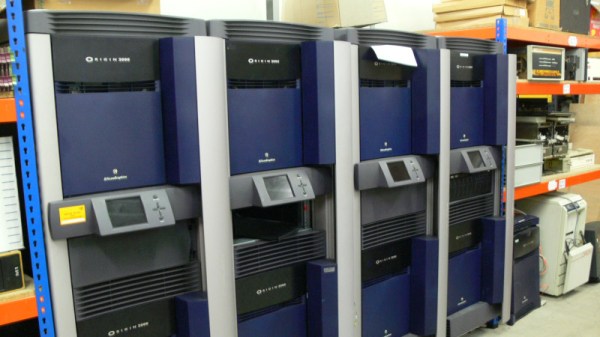
[Linus Tech Tips] undertook a fun experiment a few years back. By running multiple virtual machines on a single tower PC with tons of RAM and GPUs, it was possible to let seven gamers play on a single rig at once. [CelGenStudios] found the idea intriguing, and has theorised that the same feat could be possible on mid-1990s Silicon Graphics hardware.

The idea is to use the Origin 2000 server as the base. These didn’t ship with any form of video output or even a keyboard and mouse interface. However, by substituting in the IO6G module from the Onyx2 machine, and SI graphics cards from the Octane, it’s possible to get graphics and input up and running. With multiple graphics cards and a few CAD DUO boards installed via a PCI adapter called the “shoebox”, there’s provisions for up to four separate monitors, keyboards and mice. With all this hardware, it’s theoretically possible for four users to login to the X server running in the IRIX OS on the Origin 2000 machine. Then, it’s a simple matter of firing up four instances of Quake and a dedicated server and you’re up and gaming.

[CelGenStudios] goes so far as exploring the limits of the supercomputer-grade hardware, suggesting that 7 players or more could be possible. Unfortunately, SGI hardware isn’t easy to come by, nor is it cheap, even decades after release — so thus far, the concept remains untested. We’d dearly love to see such a setup happen at QuakeCon or a hacker con, though, so if you pull it off, you know how to call. We note there’s a few Octane 2000s at the Jim Austin Computer Collection, so perhaps they might be the ones to achieve the feat.

In the meantime, check out a practical exploration of the concept on modern hardware with the original [Linus Tech Tips] project. The basic theory is simple – create a hugely powerful PC, with a beefy CPU, plenty of RAM, and one graphics cards for each of the seven players. They run multiple virtual machines and managed to deliver a full 7 player experience running off just one CPU.

Continue reading “Could Seven Gamers Play Quake On Just One 1996 SGI Machine?” →

Modding A Casio W800-H With A Countdown Timer

Stock, the Casio W800-H wristwatch ships with dual time modes, multiple alarms, and a stopwatch – useful features for some. However, more is possible if you just know where to look. [Ian] decided to dive under the hood and enable a countdown timer feature hidden from the factory.

The hack involves popping open the case of the watch and exposing the back of the main PCB. There, a series of jumpers control various features. [Ian]’s theory is that this allows Casio to save on manufacturing costs by sharing one basic PCB between a variety of watches and enabling features via the jumper selection. With a little solder wick, a jumper pad can be disconnected, enabling the hidden countdown feature. Other features, such as the multiple alarms, can be disabled in the same way with other jumpers, suggesting lower-feature models use this same board too.

It’s a useful trick that means [Ian] now always has a countdown timer on his wrist when he needs it. Excuses for over-boiling the eggs will now be much harder to come by, but we’re sure he can deal. Of course, watch hacks don’t have to be electronic – as this custom transparent case for an Apple Watch demonstrates. Video after the break.

Continue reading “Modding A Casio W800-H With A Countdown Timer” →