Modular Vibrating ‘Bots Made From PCBs

Printed circuit boards, they’re a medium designed primarily to mount electrical components with the wires themselves places as copper traces on the boards. To accommodate wide range of needs that have arisen over decades, board houses have evolved all manner of advanced techniques in routing and plating. To our benefit, this also makes it possible to leverage PCBs in an entirely artistic way, taking advantage of the highly-optimized manufacturing process. [GeeekClub] did just that, creating awesome vibrating robots out of custom-made PCBs.

The ‘bots come as a single PCB, with the parts snapped out akin to removing parts from sprues in a plastic model kit. They can then be assembled, with a pair of pager vibration motors installed to provide motive power. But really it’s the aesthetic of the boards and not the functionality that make these so incredible.

The design nestles a coin cell in the base of each bot, providing power and using the weight to help keep them upright. There’s a smattering of LEDs on board, and the art style of the ‘bots draws from Hopi Indian, Asian, and South American influences.

Cyphercon 2017 featured these exciting cubic badges, created from PCBs and soldered by hand.
This Star Trek inspired piece shows just how far you can go with the right color soldermask and some creativity.

This “flat-pack” style of PCB design that comes to life with creative use of angles and layers is becoming its own sub-genre of the art. The Star Trek Enterprise inspired build in another great example. We’ve also seen a growing trend of using the PCB as enclosures, take the Cyphercon badge and Queercon badge projects from 2017 as examples. Get yourself up to speed on design techniques for using FR4 as an enclosure from [Voja Antonic’s] in-depth guide.

Raspberry Pi Gets PATA/IDE Drive Via GPIO Header

By and large, the Raspberry Pi is a computer that eschews legacy interfaces. Primarily relying on SD cards for storage and USB ports for further expansion, magnetic hard drives are a rare sight. However, [Manawyrm] decided that some 40-pin goodness was in order, and set to making a PATA IDE adapter for the platform.

To achieve the task of interfacing now-vintage IDE devices with the Raspberry Pi, [Manawyrm] elected to use the single board computer’s GPIO pins to get the job done. 23 pins are required, with 16 used for the data bus, with the rest dedicated to address lines, strobes, and other features.

The adapter is no speed demon, netting 800 KiB/s on reads and 500 KiB/s on writes with a Raspberry Pi 4. The main bottleneck comes from relying on libgpiod, which [Manawyrm] readily admits is designed for general IO tasks, not data transfers. Despite this, it’s still fast enough to play an audio CD from an IDE CD-ROM drive without skipping. A kernel build is required, however, as Raspberry Pis are unsurprisingly not configured to use ATA disks by default.

Obviously, more serious applications would substitute a dedicated USB hard disk adapter or give the Raspberry Pi a PCI-express (PCIe) card for sata drives instead, but that doesn’t discount the fun inherent in the build. While it may be slow, it shows that talking to PATA hard disks is actually quite straightforward when you understand the basics. Of course, if you want to do the opposite, and have your Raspberry Pi emulate a PATA disk, that’s possible too. Video after the break.

Continue reading “Raspberry Pi Gets PATA/IDE Drive Via GPIO Header”

Acoustic Camera Uses Many, Many Microphones

If you’re a human or other animal with two ears, you’ll probably find great utility in your ability to identify the direction of sounds in the world around you.  Of course, this is really just a minimal starting point for such abilities. When [John Duffy] set out to build his acoustic camera, he chose to use ninety-six microphones to get the job done.

The acoustic camera works by having an array of microphones laid out in a prescribed grid. By measuring the timing and phase differences of signals appearing at each microphone, it’s possible to determine the location of sound sources in front of the array. The more microphones, the better the data.

[John] goes into detail as to how the project was achieved on the project blog. Outlining such struggles as assembly issues, he also shares information about how to effectively debug the array, and just how to effectively work with so many microphones at once. Particularly impressive is the video of [John] using the device to track a sound to its source. This technology has potential applications in industry for determining the location of compressed air leaks, for example.

Overall, it’s a university research project done right, with a great writeup of the final results. [John]’s project would serve well as a jumping off point for anyone trying to build something similar. Phased array techniques work in RF, too, as this MIT project demonstrates. Video after the break.

Continue reading “Acoustic Camera Uses Many, Many Microphones”

45 Minute Podcast Served Up On A Floppy Disk

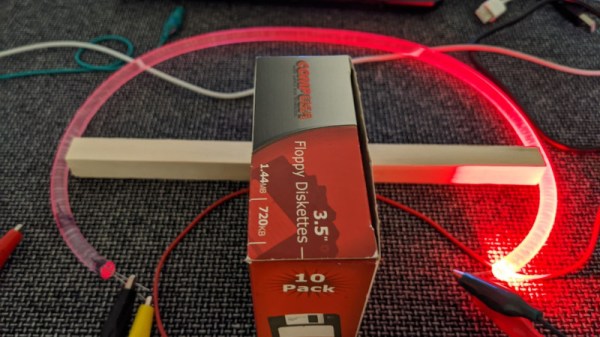
Near the turn of the millenium, portable media players like the iPod led to the development of the podcast. The format generally consists of content similar to talk-based radio, and is typically served up in modern codecs like AAC, M4A and MP3. However, [Sean Haas] decided these were all too chunky, and wanted to see if it was possible to deliver similar content on a floppy disk. The results are predictable, but impressive.

[Sean]’s aim was to try and fit roughly 45 minutes of audio on to a 1.44 MB floppy disk. To pull this off, he looked far and wide for a codec fitting for the task. The choice landed on was Adaptive Multi-Rate, or AMR. Typically used to encode audio for GSM phone calls, it can also be used to create compressed audio files.

Initial attempts weren’t quite good enough to do the job, so [Sean] introduced a pre-processing step with FFMPEG, to speed the audio up 1.2 times. It was then passed through SoX and encoded in AMR at approximately 5 kbit/s. This allowed a 45-minute long MP3 file of 72MB to be compressed down into just 1.2 MB, and thus able to fit onto a floppy disk. Audio quality is predictably poor, as you can hear in the embedded clip below, but definitely intelligible. You’d probably want to skip any musical passages if you were doing this seriously.

Continue reading “45 Minute Podcast Served Up On A Floppy Disk”

HAWT Wind Turbine Is Mostly 3D Printed

Wind turbines are a great source of renewable energy, and a great DIY project, too. They can be built with all kinds of materials and the barrier for entry is low for the beginner. [Fab] has built just such a device, taking advantage of modern construction techniques, and dubbed it the WinDIY.

The WinDIY design is mostly 3D printed, with a familiar three-bladed design. The diameter of the rotor is 1.2 m, meaning that braking and regulating the turbine is required for safety in high winds. [Fab] is aiming to achieve this control with a combination of mechanical and electronic braking, as well as variable-pitch blades. The benefit of 3D printing the design is it allows iterations to be made quickly, particularly of parts with complex geometries that would be too time-consuming or expensive to machine otherwise.

[Fab]’s writeup goes into great detail on topics like the design of the pitch control systems and other minutae, which should serve as a great reference for anyone else working on a similar project. If you’re looking for something with more of a sci-fi future vibe, consider attempting a vertical-axis build instead.

Optimizing GIF Playback For Microcontrollers

Despite being cooked up by Compuserve back in the late 1980s, GIFs have seen a resurgence on the modern internet, mostly because they’re fun. However, all our small embedded systems are getting color screens these days, and they’d love to join in the party. [Larry Bank] has whipped up a solution for just that reason, letting embedded systems play back short animated GIFs with limited resources.

[Larry] does a great job of explaining how the GIF format works, using LZW compression and variable-length codes. He talks about how the design of the format presents challenges, particularly when working with microcontrollers. Despite this, the final code works well, and is able to work with most animated GIFs of the right dimensions and construction. 24K of RAM is required, and image width is limited to 320 pixels. Images can be loaded from flash, memory, or SD cards, and he notes that best performance is gained with a microcontroller with fast SPI for writing to screens quickly.

It’s a great piece of software that promises to add a lot of charm, or silliness, to microcontroller projects. It also simplifies the use of animations, which can now be designed on computers rather than by using onboard graphics libraries. GIF really is the format that never seems to die; we’ve featured cameras dedicated to the form before. Video after the break.

Continue reading “Optimizing GIF Playback For Microcontrollers”

Cryptographic LCDs Use The Magic Of XOR

Digital security is always a moving target, with no one device or system every being truly secure. Whether its cryptographic systems being compromised, software being hacked, or baked-in hardware vulnerabilities, it seems there is always a hole to be found. [Max Justicz] has a taste for such topics, and decided to explore the possibility of creating a secure communications device using a pair of LCDs.

In a traditional communications system, when a message is decrypted and the plaintext is displayed on screen, there’s a possibility that any other software running could capture the screen or memory state, and thus capture the secret data. To get around this, [Max]’s device uses a concept called visual cryptography. Two separate, independent systems with their own LCD each display a particular pattern. It is only when the two displays are combined together with the right filters that the message can be viewed by the user, thanks to the visual XOR effect generated by the polarized nature of LCDs.

The device as shown, working with both transparent OLEDs and traditional LCDs, is merely a proof of concept. [Max] envisions a device wherein each display is independently sourced, such that even if one is compromised, it doesn’t have the full message, and thus can’t compromise the system. [Max] also muses about the problem of side-channel attacks, and other factors to consider when trying to build a truly secure system.

We love a good discussion of cryptography and security around here; [John McMaster]’s talk on crypto ignition keys was a particular hit at Supercon last year. Video after the break.

Continue reading “Cryptographic LCDs Use The Magic Of XOR”