Credit Card Skimmers Evolve – Shimmers Are Here

Credit cards are loaded with security features, but the game of cat and mouse goes on. Nefarious syndicates continue to develop technology to steal data in new and innovate ways. After SparkFun did a teardown on some illicit hardware, they were visited by local law enforcement, who requested their help once more.

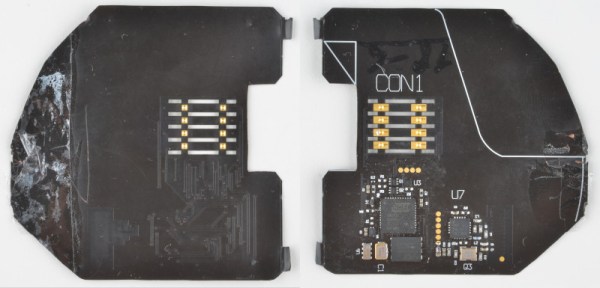
[Nick] from SparkFun refers to the device in question as a “shimmer”. It’s intended to be installed inside the chip reader of a credit card terminal, in between the terminal and the user’s credit card. Fabricated on a flexible film PCB, it’s thin enough to glue inside without being obvious even during maintenance.

The investigation begins with identification of the major components on board, followed by attempts to communicate with the device. Unfortunately, the hardware was largely unresponsive, even when connected to a card reader. In an effort to learn more, a schematic was produced. [Nick]’s analysis raised more questions than answers, and the suspicion is that the hardware may have been damaged at some point. However, the basic capabilities of the device are obvious, given the ability of the hardware to interact with a card via its contacts and offload the data through the onboard nRF24L01 radio module.

Thanks to people like [Nick], and earlier work from SparkFun, we all now have a better understanding of the risks when using payment terminals out in the wild. Unfortunately, unless your local gas station is willing to let you spend 20 minutes disassembling their card reader before paying, there’s not a whole lot the individual can do about it. Stay vigilant, and if you’ve got the skinny on a skimmer, drop us a line.

Quick And Dirty Digital Conversion For Analog SLR

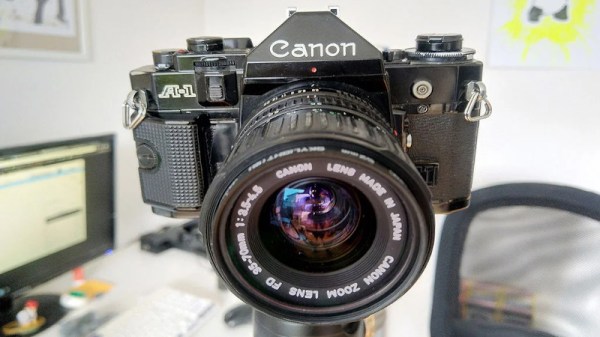
The unarguable benefits of digital photography has rendered the analog SLR obsolete for most purposes. This means that a wide selection of cameras and lenses are available on the second hand market for pennies on the dollar, making them ripe targets for hacking. [drtonis] decided to experiment with a quick and easy digital conversion to an old Canon A-1, and it’s got us excited about the possibilities.

Who needs Instagram filters? Just distort in-camera!

It’s a simple hack, but a fun one. The SLR is opened up, and the spring plate for holding the film is removed. A Raspberry Pi camera then has its original lens removed, and is placed inside the film compartment. It’s held in with electrical tape, upon a 3mm shim to space it correctly to work with the original optics.

[drtonis] notes that the build isn’t perfect, with some aberration likely caused by the reflective electrical tape in the film cavity. However, we think it’s a nice proof of concept that could go so much further. A Raspberry Pi Zero could be easily squeezed inside along with the camera, and everything glued in place to make things more robust. A specialist paint such as Stuart Semple’s Black 2.0 could also help cut down on light leaks inside. Plus, there’s plenty of small screens that can be used with the Raspberry Pi that would provide a useful preview function.

We’d love to see more conversions like this one. While it’s unlikely they’ll compete with commercial DSLRs on outright performance, everyone loves a little bit of charming distortion here and there, and all manner of fancy lenses can be had for cheap for analog platforms. We’ll be keeping a close eye on the tipline for further This fundevelopments – you know what to do!

Continue reading “Quick And Dirty Digital Conversion For Analog SLR” →

5 Kilowatts In A 3D Printed Jet Boat

Radio control projects used to be made of materials such as metal or wood, and involve lots of hand crafted parts. That’s still one way to go about things, but 3D printing has become a popular tool in recent years. [RCLifeOn] has been working on a 3D printed jet boat, which recently got a serious power upgrade.

The boat in question received a 5000W brushless motor – significant power for a vehicle weighing less than 2kg. Powered by a 12S lithium pack, and outfitted with a water jacket for cooling, it drives the boat through an off-the-shelf turbine after initial attempts to DIY the drivetrain were unsuccessful.

The biggest problem in the project came from coupling the motor to the turbine. A 3D printed coupler was unable to hold up to the strain, while attempts to make a metal part failed due to the lack of a lathe. Eventually the solution was found by daisy chaining two off-the-shelf parts together.

The boat proved itself ably on the water, with the large motor proving more than capable of shifting the boat at a strong clip. It’s an excellent shakedown for the parts that will eventually find themselves in a powered surfboard build. We’ve seen [RCLifeOn]’s work before, too, like these stylish 3D printed sneakers. Video after the break.

Continue reading “5 Kilowatts In A 3D Printed Jet Boat” →

Aging Alcohol In 30 Minutes

Many alcoholic beverages are aged in barrels for long periods of time. The aim is to impart flavors from the wood of the barrel into the liquid, and allow a whole host of chemical reactions to happen, changing the character of the taste. However, this takes time, and time is money. There’s potentially a faster way, however, and [The Thought Emporium] set out to investigate.

Inspired by several research papers, the goal was to examine whether using ultrasound to agitate these fluids could speed the aging process. Initial tests consisted of artificially aging milk, apple cider, and vodka in a small ultrasonic jewelry cleaner for 30 minutes, with cognac chips for flavor. Results were positive amongst the tasters, with the vodka in particular showing a marked color change from the process. A later test expanded the types of wood chip and beverages under test. Results were more mixed, but with a small sample size of tasters, it’s to be expected.

While taste is subjective, there were definite visible results from the aging process. It’s a technique that’s being explored by industry, too. We’ve seen hackers brew up plenty of tasty beverages before, too – often with a little automation thrown in Video after the break.

Continue reading “Aging Alcohol In 30 Minutes” →

Superconference Interview: Sam Zeloof

In less than four days, the fifth Hackaday Superconference kicks off in Pasadena, California, and it’s shaping up to be a hoot. With a cavalcade of exciting workshops and talks on offer, hackers and makers are pouring in from across the globe for this celebration of software, firmware, and hardware.

Of course, the real gift of Supercon is the personalities which make up this awesome community. [Sam Zeloof] is one such luminary, well known for producing his very own silicon integrated circuits in his parent’s garage. Not content to keep this knowledge to himself, [Sam] gave an amazing talk at the 2018 Supercon on just what goes into creating your own silicon fab on a budget.

Our very own [Mike Szczys] caught up with [Sam] for an interview, discussing being inspired by the work of [Jeri Ellsworth], as well as the finer points of getting into lithography at home. [Sam] will be in attendance at the 2019 Superconference, of course. While he won’t be on the speaking circuit this year, his brother [Adam] will be presenting a talk called Thermodynamics for Electrical Engineers: Why Did My Board Melt (And How Can I Prevent It)?, which is sure to be a must-see.

You really should be there, but alas tickets have been sold out for almost two months! Never fear, we’ll be livestreaming the event. Be sure to subscribe to Hackaday on Youtube to be notified when it all kicks off, around 10 AM Pacific Time on Saturday, November 16th. If you scored tickets and are heading to Supercon, we can’t wait to see you there — the badge hacking begins early Friday morning.

Be sure to check out Sam’s interview after the break!

Continue reading “Superconference Interview: Sam Zeloof” →

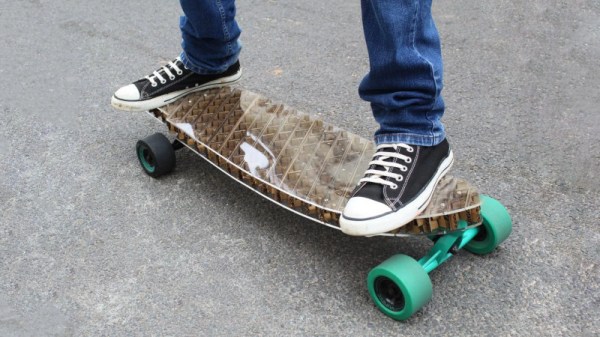
Cardboard Longboard Uses Quarter-Isogrid Structure

Skateboards are most typically crafted by hand, carved out of wood layered by care. However, many makers have sought to explore alternative techniques. [Technovation] decided to combine alternative materials and digital fabrication techniques to produce this attractive cardboard longboard.

The structure of the board was designed in Fusion 360, featuring a quarter isogrid design. The structure consists of stringers connected by ribs, all made of cardboard, with interlocking slots to hold everything together. 1/4″ plywood is then used to reinforce the truck mounts, and a top and bottom baseplate of 4mm acrylic is installed to protect the cardboard from damage.

The parts for the board are all laser cut, making production and assembly a snap. No glue is used, either – the structure is able to hold itself together perfectly well with its slotted construction. The team note that having a rider on the board does create some significant flex, but it hasn’t caused a failure in practice.

Skateboards are a popular maker project, and we’ve seen all kinds over the years. Modern manufacturing techniques are often brought to bear, or designs are created to solve tricky travel problems. Video after the break.

Continue reading “Cardboard Longboard Uses Quarter-Isogrid Structure” →

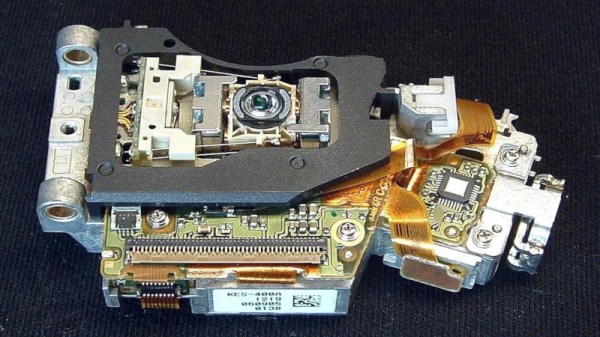
Tearing Down A PS3 Blu Ray Drive

Optical drives are somewhat passe in 2019, with most laptops and desktops no longer shipping with the hardware installed. The power of the cloud has begun to eliminate the need for physical media, but that doesn’t mean the technology is any less marvellous. [Leslie Wright] and [Samuel Goldwater] took a deep dive into what makes the PS3’s optical drive tick, back in the heyday of the Blu Ray era.

The teardown starts by examining the layout of the assembly, and the parts involved. This is followed by a deep dive into an exploration of the triple-laser diode itself, There are tips on how to safely extract the delicate parts, which are highly sensitive to electrostatic discharge, as well as exhaustive specifications and measurements of performance. There’s even a break down of the optical package, too, including a patent search to shed more light on the complicated inner workings of the hardware.

And if this lures you to dig deeper into Sam’s Laser FAQ, prepare to spend the rest of the week.

We’ve seen other optical teardowns before, too – like this look inside a stereo microscope. It’s quite technical stuff, and may fly over the heads over the optically inexperienced. However, for those in the know, it’s a great look at the technology used in a mass-produced console.