Investigating Retroreflectors With One Heck Of A Microscope

Retroreflectors are interesting materials, so known for their nature of reflecting light back to its source. Examples include street signs, bicycle reflectors, and cat’s eyes, which so hauntingly pierce the night. They’re also used in the Tilt Five tabletop AR system, for holographic gaming. [Adam McCombs] got his hands on a Tilt Five gameboard, and threw it under the microscope to see how it works.

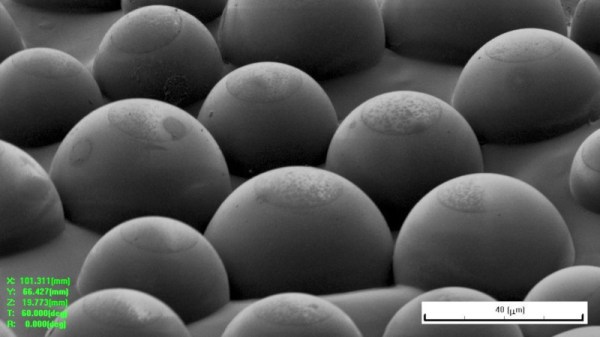
Using the ion beam, a trench was dug around the side of one of the spheres, revealing the interface between the adhesive and the sphere itself.

[Adam] isn’t mucking around, fielding a focused ion beam microscope for the investigation. This scans a beam of galium metal ions across a sample for imaging. With the added kinetic energy of an ion beam versus a more typical electron beam, the sample under the microscope can be ablated as well as imaged. This allows [Adam] to very finally chip away at the surface of the retroreflector to see how it’s made.

The analysis reveals that the retroreflecting spheres are glass, coated in metal. They’re stuck to a surface with an adhesive, which coats the bottom of the spheres, and acts as an etch mask. The metal coating is then removed from the sphere’s surface sticking out above the adhesive layer. This allows light to enter through the transparent part of the sphere, and then bounce off the metal coating back to the source, creating a sheet covered in retroreflectors.

[Adam] does a great job of describing both the microscopy and production techniques involved, before relating it to the fundamentals of the Tilt Five AR technology. It’s not the first time we’ve heard from [Adam] on the topic, and we’re sure it won’t be the last!

Syringes Become Rockets In This Flying Build

Syringes have all kinds of useful applications in the workshop, from injecting fluids to helping pick up tiny components. There’s always room for a bit of levity however, and [Tom Stanton] decided to have a play with some syringe rocket builds.

The basic idea involves blocking the end of a syringe, and then pull the plunger to create a vacuum in the tube. When released, the plunger will rush forward from the atmospheric pressure counteracting the vacuum, hitting the end of the tube and launching the syringe forward.

[Tom]’s initial attempts with small syringes were fun, but larger builds struggled with breakages, sealing issues, and excessive weight. Some more luck was had with a vacuum cannon build, which was able to launch a projectile to a decent height, albeit without a lot of stability. [Tom] wrapped things up by designing a small 3D printed launcher that fits 10mm syringes and lets you shoot them around the workshop with abandon.

It’s fun to see the concept explored in detail, with [Tom] doing a great job of explaining the basic physics behind the phenomenon. If you’re hungry for more, consider using syringes as basic hydraulic actuators for model builds. Video after the break.

Continue reading “Syringes Become Rockets In This Flying Build” →

3D Scanner For Tiny Objects Uses Blu-Ray Parts

There’s plenty of different methods to build a 3D scanner, with photogrammetry being a particularly accessible way to do it. This involves taking a series of photos from different angles to build up the geometry of the model. If you want to do this with something small, instead of a camera, just substitute a microscope! [NoseLace’s] LadyBug does just that.

It’s a 3D scanner built in a very hacker fashion. The X-Y stage that moves the sample is from a KES-400a Blu-Ray drive, salvged from the original “fat” Playstation 3. The Z axis is then created using the linear stepper motor from the optical pickup of the same drive. A rotary stepper motor is added on to the Z-axis to allow the sample to be rotated. It’s all combined with a basic USB microscope to take the images, and a Raspberry Pi which handles running all the stepper motors with some add-on driver boards.

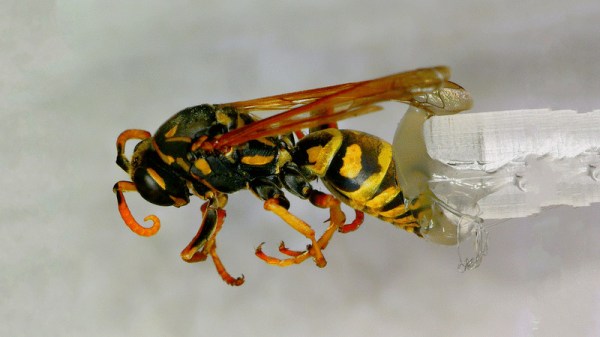
[NoseLace] uses the device to create 3D models of insects, but it would work just as well with other small objects. The benefit of this approach is that it creates both the 3D model and the requisite texture, too. There’s plenty of open-source tools available if you’d like to try it for yourself. Video after the break.

Continue reading “3D Scanner For Tiny Objects Uses Blu-Ray Parts” →

The Basics Of Persistence Of Vision Projects

Persistence of Vision (POV) is a curious part of the human visual system. It’s the effect by which the perception of an image lingers after light has stopped entering the eye. It’s why a spinning propeller appears as a disc, and why a burning sparkler appears to leave a trail in the air. It’s also commonly used as a display technology, where a series of flashing LEDs can be used to create messages that appear to float in the air. POV displays are a popular microcontroller project, and today, we’ll explore the basic techniques and skills required in such builds.

Continue reading “The Basics Of Persistence Of Vision Projects” →

Check Your Halloween Candy For Malicious Payloads

There’s long been much handwringing around Halloween around the prospect of pins, needles and razor blades being hidden in candy and passed out to children. On the very rare occasion this does happen, the outcome is normally little more than some superficial cuts. However, for 2019, [MG] has developed an altogether different surreptitious payload to be delivered to trick or treaters.

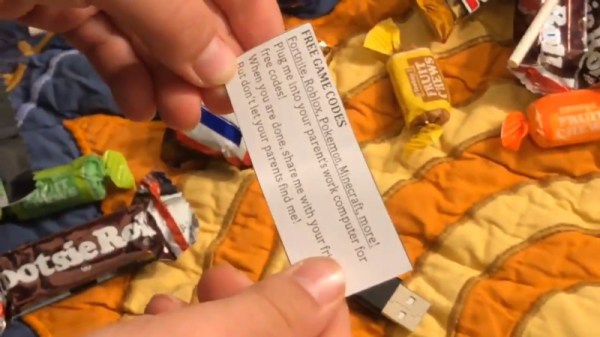
Consisting of a small USB device named DemonSeed, it’s a HID attack gadget in the genre of the BadUSB devices we’ve seen previously. When plugged in, the unit emulates a USB keyboard and can be programmed to enter whatever keystrokes are necessary to take over the machine or exfiltrate data. Files are available on Github for those looking to replicate the device.

The trick here is in the delivery. [MG] has produced a large quantity of these small devices, packaging them in anti-static wrappers. The wrappers contain a note instructing children to insert them into their parent’s work computers to access “game codes”, and to share them with their friends while hiding them from adults.

The idea of children brazenly plugging hostile USB devices into important computers is enough to make any IT manager’s head spin, though we suspect [MG] doesn’t actually intend to deploy these devices in anger. It serves as a great warning about the potential danger of such an attack, however. Stay sharp, and keep your office door locked this October 31st!

The Young Engineers Guide To Career Planning

It’s often said that engineers aren’t born, they’re made. Or more accurately, taught, tested, and accredited by universities. If you’re in high school, you’re probably starting to think about potential career paths and may be considering an engineering degree. A lot of work goes into a good college application, and it might seem like the hardest part is getting in. However, if your end goal is to get yourself a great engineering job at the end of your studies, it pays to have your head up from day 1!

I Just Need A Degree, Right?

Back in my freshman days, there was a saying that was popular on campus, particularly with those studying STEM topics. “Ps get degrees.” Your college’s grading system might use different letters, but the basic gist was that a pass mark was all that was required to get your piece of paper at the end of your four years. While this is technically true, it’s only really a useful ethos if your aim is to simply get a degree. If your goal is to use that degree to score yourself a plum job in your field, it would be unwise to follow this credo.

This attitude will net you plenty of wonderful memories at the bar, but it will dent your chances of landing a solid job upon graduation. All in moderation!

The reality of the modern job market is that it’s highly competitive. Recruiters can receive hundreds of applications for a single job, meaning the vast majority of applicants don’t even make it to the interview stage. To trim down the pile, various criteria are used to pick out the ideal candidates. An easy way to do this is to sort by grades. Having a low GPA can therefore see your application relegated to the trashcan, before you even get a chance to impress anyone with your carefully honed skills. Continue reading “The Young Engineers Guide To Career Planning” →

Laser Toy Keeps Cats Entertained

Cats are among the most popular domesticated creatures, and their penchant for chasing laser pointers is well known. With a pair of felines of his own to look after, [Tobi] set about making a device to help keep them entertained.

The aim of the device is to automate the motion of a laser pointer to make playing with the cats a hands-free operation. A pan-tilt servo mechanism has a low-power red laser pointer fitted, and the assembly is hooked up to a NodeMCU microcontroller. Based on the ESP8266, it allows the system to be controlled remotely over WiFi. Various sweeps can be automatically commanded from a smartphone, or the servo position can be controlled manually.

Test footage confirms that [Tobi’s] pets do indeed find the device to be worthy prey. It’s a popular build for cat lovers, and readily achievable with off-the-shelf parts. If you’ve built your own hardware to keep these proud hunters out of trouble, be sure to hit up the tip line.