Stylish Alarm Clock Rocks A VFD

There are a great many display technologies available if you wish to make a digital clock. Many hackers seem to have a penchant for the glowier fare from the Eastern side of the Berlin Wall. [ChristineNZ] is one such hacker, and managed to secure some proper Soviet kit for an alarm clock build.

The clock employs an IV-27M vacuum fluorescent display, manufactured in the now-defunct USSR. Featuring 13 seven-segment digits, it’s got that charming blue glow that you just don’t get with other technologies. A MAX6921AWI chip is used to drive the VFD, and an Arduino Mega is the brains of the operation. There’s also an HD44780-compliant LCD that can display further alphanumeric information, and a 4×4 keypad for controlling the device.

The best part of the build though is the enclosure. The VFD is encased in a glass tube, and supported at either end by 90-degree copper pipe couplers. These hold the VFD aloft, and also act as a conduit for the wires coming off each end of the tube. It’s all built on top of a wooden base that holds the rest of the electronics.

It’s an attractive build, and we love the floating look created by the glass tube construction. It’s not the first time we’ve seen old Russian VFDs, and we doubt it will be the last. Video after the break.


Continue reading “Stylish Alarm Clock Rocks A VFD” →

Augmented Arthropod Gets A Self-Balancing Ride

There are many people who find being around insects uncomfortable. This is understandable, and only likely to get worse as technology gives these multi-legged critters augmented bodies to roam around with. [tech_support], for one, welcomes our new arthropod overlords, and has even built them a sweet new ride to get around in.

The build follows the usual hallmarks of a self-balancing bot, with a couple of interesting twists. There’s twin brushed motors for drive, an an Arduino Uno running the show. Instead of the more usual pedestrian IMUs however, this rig employs the Bosch BNO055 Absolute Orientation Sensor. This combines a magnetometer, gyroscope, and accelerometer all on a single die, and handles all the complicated sensor fusion maths onboard. This allows it to output simpler and more readily usable orientation data.

The real party piece is even more interesting, however. Rather than radio control or a line following algorithm, this self-balancer instead gets its very own insect pilot. The insect is placed in a small chamber with ultrasonic sensors used to determine its position. The insect may then control the movement of the bot by moving around this chamber itself. The team have even developed a variety of codes to dial in the sensor system for different types of insect.

It’s not the first time we’ve seen insects augmented with robotic hardware, and we doubt it will be the last. If you’re working on a mad science project of your own, drop us a line. Video after the break.

Continue reading “Augmented Arthropod Gets A Self-Balancing Ride” →

LEDSpicer Is An Open Source Light Controller For Your Arcade Machine

In this day and age of cheap and easy emulation, it’s more tempting than ever to undertake a home arcade cabinet build. If you want to show off, it’s got to have a light show to really pull the crowds in. To make that easier, [Patricio] put together a software package by the name of LEDSpicer.

The project came about when [Patricio] was working on his Linux-based MAME cabinet, and realised there were limited software options to control his Ultimarc LED board. As the existing solutions lacked features, it was time to get coding.

LEDSpicer runs on Linux only, and requires compilation, but that’s not a huge hurdle for the average MAME fanatic. It comes with a wide variety of animations, as well as tools for creating attract modes and managing LEDs during gameplay. There are even audio-reactive modes available for your gaming pleasure. It’s open source too, so it’s easy to tinker with if there’s something you’d like to add yourself.

It’s a great package that should help many arcade builders out there. LEDs can be used to great effect on a cabinet build; this marquee is a particularly good example. Video after the break.

[Thanks to Guillermo for the tip!]

Continue reading “LEDSpicer Is An Open Source Light Controller For Your Arcade Machine” →

Magic Record Stand Can Play Your Records For You

Vinyl remains a popular format, despite taking a huge hit in popularity for a couple decades while CDs ruled the roost. It has a charm that keeps it relevant, and likely will continue to do so until everyone who grew up with a record player dies out. In the meantime, [sp_cecamp] has come up with a great way to experience your collection, with the magic of modern technology. It goes by the name of Plynth.

Fundamentally, it’s a small record stand with an excellent party trick. The prototype consists of a 3D-printed body, which holds a record sleeve at an attractive angle for display. A camera built into the base then images the artwork. The first image taken is run through the Google Vision API, and further images are then run through OpenCV to identify the record. This data is then passed to the Spotify API to play the track. The whole process takes a couple of seconds, and the music is then pumped out of whatever streaming device is connected to the rig.

It’s a fun way to play your old records, and would be a welcome change to those tired of screaming at Siri to play Weezer (Blue Album), not Weezer (Green Album). For those interested, [sp_cecamp] has thrown up a site to gauge interest in the project, and may make a limited production run in future.

Of course, you could instead just go about building your own turntable. To each their own!

Mechanical Tremolo Does Things The Old-School Way

The word “tremolo” has a wide variety of meanings in the musical lexicon. A tremolo effect, in the guitar community at least, refers to a periodic variation in amplitude. This is often achieved with solid state electronics, but also recalls the sounds created by Hammond organs of years past with their rotating Leslie speakers. [HackaweekTV] decided to do things the old fashioned way, building a mechanical tremolo effect of his own (Youtube link, embedded below).

Electronically, the signal is simply passed through a linear audio potentiometer. The effect is generated by rapidly cycling this potentiometer up and down. The motion is achieved through a geared motor salvaged from a Roomba, which turns a cam. A sprung follower sits on top of the cam, and is attached to the potentiometer.

There were some challenges in development. Rigidity of the frame was an issue, and the follower had issues with snagging on the cam. However, with some careful iteration they were able to get everything up and running. The final project sounds great, and with the amplifier turned up, there’s no need to worry about the sound of the moving parts.

Naturally, you can always build a tremolo with a 555 instead. Video after the break.

Continue reading “Mechanical Tremolo Does Things The Old-School Way” →

Reverse Engineering WyzeSense Hardware

Wyze are a company that produces a variety of home automation products. Their Wyze Sense package is a system of contact and PIR home security sensors, that piggy backs off their Wyze Cam product. In the interests of being able to use this hardware outside the prescribed corporate ecosystem, [Xuan Xing] got down to hacking.

The project starts by tearing down the Wyze Cam, and getting serial console access. This was made easier by an existing Github project, which develops custom firmwares for smart cameras. With that in place he was able to see what was going on under the hood, and read the camera’s system logs.

By poring over these logs, and examining the disassembled Wyze Sense dongle, he’s well on the way to discovering how the sensors communicate with the Wyze Cam. The end goal is to enable the Wyze security sensors to be used with the Raspberry Pi platform, and to share the code on Github for other makers to experiment with.

Home automation platforms come and go quicker than the seasons change. This makes the hardware a popular target for hackers trying to get things running independently of any one company’s servers.

Injection Molding With A Hot Glue Gun

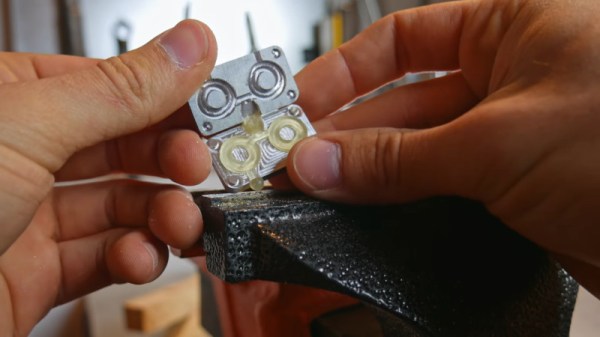
Injection molding is an industrial process used the world over for the quick and economical production of plastic parts. [Nikodem Bartnik] wanted to experiment with this at home, so whipped up some molds and got to work (Youtube link, embedded below).

[Nikodem] produced aluminium molds, using a Dremel-based CNC platform. This allowed for the design to be created in CAD software, and helps with the production of the geometry for both the part, as well as the gates and vents. Having learned about thermal issues with an early attempt, the mold was then clamped in a vice. Wood was used as an insulator to minimise heat lost to the vice.

With this setup, it was possible to mold M5 washers using hot glue, with good surface finish. Later attempts with a larger mold were unsuccessful, due to the glue cooling off before making it through the entire mold. [Nikodem] has resolved to improve his setup, and we look forward to seeing what happens next. We’ve seen others experiment in this area before, too. Video after the break.

Continue reading “Injection Molding With A Hot Glue Gun” →