LED Christmas Lights Optimized For Max Twinkleage

Old-school filament-based Christmas lights used to be available in twinkling form. LEDs, with their hard-on and hard-off nature, aren’t naturally predisposed to such behavior. To rectify this, some time ago, [Mark Kriegsman] built an Arduino program that makes LEDs twinkle beautifully.

The program is known as TwinkleFOX, and relies on the popular FastLED library for addressable LEDs. [Mark’s] demo setup is built around using WS2811 LEDs, put together in a string with plastic diffusers on each bulb. The Arduino is programmed to vary the brightness of each LED according to a triangle wave function. To create the twinkling effect, each LED has its own unique clock signal, so they vary in brightness at different times and at different rates.

Using an Arduino Uno or Leonardo, [Mark] reports its possible to twinkle 300 individual LEDs at a rate of over 50 updates a second. Using a faster microcontroller should net reliable performance with longer strings. Meanwhile, if you’re wondering how the older-style lights used to twinkle, we’ve covered that before too. Video after the break.

Continue reading “LED Christmas Lights Optimized For Max Twinkleage”
2022 FPV Contest: The LOTP Robot Dog

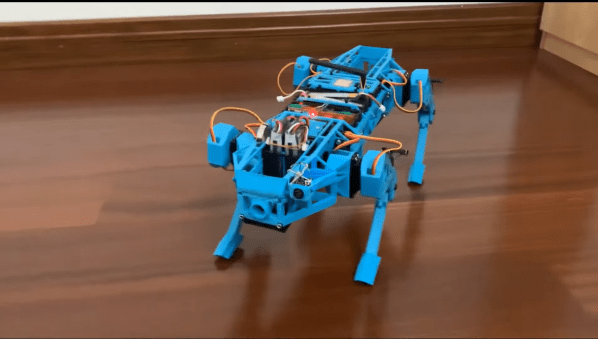
When you think of first person view (FPV) vehicles, aircraft might be what first comes to mind. However, [Limenitis Reducta] has brought a robot dog into the world, and plans to equip it for some FPV adventures.

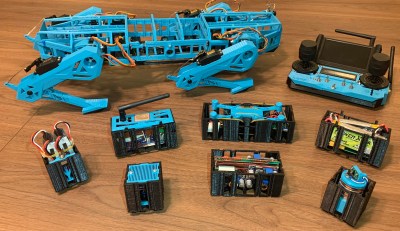
LOTP pictured with various equippable modules.

The robot dog itself goes by the name of LOTP, for unspecified reasons, and was designed from the ground up in Fusion 360. A Teensy 3.5 is charged with running the show, managing control inputs and outputting the requisite instructions to the motor controllers to manage the walk cycle. Movement are issued via a custom RC controller. Thanks to an onboard IMU, the robotic platform is able to walk effectively and maintain its balance even on a sloping or moving platform.

[Limenitis] has built the robot with a modular platform to support different duties. Equitable modules include a sensor for detecting dangerous gases, a drone launching platform, and a lidar module. There’s also a provision for a camera which sends live video to the remote controller. [Limenitis] has that implemented with what appears to be a regular drone FPV camera, a straightforward way to get the job done.

It’s a fun build that looks ready to scamper around on adventures outside. Doing so with an FPV camera certainly looks fun, and we’ve seen similar gear equipped on other robot dogs, too.

Continue reading “2022 FPV Contest: The LOTP Robot Dog”

Blood Pressure Monitoring, Courtesy Of Cameras And AI

At the basic level, methods of blood pressure monitoring have slowly changed in the last few decades. While most types of sphygmomanometer still rely on a Velcro cuff placed around the arm, the methodology used in measurement varies. Analog mercury and aneroid types still abound, while digital blood pressure monitors using electrical sensors have become mainstream these days.

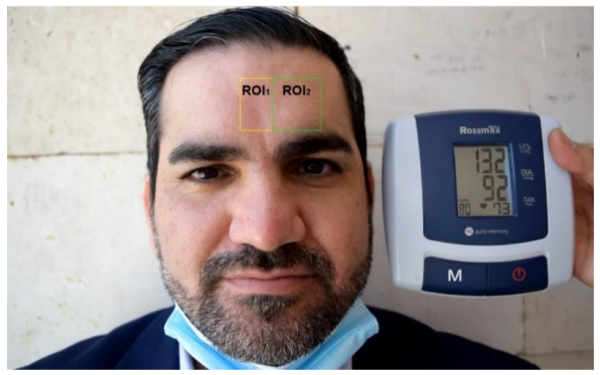
Researchers have now developed a new non-invasive method of measurement that does away with the arm cuff entirely. The method relies entirely on video capture with a camera and processing via AI.

Continue reading “Blood Pressure Monitoring, Courtesy Of Cameras And AI”

Squeezing GIFs Into Even Tighter Spaces

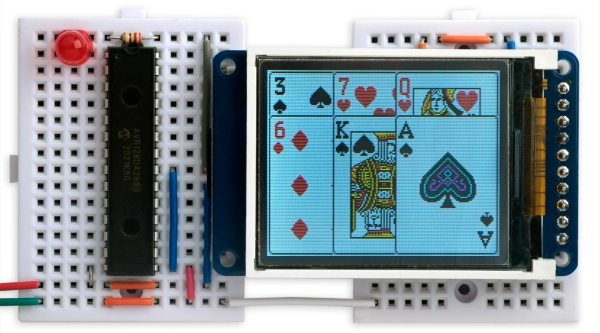
Showing images on a TFT or OLED display with a small AVR microcontroller can be a challenge as it requires significant storage space. One solution is to compress the images, but then you need more RAM to decompress it, and that’s a whole other problem. [David Johnson-Davies] of Technoblogy couldn’t find a GIF decoder that fit his needs, so he started writing his own.

We had previously seen a minimal GIF decoder aimed at a Cortex-M0+ that required 24 K of RAM, but this technique is running on an AVR with just 12 K of RAM. Along the way, [David] uses little tricks to shave down the requirements. Since the TFT he targets is a 5-6-5 color space, those 3-byte colors become 2 bytes. The LZW lookup table is encoded as 12-bit pointers to earlier entries plus an additional pixel. However, these savings come at a cost. Animated, local color tables, transparency, interlacing, or GIF87a formatted images aren’t supported. But he ports it over to the PyBadge, which is ATSAMD51 based.

[David] provides some sample code to display a GIF from program memory and an SD card. All the code is on GitHub under a CC By 4.0 license.

Big Chemistry: Liquefied Natural Gas

The topic of energy has been top-of-mind for us since the first of our ancestors came down out of the trees looking for something to eat that wouldn’t eat them. But in a world where the neverending struggle for energy has been abstracted away to the flick of a finger on a light switch or thermostat, thanks to geopolitical forces many of us are now facing the wrath of winter with a completely different outlook on what it takes to stay warm.

The problem isn’t necessarily that we don’t have enough energy, it’s more that what we have is neither evenly distributed nor easily obtained. Moving energy from where it’s produced to where it’s needed is rarely a simple matter, and often poses significant and interesting engineering challenges. This is especially true for sources of energy that don’t pack a lot of punch into a small space, like natural gas. Getting it across a continent is challenging enough; getting it across an ocean is another thing altogether, and that’s where liquefied natural gas, or LNG, comes into the picture.

Continue reading “Big Chemistry: Liquefied Natural Gas”

Arc Overhangs Make “Impossible” 3D Prints

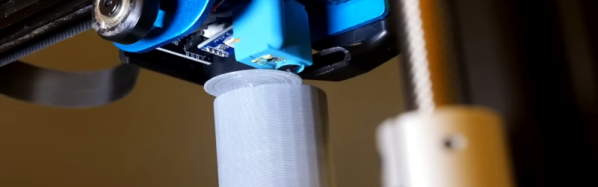
An accidental discovery by [3DQue] allows overhangs on FDM printers that seem impossible at first glance. The key is to build the overhang area with concentric arcs. It also helps to print at a cool temperature with plenty of fan and a slow print speed. In addition to the video from [3DQue], there’s also a video from [CNC Kitchen] below that covers the technique.

If you want a quick overview, you might want to start with the [CNC Kitchen] video first. The basic idea is that you build surfaces “in the air” by making small arcs that overlap and get further and further away from the main body of the part. Because the arcs overlap, they support the next arc. The results are spectacular. There’s a third video below that shows some recent updates to the tool.

We’ve seen a similar technique handcrafted with fullcontrol.xyz, but this is a Python script that semi-automatically generates the necessary arcs that overlap. We admit the surface looks a little odd but depending on why you need to print overhangs, this might be just the ticket. There can also be a bit of warping if features are on top of the overhang.

You don’t need any special hardware other than good cooling. Like [CNC Kitchen], we hope this gets picked up by mainstream slicers. It probably will never be a default setting, but it would be a nice option for parts that can benefit from the technique. Since the code is on GitHub, maybe people familiar with the mainstream slicers will jump in and help make the algorithm more widely available and automatic.

What will you build with this tool? If you don’t like arcs, check out conical slicing or non-planar slicing instead.

Continue reading “Arc Overhangs Make “Impossible” 3D Prints”

Morphing Keyboard Gets You Dialed In Just Right

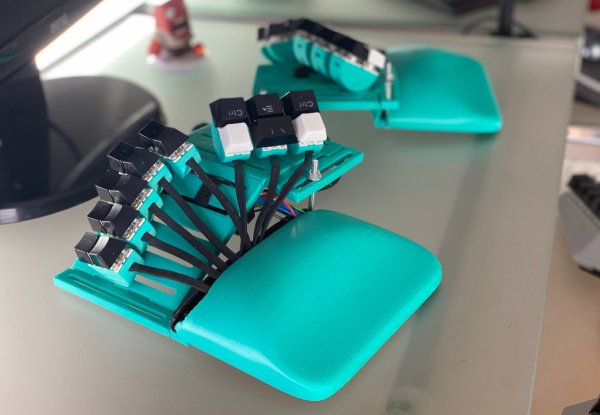
So you’re tired of rectangular, brick wall-staggered keyboards and want to go split and/or ergo. But how? Which style? What do? Here’s what you do: you build one of these here LHM Morph boards and customize the crap out of it, because that’s what it’s for.

So what is this thing, anyway? Is it a even a keyboard? Well, as long as you can press switches and send key commands to a computer, it certainly smells like a keyboard to us. Now that we’ve gotten that out of the way, what’s going on here is that [LifeHackerMax] has built a highly-customizable version of the LHM, their 26-key split. The LHM Morph can be fine-tuned to nearly any degree imaginable, including the tenting angle. The keys are grouped in modules that can slide back and forth to suit your varying finger lengths. As they are half-round, these modules can also be tilted and rotated until they’re just right.

But the super cool thing about the LHM Morph is the way it goes together — like LEGO. It’s completely modular, and you don’t even have to go split if you’re not ready for that. But all the pieces connect via rods made of copper wire. If you’d like to make one for yourself, the 3D files are up on Thingiverse, and the firmware is on GitHub. Be sure to check out the video after the break.

Does this keyboard remind you of anything? [Peter Lyons]’ Squeezebox, perhaps?

Continue reading “Morphing Keyboard Gets You Dialed In Just Right”