How Packaging Can Kill An Electronics Microbusiness

Quite a few in our community make a bit of cash on the side by selling our creations, and it’s not uncommon to find that a project which catches your eye can be picked up as a kit for a few of your preferred currency units. But there’s a problem facing such tiny producers in the form of regulations intended for large businesses which are beyond their ability to comply with. [Alain Pannetrat] writes for the Lectronz marketplace about one of them, the new European Union packaging waste regulations.

At face value it sounds like a good idea, that suppliers should be responsible in some way for the disposal of their packaging. It discourages excessive packaging and encourages recycling, indeed the EU even describe the scheme as boosting business. The problem is that its administration is left to individual member states, and someone selling across the whole bloc would have to join multiple schemes. The hefty price is nothing to a large enterprise, but impossible for a tiny one. He makes a very good point, that it’s difficult to claim to champion innovation, while also imposing something like this on grass-roots innovators. Going by the experiences of our acquaintances in this space an extra burden on top of that presented by the current unstable tariff and customs situation involved in selling to the USA would likely be the straw which broke the camel’s back.

In practice we suspect that many are simply doing the same as they have with compliance marking and waste electronic equipment regulations, simply not bothering and hoping they fly under the radar and never get caught. We hope we won’t end up reporting on any future crackdown, the landscape has definitely changed since we tried our hand in this business.


Hackaday Europe 2026: PCBs With A Plot

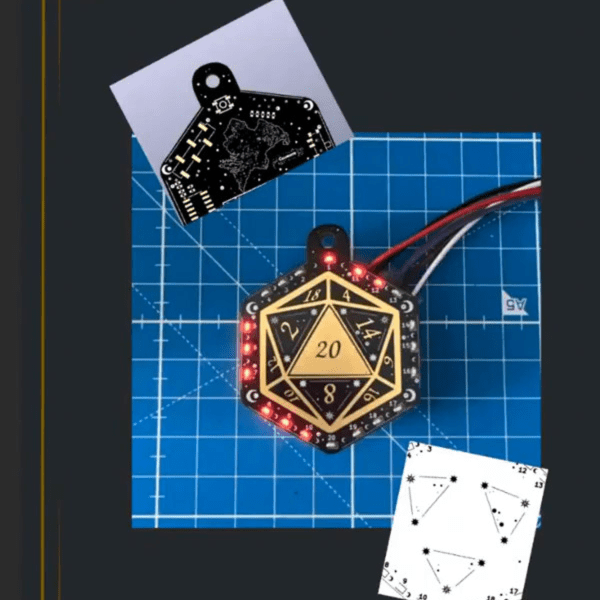
Printed circuit boards were developed first for function over form. They were a way to mount components and connect them in a stable, robust fashion, while taking into regard things like packaging and cooling requirements to enable a circuit to function. Circuit boards often end up looking cool in a techy kind of way, but their aesthetic is usually very much secondary to their actual purpose.

Katrin Dietzsch likes to use her PCBs a little differently, however. She designs boards that are intended to be a narrative tool for tabletop roleplaying, and came down to Hackaday Europe 2026 to walk us through the development of this very whimsical hardware.

Continue reading “Hackaday Europe 2026: PCBs With A Plot”

Claude Plays DOOM

Large language models (LLMs) are generally thought of as machines that accept textual prompts and spit out textual content. However, if you’re creative in the way you interface with them, you can get them to do a wider range of tasks. For example, [Andrea Ricci] figured out how to get one to play DOOM.

For this project, [Andrea] began by porting the game to the SCINTIX P4. It’s a rather interesting device, being a single board designed in the Raspberry Pi CM4/CM5 form factor, but carrying an ESP32-P4 and an ESP32-C6 instead. The game runs on the P4 and is displayed on a 1024×600 MIPI DSI panel, but it’s only stepped through a few frames at a time. These frames are then passed to Claude Sonnet via a WebSockets setup. With only the same information as a human player would get, the LLM has to figure out what it’s looking at, and then respond with movement and fire commands to play the game.


It’s quite interesting to watch the system play—the LLM mostly accurately describes the game world, navigates down corridors, opens doors, and shoots at enemies. There is a bit of work behind the scenes to enable it to see and understand the game world—namely, using a depth fan across the field of view so it can figure out where walls are and how not to bang into them. There’s also an ASCII automap used to allow the system to keep track of where it has already been. But fundamentally, the LLM is playing the game without any other sort of additional assistance.

We’ve seen some other great ways in which AIs have been whipped up to play various games, like Trackmania.

Continue reading “Claude Plays DOOM

New Controller Makes Heavy Machinery Intuitive

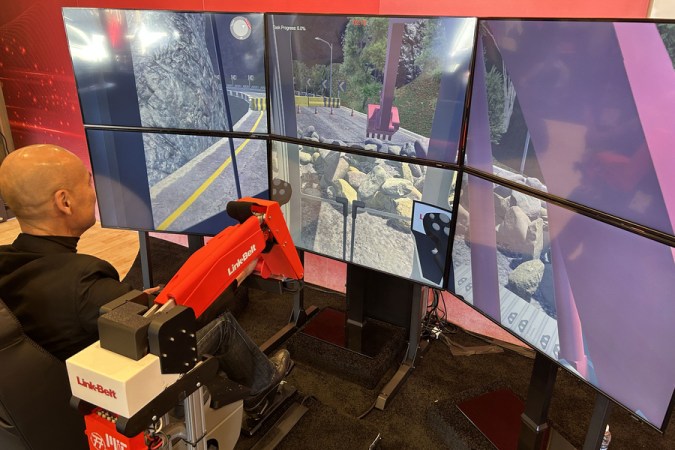
As children, many of us looked wistfully into the cockpits of heavy machinery, wondering just how the series of knobs and levers would do something like operate a bulldozer, crane, or excavator. The nature of these myriad of hydraulic and electronic controls for equipment like this is often inscrutable to adults as well; it takes a considerable amount of training to be able to competently operate most of these machines. But this new controller from MIT may help shorten that training time.

The controller is specifically meant for excavators. In a standard excavator, a pair of joysticks is typically used, with one controlling the swing and the boom and the other controlling the stick and the bucket. Getting used to this combination can take practice, so instead the group of researchers replaced them with a model excavator arm that the operator controls directly with their own arm. The new controller is more intuitive to use as it translates the movements of the model to that of either a real excavator or a training simulation.

The researchers plan to include haptic feedback in future versions, which will hopefully further increase the ease of which new operators can get a feel for using these machines. For those not working towards a new career or an ambitious weekend with rental equipment, there are some other ways of learning how to operate excavators and other pieces of heavy machinery.

Blow Those Pyros With A Telephone!

A pyrotechnic charge is set off by passing a high voltage through a filament within it, melting the filament and igniting the charge. We could think of a variety of circuits that could do this, but perhaps we wouldn’t have come up with [MichaÅ‚ SÅ‚omkowski]’s solution. He’s used the ringer crank generator from an old military field telephone. It’s an old project he’s shared with us due to its recent republishing on his website.

The basic principle is simple enough, winding the generator charges a capacitor bank through a bridge rectifier. Then a thyristor is used as the trigger device, dumping the contents of the capacitor into the filament. But the full circuit has a couple of refinements. There’s a charge indicator circuit using a couple of Zener diodes and an LED, and a filament tester which passes a non-triggering current through the filament from a 9 volt battery. We like the use of an over-the-top high-current thyristor, no doubt what he had in his junk box.

Perhaps it’s a symbol of how far technology has moved, that today it’s surprisingly rare to find a bridge rectifier or a thyristor, and building this device today would involve a microcontroller and probably an AliExpress inverter module as a matter of course.

Meanwhile, should field telephones interest you, we’ve been there before.

Cheap AI Token Resellers: The Secret Ingredient Is Fraud

[Matt Lenhard] has an interesting writeup explaining exactly how fraudsters offer access to cutting-edge AI models at a tenth of the price. Perhaps unsurprisingly, the secret is to get tokens for free from anywhere they can and by any means necessary. Then wrap them in a pretty relay API, and sell access to it.

Relaying tokens is not by itself a shady practice. That distinction belongs to services that obtain tokens fraudulently, opening the door to selling them at rates far below market value. This practice is widespread and profitable, in part because the abuse is so hard to pin down and stop.

One source of tokens is free credits on new accounts. New accounts are spooled up as fast as possible, hammered until they’re empty, then it’s done all over again. Another method is to sign up as pay-after, possibly with a stolen card, and simply ensure the account has no valid payment method once the bill comes due. Or set up a temporary card, pay some minimum up front and consume as much as possible, then initiate a chargeback. It doesn’t matter if individually each of these doesn’t amount to much before they get flagged, because it’s being leveraged relentlessly on a massive scale by automated systems.

There are the shadier methods, too. Fraudsters don’t just target providers directly. Consumer software products with AI features get reverse-engineered, then the back ends hammered for all they are worth. Poorly-coded support chatbots can be highjacked into serving fraudsters’ traffic instead of just their own. It doesn’t actually matter where the tokens come from, after all. As long as the fraudsters are obtaining them for free (or at least below their costs) then it’s profit.

That last point is one [Matt] zeroes in on with advice on how to mitigate this abuse. He goes into detail in his writeup but what it comes down to is recognizing that it’s a numbers game. Fraudsters depend entirely on obtaining tokens for free, or nearly free. So just like using an AI to keep phone scammers tied up, anything that raises friction increases the fraudster’s costs, in turn encouraging them to find an easier target.

Reject Fluid Simulations, Return To Rheoscopic Fluid

Fluid simulations are one of the “killer apps” of high-performance computing, but if you can’t afford the performance, they can take a depressingly long time to run. Depending on your use case, as long as you keep the Reynold’s number in mind– or are just looking for a qualitative look at pretty flows–you might be able to get away with purely-practical simulations using rheoscopic fluid, as [Visual Thinker] demonstrates in a recent video.

The fluid, as you can guess from the name, lets you scope out rheos— that’s flow, for those of you didn’t take Greek. Making it is as simple as you could ask for: get some mica flakes, which are readily available to add ‘sparkle’ to cosmetics, and mix with water and a drop of soap. The soap isn’t always necessary, but depending on your mica it helps keep it in suspension and avoid clumping– [Visual Thinker] found it helped him a good deal. Being flat plates of reflective material, the mica flakes catch the light and sparkle beautifully– and since they align with the fluid shear, they show you exactly what’s going on in your ‘simulation’.

[Visual Thinker] isn’t starting with serious simulations; the first thing he tries is essentially a toy that lets him see fluid flow around a Benchy by sticking magnets in it and using it to move a cross-section of its hull though a thin layer of fluid sandwitched betwixt pieces of laser-cut acrylic. We don’t call it a toy to disparage it, though– we totally want one. [Visual] mentions the idea of a coffee table combining the concept with the kind of underslung mechanism we see in sand drawing tables, which sounds dangerously hypnotic. If any of you build one, please try and tear your eyes away long enough to let us know.

He has another beautiful piece that make the video worth watching: a wind-tunnel, again made of laser-cut acrylic and printed parts. With careful consideration of the scale and flow speeds, that one might actually prove useful– and even if it doesn’t, it’s pretty enough that it doesn’t really matter. Beauty has its own utility sometimes.

Most wind tunnels we see around here use actual wind, but rheoscopic fluid was invented for this sort of thing, even if it does make for pretty baubles.

Continue reading “Reject Fluid Simulations, Return To Rheoscopic Fluid”