A dark green two door coupe sits in the center of an auto garage with its hood open. Two men stand on either side of it while another sits inside testing the vehicle. A pair of shoes sit on the floor next to the door.

Who Resurrected The Electric Car?

There are a few cars that serve as touchstones of the state-of-the-art, even if they weren’t necessarily a commercial success. Some only survive as memories, but a restored EV1 has just shown that this electric car couldn’t be killed.

A full body off-vehicle restoration is quite a project, and setting a one year turn around for such a task is aggressive. The restoration of V212 turns it up to 11 since only a handful of examples are even still in existence, and this is the only one in private hands. Thankfully, GM lent a hand with parts and technical knowledge in an about face from the company’s position when it took all EV1s off the road at the end of their leases. Most were crushed, although a few were sent to museums, universities, or storage at GM.

This final installment in the restoration of the vehicle, covers the final days before the 30th Anniversary of the first EV1 rolling off the production line. The crew from [The Questionable Garage] race against the clock to get the vehicle running again after having the magic smoke release from some of the power electronics boards. Most of us can relate to having to trace down mysterious electrical gremlins on a project, and we’re glad that they were eventually successful in getting this icon moving again under its own power.

We previously covered the teardown of V212 when it first arrived at the garage.
Continue reading “Who Resurrected The Electric Car?” →

Repurposing Lava Lamps To Cook Dinner

Should you cook anything with a lava lamp? Probably not. Can you? Well, [Nate Scovill] seemed to think he could, and he set out to demonstrate just that.

From the factory, lava lamps ship containing a bunch of wax sitting in chemically-treated water. Heat from a bulb in the base melts the wax, and causes blobs of it to float up and down the water column as the relative density of the wax and the fluid changes. None of this is conducive to cooking.

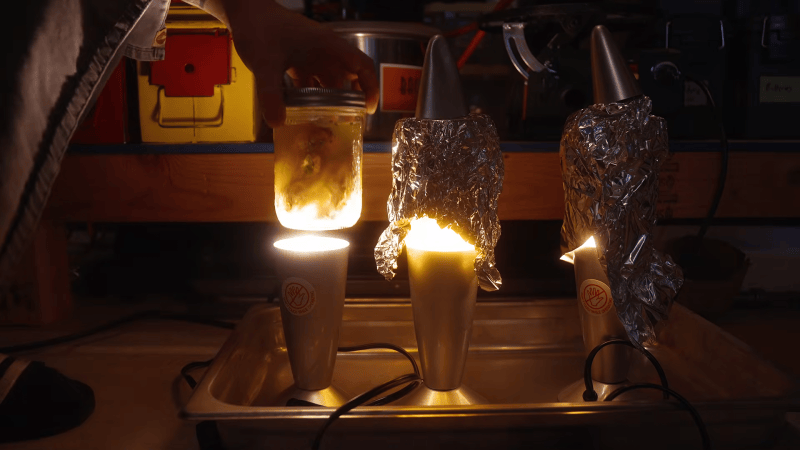
[Nate] decided he’d figure out how to use this unlikely apparatus to cook turkey, buttermilk squash, mash potato, apple cider, pumpkin pie—that is, a full Thanksgiving dinner. Or, more accurately, he decided to build lava lamps full of food instead of wax. He used lava lamp bases with sealed jars on top. The lava lamp bulbs heated the jars and their contents, cooking them, with aluminium foil used as insulation to ensure the jars got up to safe cooking temperatures.

Ultimately, the hack was vaguely successful. The light bulbs produced heat which cooked the various foods, with the squash and mashed potatoes being particularly edible. However, the rig that [Nate] built didn’t exactly look or operate like a lava lamp—there were no gloopy blobs of potato floating up and down in the jars to pleasant visual effect.

We wouldn’t recommend cooking with lamps as it’s just tiresome compared to using a proper oven or air fryer. But you know, sometimes it’s fun to try something weird for the bit. Video after the break.

Continue reading “Repurposing Lava Lamps To Cook Dinner” →

A Detailed Breakdown Of The 2021 Texas Power Crisis

Although the Texas grid operator managed to prevent a full-blown collapse of the electrical grid in February 2021, they only managed to do so after exhausting every measure at their disposal, while the emergency kept happily zipping through the neatly lined up holes in the stack of cheese slices. These events, what led up to them and the conclusions of the official investigative report are covered in a detailed breakdown by [Jordan], also known as [The Electric Brit].

The most obvious problem was the lack of cold weather proofing, which during Winter Storm Uri set in motion something that would end up costing the lives of hundreds of people. The sudden extreme freezing weather conditions affected all generators on the grid, with wind turbines suffering from iced-up blades that led to loss of capacity and protection mechanisms kicking in due to e.g. excess vibrations caused by unbalanced blades.

For gas-powered plants the issues were many, with them relying on a constant supply of pressurized gas and thus having many weak points at processing and extraction sites. Even one nuclear power unit tripped due to an external feedwater sensor malfunctioning, highlighting the importance of weatherproofing auxiliary systems, with this also taking out some solar capacity.

Although often called a blackout, the grid operator managed to disconnect enough load to limp by on the remaining generators to keep part of the grid functional. Yet with 20 GW disconnected, the impact on the Texan population was severe, trying to survive in houses not built to withstand temperatures down to -20°C.

Perhaps most inexcusable of this event was that previous events in 1989 and again in 2011 showed the need to better prepare, yet with the short memory of the politicians and populace at large those lessons were repeatedly forgotten, including the benefits of having more interconnects with the wider US grids.

Keeping a large grid stable is a delicate balance between voltage, frequency and reactive power. Usually this goes well, but as the 2003 Northeast Blackout showed, sometimes the holes line up perfectly and all you can do is hold on for dear life. If you’re lucky the crisis happens during pleasant weather as in 2003 or with the 2025 Iberian peninsula blackout, rather than during an extreme winter storm.

Although the idea of using electric cars as grid-level backup is rather daft, they can be very useful to power one’s home during an outage, providing a lot of power without the risks of e.g. gas-powered generators.

Continue reading “A Detailed Breakdown Of The 2021 Texas Power Crisis” →

ESP32 Remote Access Done Light

The team behind Pinscope had a problem. They needed an ESP32 to stay securely connected to a server, but they didn’t have enough spare RAM on the chip to do TLS, what with everything else going on. Thus, they whipped up a useful workaround to get remote access on an ESP32 without TLS.

The team noted they didn’t need the general functionality of TLS. See, TLS is great for connecting any client and server securely with certificates, but it’s a bit heavy when you’re working with a device that only needs to connect to one server for maintenance. The team decided the device just needed to ID whether it was talking to the real server, it must ensure credentials are sent over the wire encrypted, and messages should not be able to be replayed, read, reordered, or otherwise changed while in transit.

The solution to this problem was the Noise protocol. Specifically, Noise_NK_25519_ChaChaPoly_SHA256, where the server uses a static key which the device knows in advance. Since only the holder of the server’s private key can properly finish a handshake, the device knows it’s talking to the real server, and the entire handshake takes just 0.3 seconds on the ESP32, with just 100 bytes sent over the wire. The results are compelling. The ESP32 needed 23.6 KB of RAM to stay connected via TLS, while this dropped to just 9.4 KB using the Noise protocol.

If you need to lighten the burden on a remotely-connected ESP32, you might find this work very useful. Files are on Github for the curious.

Continue reading “ESP32 Remote Access Done Light” →

How To Make A Nixie Tube

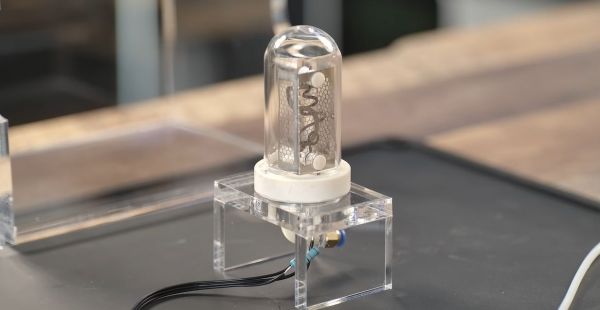
Recently [polymatt] had a poke at one of the all-time favorites in the retro community, by making his own Nixie tube. Over the course of two weeks he tried to create one from scratch, following in the footsteps of other people who are trying to revive this obsolete type of indicator.

Before VFDs and LED technology made them firmly obsolete, Nixie tubes were one of the few ways that devices could provide something like an alphanumeric indicator to a user. Each digit or other symbol is formed by its own cathode, which glows when powered. They’re a type of neon lamp, though with multiple cathodes and a mesh anode for a distinctive look. Simple neon lamps served effectively the purpose of LED indicators alongside their Nixie siblings.

While the design of a Nixie tube fundamentally isn’t much more complex than making a simple neon indicator lamp, the internal structure has many more elements, all of which have be carefully designed, created and assembled, before evacuating the air from the glass envelope and filling it with the usual neon-argon Penning gas mixture.

For his design, [polymatt] used borosilicate test tubes for the glass envelope, leaving just designing the base, the internals and sealing the whole construction. Even with a range of laser cutting heads at his disposal this took a while, especially for finer features like the mesh anode. Rather than going for the typical Penning mixture pure argon would be used, which requires a higher voltage.

Unfortunately the first major test after the two-week deadline showed that his vacuum setup was leaking just about everywhere, so the big glow-up gets pushed to a follow-up video. Unfortunately it’s not mentioned why a pure argon gas mixture would be used, though it’s probably just for ease of filling with just one tank required.

Continue reading “How To Make A Nixie Tube” →

PS3 Boomerang Controller Concept Flies Back Into Your Hands

Think back long ago, to the halcyon days of 2005 — those of you who were alive and cognizant in those days, that is — specifically to E3 that year. Sony was teasing their next-generation console, the PlayStation 3, with a rather odd boomerang-shaped controller. That controller did not survive to production, but [polymatt] has decided to bring it back as an open source project.

As far as DIY game controllers go, the only exceptional thing is the shape and the history. Otherwise it’s got everything you’d expect in a PS3 Dual Shock controller. Although it doesn’t actually use PS3 parts for things like analog sticks, and has actual buttons soldered to the custom PCB. Everything goes through an ESP32, and the firmware is partially based on [lemmingDev]’s ESP32-BLE-Gamepad library, as there’s no need to reinvent the wheel to recreate a controller concept from 2005. It can even work with an original PS3, though admittedly only in wired mode, and it doesn’t look like the most ergonomic way to play.

It still beats the keychain-sized GameCube controller we featured recently, if you want to talk ergonomics. In terms of style, that’s a matter of taste, but we like the cut of anybody’s jib if they’re making their own controllers. 

Continue reading “PS3 Boomerang Controller Concept Flies Back Into Your Hands” →

Hackaday Podcast Episode 396: Robot Hands, The Inner Life Of Mechanical Watches, And The Truth About 3D Scanning

Hackaday Editors Elliot Williams and Al Williams met to review the week in Hackaday. It was a week for hands, in more ways than one, along with a voice assistant that ditches the cloud, a GPU for twenty cents, glasses that help the visually impaired see with LiDAR, and a virtual mechanical watch that shows you exactly how the real thing ticks.

Beyond watch hands, you might like an eighteen-degrees-of-freedom robot hand for under $300 in parts.  Or plant your own hands on a spinning wheel to make virtual honey feel sticky and virtual oil feel slippery in VR.

For the Can’t-Miss Articles, Elliot digs into the truth about hobbyist 3D scanning, photogrammetry versus structured light, and why the meshes you get are rarely the CAD models you wanted. Al, meanwhile, looks at how modern smartphones talk to satellites, bent pipes, flying cell towers, and all.

Check out the links below to follow along, and as always, tell us what you think about this episode in the comments! Or drop us a note at mailbag@hackaday.com.


Download in non-robotic MP3 format.

Continue reading “Hackaday Podcast Episode 396: Robot Hands, The Inner Life Of Mechanical Watches, And The Truth About 3D Scanning” →