Hackaday Prize 2023: Scratch Made 8-Bit Educational Computer

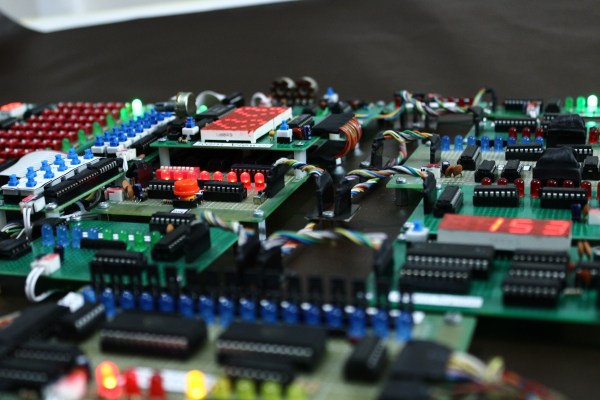
To demonstrate the functionality of an 8-bit computer processor at a very basic level,  [Mazen Gomaa] assembled a Homemade 8-Bit Educational Computer using common CMOS logic chips, a handful of prototyping boards, and an impressive number of carefully connected wires. [Mazen] was inspired by Ben Eater’s 8-bit TTL Breadboard Computer but opted to solder the chips and other components onto proto boards instead of using solderless breadboards.

The 8-Bit computer is based on the Simple-As-Possible (SAP) computer architecture described in the book “Digital Computer Electronics” by [Paul Malvino] and [Jerald Brown]. These useful educational examples demonstrate data, computer logic, and even programming in the context of basic electronic components. Tinkering with such simple computers provides a real “zeros and ones” exposure to computation.

[Mazen] added some additional features and functionality to his computer, including an instruction keypad, an address keypad, a dot matrix memory data viewer, a Schottky diode matrix ROM, and a boot loader that initializes the RAM with data stored in ROM. With clock speeds up to 100 Hz, the computer consumes around 300-500 mA of current.

Future plans include expanding the memory and instruction set from the present 128-bit (8×16) RAM, 64-bit (8×8) ROM, and a set of ten instructions.  Already, this project is a great addition to an ever-growing catalog of homemade solderless breadboard computers, LCD snake games, and VGA video cards.

Continue reading “Hackaday Prize 2023: Scratch Made 8-Bit Educational Computer”
All Your Robots Are Belong To Us: You Just Rent Them

Monthly bills. Everyone has them. Except if you go far enough back, not everyone had them. After all, you might live in a home your family has owned for generations. You might be able to produce all the basic necessities using your homestead: food from a garden, water from a well, textiles, soap, and candles. You might have to buy the occasional animal, but your recurring bills could be modest outside of the ever-present tax burden.

But as people moved to cities, they had to pay rent. Buy gas or coal and, eventually, electricity. Water and trash collection are pretty essential, too. But at some point, everyone realized that being in a position to bill you monthly is a good idea. Now we pay for the internet, movie subscriptions, meal plans, alarm monitoring, shopping clubs, cell phones, spa memberships. Soon we might be paying a monthly fee for our robots, too.

Rent To (Not) Own

In industry, this is a common occurrence. You often don’t buy a robot arm or similar device. That, after all, is a capital expense, and most tax codes require you to count it as an asset that slowly depreciates. Instead, you hire a robot from a service provider. Not only does that make it a pure expense, but the provider worries about software, repairs, and all that.

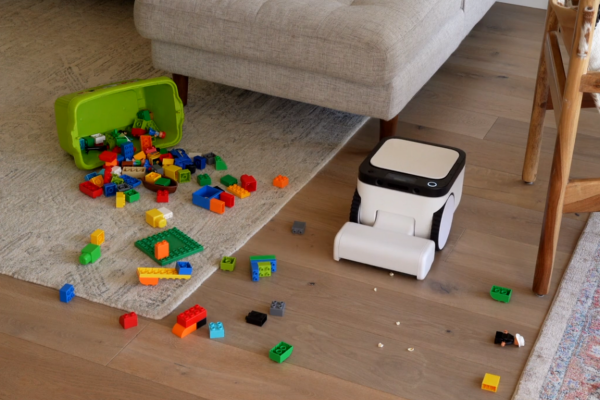
But at home, it is different. There’s no tax advantage in most places between owning a car and leasing it. Yet vendors want to adopt a rent-a-robot strategy. Case in point: a startup named Matician wants you to sign up for a robotic vacuum. For $125 a month, you get a super smart robot vacuum. You could, of course, buy a Roomba, but — according to Matician — the Matic robot uses computer vision to map your house and automatically finds messes. You can also voice command it to clean up areas. It also avoids wire and furniture. They didn’t mention if it can avoid presents left by your pets or not. It will avoid pets and kids, though.

Continue reading “All Your Robots Are Belong To Us: You Just Rent Them”

Open-Source AR Hack Chat

Join us on Wednesday, May 31 at noon Pacific for the Open-Source AR Hack Chat with Raj Nakaraja!

We may live in a soup of electromagnetic waves that range in wavelength from the diameter of Jupiter down to a fraction of the radius of a hydrogen atom, but our eyeballs have evolved to only let us sense a tiny slice of that spectrum. That’s too bad, really, because there’s a lot going on in the rest of the spectrum that could potentially inform our ROYGBIV-centric view of the world. Think of the possibilities of being able to see UV the way an insect does, or being able to watch the radiation pattern of an antenna and make adjustments on the fly. Sounds like a job for augmented reality.

join-hack-chatIf seeing the world with different eyes sounds as cool to you as it does to us, you won’t want to miss Raj Nakaraja’s stop by the Hack Chat. Raj is head of engineering at Brilliant Labs, an augmented reality company that’s looking to bring AR into the mainstream. They’ve got some cool ideas about AR, and we’re going to take the opportunity to talk to Raj about open-source AR in general, Brilliant’s products specifically, and how AR can be incorporated into not only our projects, but into our lives as well.

Our Hack Chats are live community events in the Hackaday.io Hack Chat group messaging. This week we’ll be sitting down on Wednesday, May 31 at 12:00 PM Pacific time. If time zones have you tied up, we have a handy time zone converter.

Click that speech bubble to the right, and you’ll be taken directly to the Hack Chat group on Hackaday.io. You don’t have to wait until Wednesday; join whenever you want and you can see what the community is talking about.

Macro Pad Cheap Enough To Give Away

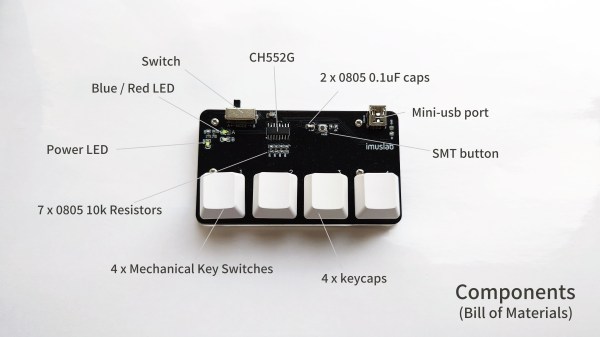
Supercon 2022 showed that hackers are starting to come together again in Maker Faires, conventions, and festivals. [Toby Chui] plans to be one of those hackers and wants something to give to fellow attendees. Thus, the $3 Macro Pad was born.

We’ve seen our fair share of macro pads, so a simple four-key pad isn’t exactly novel. However, the focus on size and cost makes it stand out. The pad is the size of a business card, making it easy to give away. For a microcontroller, [Toby] used a CH552G, which is cheap and compatible with the Arduino IDE. Although, with 10 GPIO, a matrix layout could have supported a full-sized number pad, the diodes required would have added to the cost significantly. A cheap PCB and 3d-printed base make up the device’s bulk.

[Toby] provides a handy tool for assigning keys from your browser without coding. However, the source code is on GitHub if you want to develop a more complicated scheme. This isn’t the first time we’ve featured the CH552 chip, and it likely won’t be the last.

Continue reading “Macro Pad Cheap Enough To Give Away”

ChatGPT V. The Legal System: Why Trusting ChatGPT Gets You Sanctioned

Recently, an amusing anecdote made the news headlines pertaining to the use of ChatGPT by a lawyer. This all started when a Mr. Mata sued the airline where years prior he claims a metal serving cart struck his knee. When the airline filed a motion to dismiss the case on the basis of the statute of limitations, the plaintiff’s lawyer filed a submission in which he argued that the statute of limitations did not apply here due to circumstances established in prior cases, which he cited in the submission.

Unfortunately for the plaintiff’s lawyer, the defendant’s counsel pointed out that none of these cases could be found, leading to the judge requesting the plaintiff’s counsel to submit copies of these purported cases. Although  the plaintiff’s counsel complied with this request, the response from the judge (full court order PDF) was a curt and rather irate response, pointing out that none of the cited cases were real, and that the purported case texts were bogus.

The defense that the plaintiff’s counsel appears to lean on is that ChatGPT ‘assisted’ in researching these submissions, and had assured the lawyer – Mr. Schwartz – that all of these cases were real. The lawyers trusted ChatGPT enough to allow it to write an affidavit that they submitted to the court. With Mr. Schwartz likely to be sanctioned for this performance, it should also be noted that this is hardly the first time that ChatGPT and kin have been involved in such mishaps.

Continue reading “ChatGPT V. The Legal System: Why Trusting ChatGPT Gets You Sanctioned”

A man playing an automated recorder

Musical Robot Lets You Play The Recorder Hands-Free

Although many people might remember the recorder as just a simple instrument from their introductory music classes, it can nevertheless produce rich and varied melodies in the hands of a virtuoso like Frans Brüggen. [Luis Marx] also took music lessons as a child, but never progressed much beyond an elementary level. Instead, he preferred to spend his time honing his engineering skills, which eventually enabled him to get back into music.

Initially, he wanted to build a piano-playing exoskeleton, to marionette his fingers up and down the ivories, but had to bail on that one because of the insane complexity. So instead, he built himself a robot that helps him play the recorder. (Video, in German, embedded below, fast-forwarded to the recorder part.)

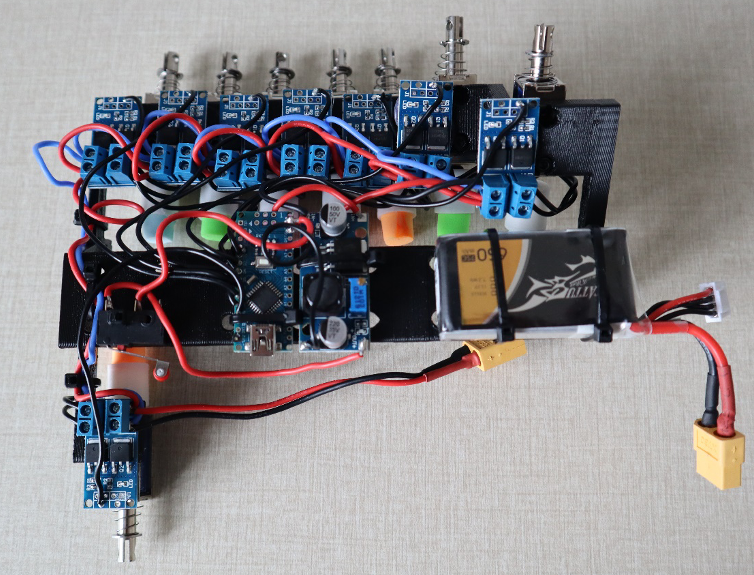
A set of solenoids and an Arduino on a 3D-printed frameA recorder has eight finger holes, which can be covered or uncovered in various combinations to produce tones. [Luis] therefore used eight solenoids, mounted on a 3D-printed frame, to actuate the finger holes. The basic idea worked, but getting the solenoids to fully cover the holes each time turned out to be a challenge: even a slight misalignment would cause air to leak past the plug and produce a horrible off-key sound.

After a lot of trial and error, [Luis] found foam earplugs to be a pretty good material for emulating human fingertips. He also discovered that relying on the solenoids’ spring tension to keep the holes closed was not reliable; a better solution was to flip the solenoids around and use the much larger force from their powered stroke to create an air-tight seal.

The solenoids are driven by an Arduino Nano through a set of MOSFET modules, powered by a lithium battery. [Luis] wrote some Arduino sketches with famous melodies like Beethoven’s Für Elise, which sound quite decent on the robo-recorder: perhaps not on Frans Brüggen’s level, but pretty impressive for a self-declared “music noob” like [Luis].

Many robotic musicians play instruments like pianos or xylophones. Instruments from the flute family are harder to automate, but it has been done before. We’ve even seen a MIDI-powered harmonica.

Continue reading “Musical Robot Lets You Play The Recorder Hands-Free”

The CCTV Cameras That Recorded The Chernobyl Disaster And Aftermath

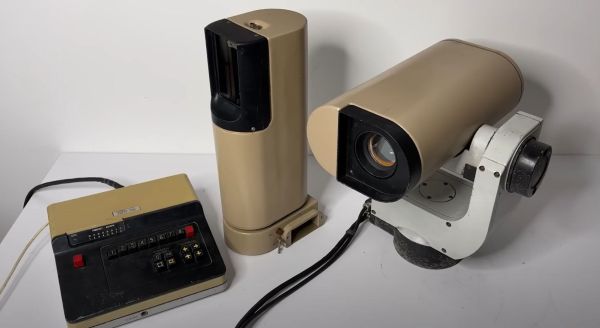
The Soviet KTP-63-based remote controlled camera system, including switch and control panel. (Credit: Chernobyl Family on YouTube)
The Soviet KTP-63-based remote-controlled camera system, including switch and control panel. (Credit: Chernobyl Family on YouTube)

When we picture the Chernobyl Nuclear Power Plant disaster and its aftermath, we tend to recall just the commonly shared video recorded by television crews, but the unsung heroes were definitely the robotic cameras that served to keep an eye on not only the stricken reactor itself but also the sites holding contaminated equipment and debris. These camera systems are the subject of a recent video by the [Chernobyl Family] channel on YouTube, as they tear down, as well as plug in these pinnacles of 1980s vidicon-based Soviet engineering.

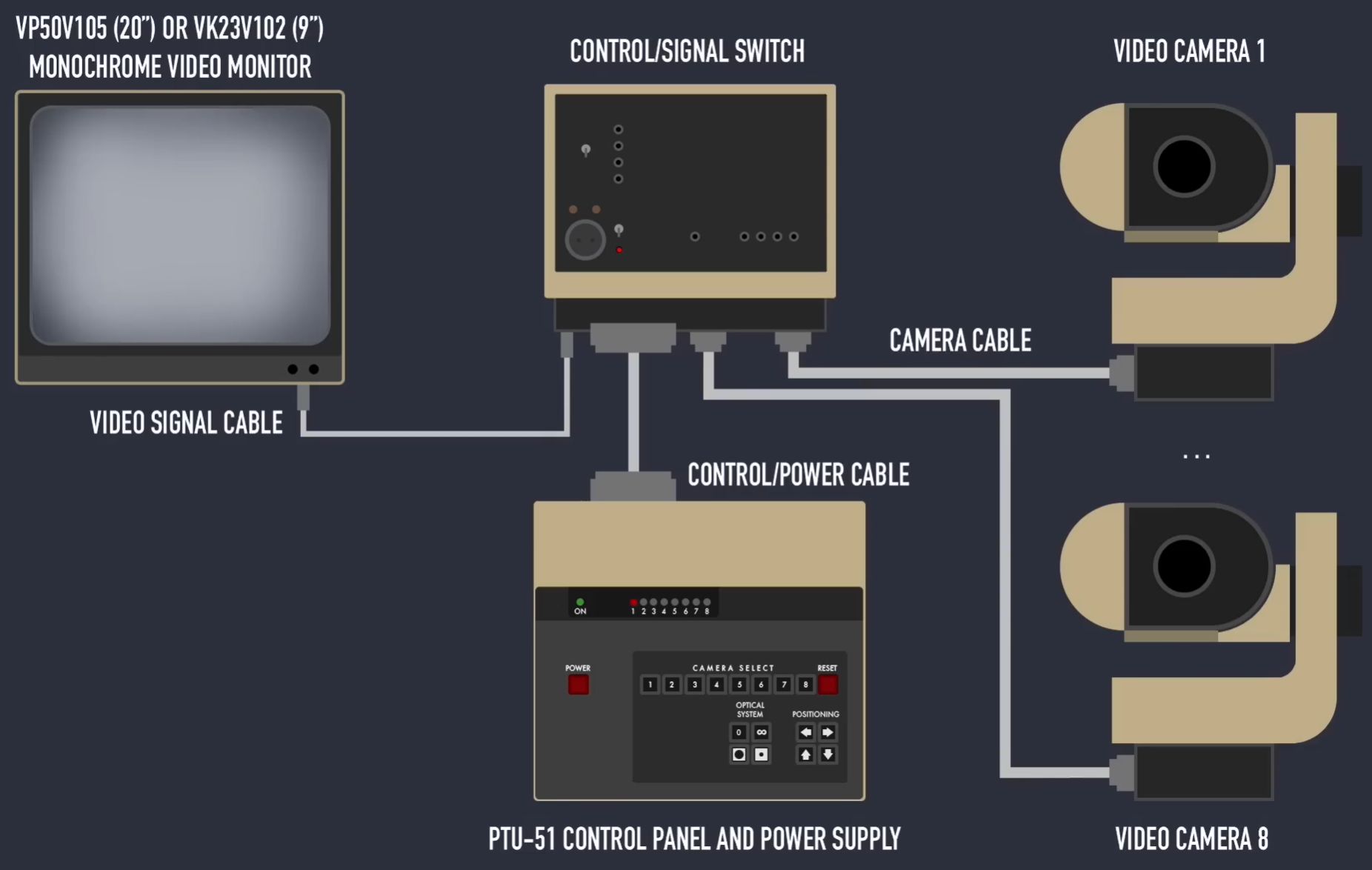
When the accident occurred at the #4 reactor at the Chernobyl Nuclear Power Plant (ChNPP) in 1986, engineers not only scrambled to find ways to deal with the immediate aftermath but also to monitor and enter radioactive areas without exposing squishy human tissues. This is where the KTP-63 and KTP-64  cameras come into play. One is reminiscent of your typical security camera, while the other is a special model that uses a mirror instead of directly exposing the lens and tube to radiation. As a result, the latter type was quite hardy. Using a central control panel, multiple cameras could be controlled.

When mounted to remotely controlled robots, these cameras were connected to an umbilical cord that gave operators eyes on the site without risking any lives, making these cameras both literally life-savers and providing a solid template for remote-controlled vehicles in future disaster zones.

Editor’s note: Historically, the site was called Чернобыль, which is romanized to Chernobyl, but as a part of Ukraine, it is now Чорнобиль or Chornobyl. Because the disaster and the power plant occurred in 1986, we’ve used the original name Chernobyl here, as does the YouTube channel.

Continue reading “The CCTV Cameras That Recorded The Chernobyl Disaster And Aftermath”