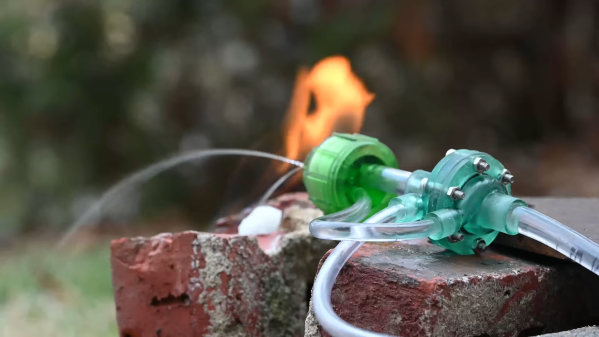
3D Printed Turbo Pump Hopes To Propel Rockets To The Sky

There are plenty of rocket experimenters toying with various liquid-fueled contraptions at the moment, and [Sciencish] is one of them. He grew tired of using air-pressurized fuel delivery systems in his experiments due to safety reasons, and decided to create something approximating more grown up rocket designs. The result was a 3D-printed turbopump for fuel delivery.

The design is not dissimilar from a turbocharger in a car. On one side, a turbine wheel is turned by compressed air supplied from a tank or compressor. This turbine wheel is affixed to the same axle as an impeller which draws up fuel and pumps it out, ideally into a rocket’s combustion chamber. It’s all made out of resin-printed parts, which made creating the fine geometry of the turbine and impeller a cinch.

Running on compressed air at 80 psi, the turbopump is able to deliver 1.36L of water or rubbing alcohol fuel a minute. However, unfortunately, this first pass design can only deliver 20 psi of fuel pressure, which [Sciencish] suspects will not be enough to counteract combustion chamber pressures in his rocket design. More work is required to up this figure. Paired with a nozzle and ignition source, though, and it does make for some great flames.

Overall though, the safety benefit of this turbopump comes from the fact that the fuel is kept separate from the oxidizer until it reaches the combustion chamber. This comes with far less chance of fire or explosion versus a system that stores fuel pressurized by air.

While the design isn’t yet up to scratch for rocket use, it nonetheless works, and we suspect with some improvement to tolerances and fin design that the project should move along at a quick pace.

If solid rockets are more your thing though, we’ve featured plenty of those too. Video after the break.

Continue reading “3D Printed Turbo Pump Hopes To Propel Rockets To The Sky”

2022 Sci-Fi Contest: A Mac-Based Droid Named R.O.B.

Droids and robot assistants are still not really a part of our daily lives, even if they started showing up in movies many long decades ago. [Rudy Aramaryo] perhaps hopes that will change one day, and is pursuing this goal with their own droid build named R.O.B.

R.O.B. is quite a hefty ‘bot, weighing 140 lbs and sporting a full 80 Ah of lithium-iron-phosphate batteries for a long running time and plenty of power. For brains, R.O.B. packs in an Apple Mac Mini M1 and a Mac Studio, running OS X. It’s an unusual choice for a robot, but one that brings plenty of computing power to bear, nonetheless. Equipped with tracked propulsion, R.O.B. also features a slip-ring setup in the base allowing the droid to rotate endlessly without tangling wires.

By virtue of its size and power, R.O.B. goes a long way to emulating the general feel of the droids of the Star Wars series. It’s all about the roughly-human-scaled design, and the anthropomorphic features. Further helping the cause are a basic chat ability powered by Python, along with arms and actuators to interact with the world.

The name of this droid recalls us of the charming Nintendo console toy from the 1980s. If these aren’t the droids you’re looking for, and you’ve been hacking on ‘bots of your own, be sure to drop us a line. 

Explosion Welding Goes Off With A Bang

Welding is often a hot and noisy process. It generally involves some fancy chemistry and proper knowledge to achieve good results. Whether you’re talking about arc, TIG, or MIG, these statements all apply.

The same is true for explosion welding, though it’s entirely unlike any traditional hand welding methods you’ve ever seen before. Today, we’ll explore how this technique works and the applications it’s useful for. Fire in the hole!

Don’t Blow Them Apart, Blow Them Together!

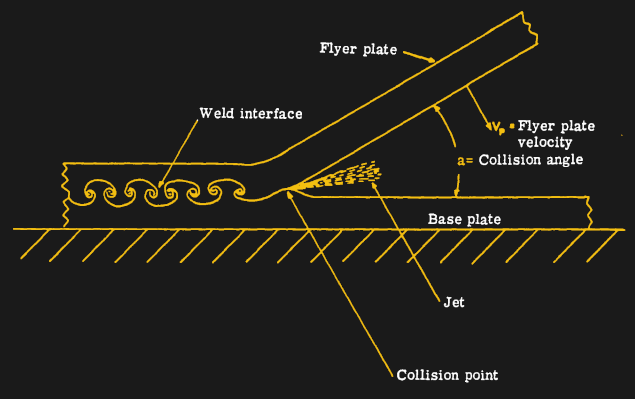
Explosion welding occurs near-instantaneously, but is done in a progressive fashion. The angle of collision, as well as the speed of the explosive front, is key to getting a quality weld. Image credit: NASA, public domain

The technique of explosion welding is relatively new compared to other metal-joining techniques. In the two World Wars of the 20th century, pieces of shrapnel were often found stuck to armor plating. Close observation showed that shrapnel was in fact welding on to metal armor, rather than simply being embedded in such. Given that collisions between shrapnel and armor often occur without the extreme heat of typical welding operations, it indicated that it was instead great velocity of the impact between shrapnel and armor that was melding the metals together.

The same results were later recreated in the lab, and explosoin welding was developed into a refined technique after World War II. 1962 saw DuPont patent a process for explosion welding later to be known under the “Detaclad” trademark.

Continue reading “Explosion Welding Goes Off With A Bang”

Software Defined Instrumentation Hack Chat

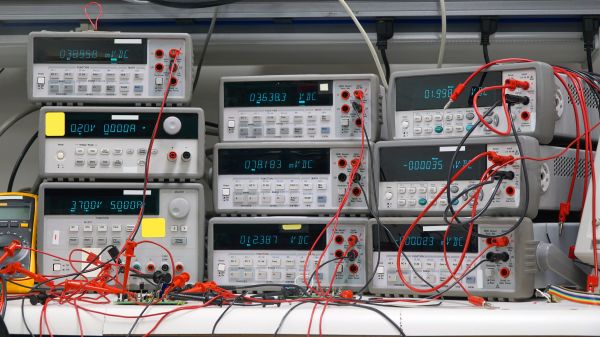
Join us on Wednesday, April 27 at noon Pacific for the Software Defined Instrumentation Hack Chat with Ben Nizette!

Imagine, if you will, the perfect electronics lab. Exactly how it looks in your mind will depend a lot upon personal preferences and brand loyalty, but chances are good it’ll be stocked to the gills with at least one every conceivable type of high-precision, laboratory-grade instrument you can think of. It’ll have oscilloscopes with ridiculously high bandwidths, multimeters with digits galore, logic analyzers, waveform generators, programmable power supplies, spectrum analyzers — pretty much anything and everything that can make chasing down problems and developing new circuits easier.

Alas, the dream of a lab like this crashes hard into realities like being able to afford so many instruments and actually finding a place to put them all. And so while we may covet the wall of instruments that people like Marco Reps or Kerry Wong enjoy, most of us settle for a small but targeted suite of instruments, tailored to our particular needs and budgets.

It doesn’t necessarily need to be that way, though, and with software-defined instrumentation, you can pack a lab full of virtual instruments into a single small box. Software-defined instrumentation has the potential to make an engineering lab portable enough for field-service teams, flexible enough for tactical engineering projects, and affordable for students and hobbyists alike.

join-hack-chatBen Nizette is Product Manager at Liquid Instruments, the leader in precision software-defined instrumentation. He’s the engineer behind Moku:Go, the company’s first consumer product, which squeezes eleven instruments into one slim, easily transported, affordable package. He’s been in the thick of software-defined instrumentation, and he’ll drop by the Hack Chat to talk about the pros and cons of the virtual engineering lab, what it means for engineering education, and how we as hobbyists can put it to work on our benches.

Our Hack Chats are live community events in the Hackaday.io Hack Chat group messaging. This week we’ll be sitting down on Wednesday, April 27 at 12:00 PM Pacific time. If time zones have you tied up, we have a handy time zone converter.

Continue reading “Software Defined Instrumentation Hack Chat”

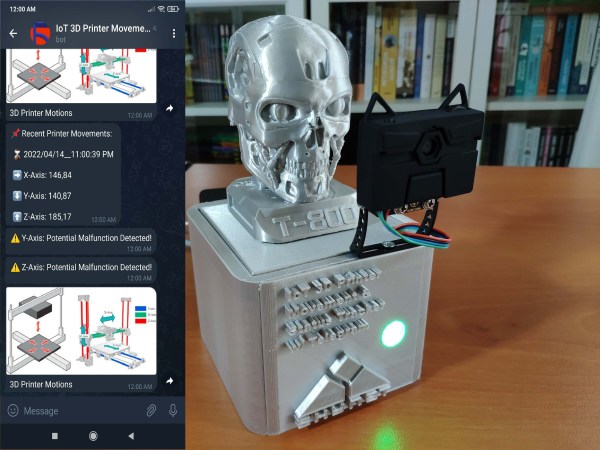
a 3D printed box with a Terminator head watching a camera

Machine Vision Helps You Terminate Failing 3D Print Jobs

If you’re a 3D printer user you’re probably familiar with that dreaded feeling of returning to your printer a few hours after submitting a big job, only to find that it threw an error and stopped printing, or worse, turned half a spool of filament into a useless heap of twisted plastic. While some printers come with remote monitoring facilities, [Kutluhan Aktar]’s doesn’t, so he built a device that keeps a watchful eye on his 3D printer and notifies him if anything’s amiss.

a 3D printed box with a Terminator head watching a cameraThe device does this by tracking the movement of the print head using a camera and looking for any significant changes in motion. If, for example, the Y-axis suddenly stops moving and doesn’t resume within a reasonable amount of time, it will generate a warning message and send it to its owner through Telegram. If all three axes stop moving, then either the print is finished or some serious error occurred, both of which require user intervention.

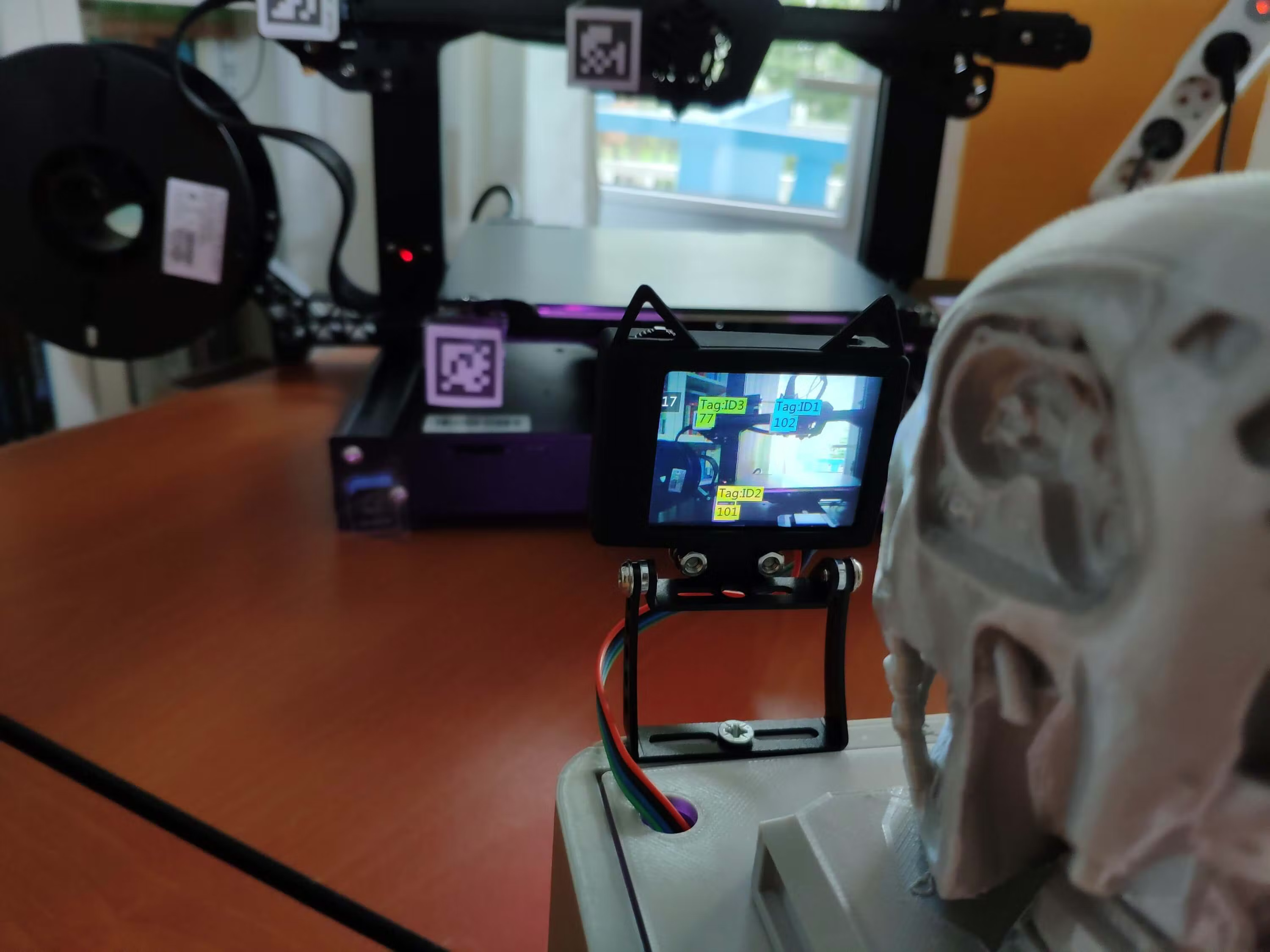
The camera [Kutluhan] used is a HuskyLens AI camera that can detect objects and output a set of 3D coordinates describing their motion. A set of QR-like AprilTags attached to the moving parts of the 3D printer help the camera to identify the relevant components. The software runs on a Raspberry Pi housed in a 3D-printed enclosure with a T-800 Terminator head on top to give it a bit of extra presence.

[Kutluhan]’s description of the project covers lots of detail on how to set up the camera and hook it up to a Telegram bot that enables it to send automated messages, so it’s an interesting read even if you’re not planning to 3D print something to check on your 3D printer. After all, software like Octoprint has many similar features, but having an independent observer can still be a good safety feature to prevent some types of catastrophic failure.

Continue reading “Machine Vision Helps You Terminate Failing 3D Print Jobs”

Axiom’s Private ISS Mission Was No Space Vacation

In an era where anyone with deep enough pockets can hitch a ride to the edge of space and back, you’d be forgiven for thinking that Axiom’s Ax-1 mission to the International Space Station was little more than a pleasure cruise for the four crew members. Granted it’s a higher and faster flight than the suborbital hops that the likes of William Shatner and Jeff Bezos have been embarking on, but surely it must still be little more than a publicity stunt organized by folks with more money than they know what to do with?

Thankfully, there’s a bit more to it than that. While the mission was privately funded, the Ax-1 crew weren’t just orbital sightseers. For one thing, there was plenty of real-world experience packed into the SpaceX Dragon: the mission was commanded by Michael López-Alegría, a veteran NASA astronaut, and crew members Larry Connor and Eytan Stibbe are both accomplished pilots, with the latter clocking in thousands of hours on various fighter jets during his time with the Israeli Air Force.

But more importantly, they had work to do. Each member of the crew was assigned a list of experiments they were to conduct, ranging from medical observations to the testing of new hardware. Of course there was some downtime — after all, if you spent $50 million on a ticket to space, you’d expect to have at least a little fun — but this wasn’t just a photo op: Axiom was looking for results. There was no hiding from the boss either, as López-Alegría is not just the Mission Commander, he’s also Axiom’s Vice President of Business Development.

Which makes sense when you consider the company’s ultimate goal is to use the ISS as a springboard to accelerate the development of their own commercial space station. The data collected during Ax-1 is going to be critical to Axiom’s path forward, and with their first module already under construction and expected to launch by 2025, there’s no time to waste.

So what did the crew members of the this privately funded mission to the International Space Station accomplish? Let’s take a look at a few of the more interesting entries from the docket.

Continue reading “Axiom’s Private ISS Mission Was No Space Vacation”

Insteon Abruptly Shuts Down, Users Left Smart-Home-Less

In today’s “predictable things that happened before and definitely will happen again”, Insteon, a smart home company boasting the Insteon ecosystem of devices built around their proprietary communication standards, has shut down their servers without a warning. For almost two decades, Insteon used to offer products like smart light switches, dimmers, relays, various sensors, thermostats – the usual home automation offerings, all linked into a cozy system. Looking through the Insteon subreddit’s history, there were signs of the company’s decline for good half a year now, but things were mostly stable – until about a week ago, when users woke up and noticed that parts of their smart home network stopped working, the mobile app would no longer respond, and the company’s resources and infrastructure went down. What’s more – the C-rank management has scrubbed their LinkedIn profiles from mentioning Insteon and SmartLabs (Insteon’s parent company).

Screenshot of Insteon's 'service status' page, saying "All Services Online: There's currently no known issues affecting Insteon services"Instantly, the Insteon subreddit has livened up. People, rightfully angry about being literally left in the dark, were looking for answers – as if mocking them, Insteon’s homepage claimed that all services were operational. Others, having expected the shutdown to eventually happen, started collecting and rehosting rapidly disappearing documentation, helping each other keep their tech up in the meantime, and looking into alternative platforms. It turned out to be imperative that users don’t factory reset their Insteon hubs, since those have to communicate with the currently Inste-Gone servers as part of initial configuration, diligently verifying the SSL certificates. Sadly, quite a few users, unaware and going through the usual solutions to make their network function again, are now left with hubs that are essentially bricked, save for a few lucky ones.

Continue reading “Insteon Abruptly Shuts Down, Users Left Smart-Home-Less”